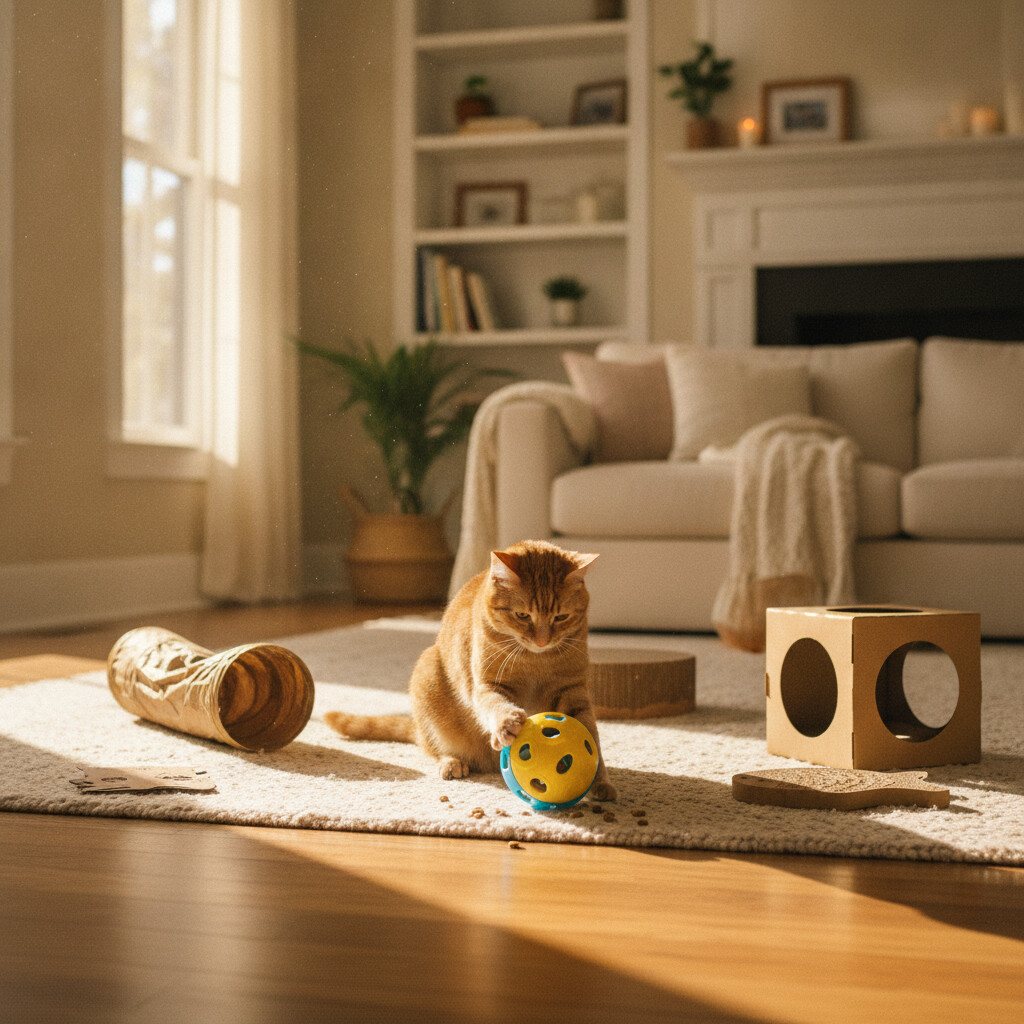
Your cat doesn’t sleep through the whole workday, whatever the stereotype says. Left alone for eight or ten hours with nothing to do, most cats spend a chunk of that time bored — and bored cats find their own entertainment, which is usually knocking things over, overeating, or shredding the couch arm. The fix isn’t a single toy purchase. It’s a simple rotation of low-effort setups that keep a solo cat occupied at different points in the day.
Why “just leave a toy out” doesn’t work
A toy that’s always on the floor stops being interesting fast. Cats habituate to static objects within days — the same reflex that makes them ignore a scratching post they used to love once it’s just part of the furniture. The American Association of Feline Practitioners (AAFP) environmental needs guidelines make novelty and unpredictability a core pillar of feline enrichment, alongside food, resting spots, and vertical territory. A cat’s environment needs to change a little, regularly, or engagement drops off.
That doesn’t mean buying more toys. It means putting away most of what you own and bringing a few back into rotation.
A rotation system that actually works
Pick four or five toys — a wand toy, a ball track, a soft mouse, a puzzle feeder — and only leave two out at a time. Swap them every three or four days. The toys that were “boring” last week read as new again once they’ve been out of sight for a bit. This costs nothing and takes about ten seconds twice a week.
Puzzle feeders deserve a permanent slot in the rotation specifically because they double as portion control and mental work. A cat who has to bat a treat ball around the kitchen for ten minutes to get her breakfast is doing something closer to natural foraging behavior than a cat eating from a bowl in four seconds flat.
Scatter feeding and timed feeders
Wild and feral cats spend a significant part of their day hunting in short bursts — many small meals, not two big ones. You can mimic that indoors without any special equipment: instead of pouring kibble into a bowl, scatter a portion across a towel, a muffin tin, or a few paper cups around a room before you leave. It slows eating down and turns a two-minute meal into a twenty-minute project.
If you free-feed dry food, a timed feeder that releases small portions across the day serves the same purpose and prevents the all-you-can-eat buffet that leads to weight gain — worth knowing given how common feline obesity has become. A cat working for four small releases of food during an eight-hour day has four separate reasons to get up and do something.
Sensory enrichment for the hours you’re not there
Not every solution needs to be interactive. A window perch with a view of a bird feeder or a busy street can occupy a cat for a surprising amount of the day — vertical space near a window works double duty as both enrichment and territory. Scent rotation helps too: swap between catnip, silvervine, and valerian on different days rather than leaving the same catnip mat out permanently, since cats habituate to a single scent just as fast as they do to a single toy.
Leaving a radio or TV on is genuinely debated — there’s no strong evidence it reduces stress for most cats, though some anecdotally seem to settle better with background noise than in silence. It’s low-risk to try, just don’t count on it as your only strategy.
What about outdoor time while you’re at work?
This is where a lot of owners get stuck: their cat clearly wants outdoor stimulation, but letting a cat roam unsupervised while no one’s home carries real risk — traffic, predators, and the cat simply not being there when you get back. Indoor enrichment covers a lot of ground, but it doesn’t fully replace the sensory richness of the outdoors for a cat who’s motivated to get out there.
If that’s your situation, a secured outdoor space is worth looking into rather than choosing between “fully indoor” and “unsupervised roaming.” A catio is the most contained option; for owners who want their cat to have the run of the whole yard, fence-top containment systems — Oscillot is one example — work by making the top of an existing fence too unstable for a cat to climb over, so they can be out there safely without you needing to be home to watch.
When boredom becomes a bigger problem
Occasional zoomies or a knocked-over plant are normal. But persistent understimulation can show up as overgrooming, increased aggression toward other pets, or destructive scratching that goes well beyond a normal scratching post habit — signs worth taking seriously rather than writing off as “just being a cat.” If you’ve tried rotating enrichment and the behavior isn’t improving, it’s worth a conversation with your vet to rule out a medical cause before assuming it’s purely boredom — some of the same behaviors (overgrooming especially) can also point to pain or a skin condition.
The practical takeaway
You don’t need a cat superhighway installed across your living room to solve this. Four or five toys on rotation, a foraging-style feeding setup, and one good window perch will cover most of what a home-alone cat needs during the day. Add secured outdoor access if that’s realistic for your setup, and keep an eye out for behavior that suggests the boredom has tipped into something that needs a vet’s attention.