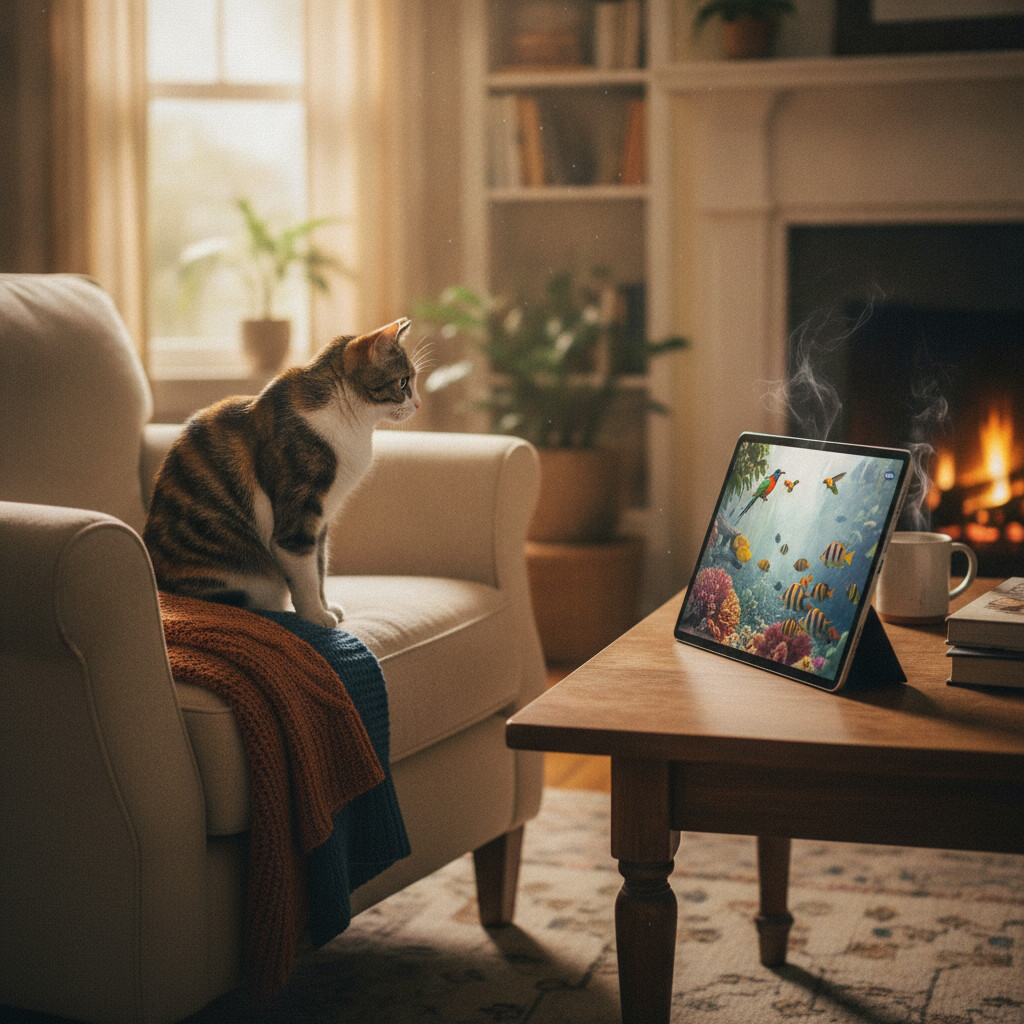
Yes, but with real caveats. Cats do respond to videos of birds, fish, and small prey animals — their attention, pupil dilation, and sometimes pouncing behavior all spike when the footage shows fast, erratic movement that mimics prey. But “responds to” isn’t the same as “is meaningfully enriched by,” and the research on cat cognition suggests screens are, at best, a supplement to real enrichment — not a replacement for it.
Do Cats Actually See What’s on a Screen?
Cats’ vision is built differently than ours. They see fewer colors (their color range is closer to a red-green colorblind human than to full human vision), but they’re far more sensitive to motion and operate well in low light. Older CRT and early LCD screens actually had refresh rates cats could perceive as flickering, which may have made “cat TV” less convincing to them than it looked to us. Modern high-refresh-rate screens have mostly solved this — most cats today see fluid motion, not a strobe.
What cats respond to isn’t the video as a narrative — it’s the same trigger as a laser pointer or a feather wand: fast, unpredictable, small-target motion that resembles prey. A bird hopping across a branch or a fish darting across a tank taps directly into predatory instinct, which is why cats fixate on it even though they intellectually have no access to “this is a video.”
What the Research Actually Shows
Feline enrichment studies consistently point to the same conclusion: interactive, participatory activities beat passive ones. A 2021 study on feline environmental enrichment (published in the Journal of Feline Medicine and Surgery) found that cats show stronger and more sustained engagement with enrichment that involves problem-solving or physical interaction — puzzle feeders, wand toys, foraging — compared to passive stimuli. Screens fall into the passive category. A cat can watch a bird video attentively for a few minutes, but that attention typically drops off quickly once the “hunt” never resolves in a catch, unlike real prey-drive play where the cycle (stalk, chase, pounce, catch) completes and satisfies the behavior sequence.
That incomplete cycle is worth understanding. Cat predatory behavior is a four-part sequence: stalk, chase, pounce, kill-bite. Interrupting that sequence repeatedly — which is exactly what a screen does, since there’s never a “catch” — can, in theory, contribute to frustration rather than satisfaction if it’s the only outlet a cat has. This mirrors what behaviorists say about laser pointers: fine as an occasional supplement, frustrating as a sole source of predatory play, because the cat never gets to complete the hunt.
When Cat TV Genuinely Helps
None of this means screens are useless. They’re a reasonable tool in specific situations:
- Short-term stimulation when you can’t provide active play — before work, during a busy stretch of the day
- Window-adjacent placement, paired with real outdoor activity (birds at a feeder, squirrels in a yard) rather than a phone screen, which gives genuine sensory engagement layered with real scent and sound cues
- Cats who are home alone for long stretches, as one piece of a broader solo enrichment plan rather than the whole plan
- Older or less mobile cats who benefit from visual stimulation without the physical demands of active play
What Works Better Than Screens
If the goal is genuine enrichment rather than just occupying attention, the research consistently favors:
- Puzzle feeders and foraging toys — these let a cat complete a full predatory sequence and get a reward, which is far more satisfying than an unresolved chase
- Interactive wand play — 10–15 minutes a day of real stalk-chase-pounce-catch play, ideally ending with the toy “dying” so the cat gets a genuine catch
- A real window view — actual birds, insects, and movement outside carry scent and sound cues a screen can’t replicate; this is one of the most consistently effective low-effort enrichment tools, which is part of why window perches show up so often in enrichment guides
- Scent-based enrichment — cats rely heavily on scent, and rotating novel, safe scents around the home taps a sense screens don’t touch at all
- Rotating physical toys — novelty matters more than most owners think; a toy that’s been out for a week loses most of its appeal regardless of how good it is
The Bottom Line
Cat TV isn’t harmful, and it’s not nothing — cats genuinely notice and respond to prey-like motion on a screen. But it’s a low-effort supplement, not a core enrichment strategy. If you use it, treat it the way you’d treat a laser pointer: fine in short doses, always paired with activities that let your cat actually finish the hunt. A cat with a rotating cast of puzzle feeders, a few minutes of daily wand play, and a real window to watch is going to be a more satisfied cat than one parked in front of a bird video for an hour.