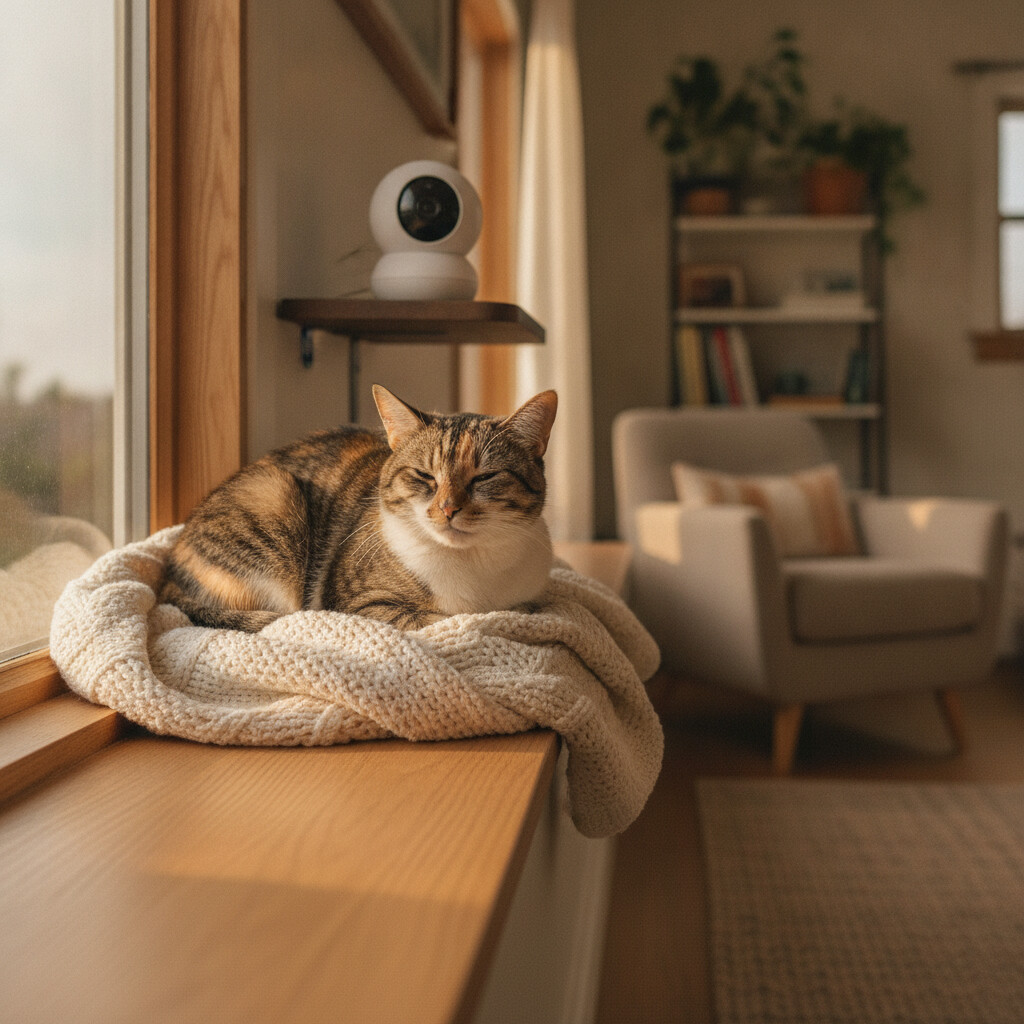
If you’ve ever wondered what your cat actually does all day while you’re at work, a pet camera will answer that question — but whether it’s worth buying depends on what you’re trying to solve. Short answer: pet cameras are genuinely useful for monitoring anxious cats, multi-cat conflict, and senior cats with mobility changes. They’re mostly a novelty for a healthy, well-adjusted cat with no behavior concerns.
What a Pet Camera Actually Does
Most models on the market now do more than stream video. Depending on price point, you’re generally getting some combination of: two-way audio (so you can talk to your cat remotely), motion-triggered clips saved to an app, night vision, and in higher-end models, activity tracking that flags unusual patterns — a cat sleeping far more than usual, or moving around far less.
None of this replaces a vet visit or a behaviorist consult. What it does is give you data you wouldn’t otherwise have: what’s actually happening in the hours you’re not there to see it.
When a Camera Is Genuinely Useful
Diagnosing separation-related distress. If your cat is vomiting, over-grooming, or house-soiling only when you’re away, a camera is often the fastest way to confirm whether the trigger is actually your absence. The American Veterinary Society of Animal Behavior notes that separation-related problems in cats are underdiagnosed partly because owners never see the behavior happen — they only see the aftermath. A camera closes that gap. If you’re already working through this, our guide on separation anxiety in cats covers what the behavior looks like and how it’s treated.
Multi-cat households with suspected tension. Owners often assume their cats “get along fine” because nothing dramatic happens when everyone’s home. Cameras regularly reveal a different story — one cat blocking access to the litter box or food bowl while the household is out, which shows up later as unexplained litter box avoidance or weight loss in the cat being bullied.
Senior cats living alone for long stretches. For a cat with early mobility issues or cognitive changes, a camera lets you check that they’re not stuck somewhere, struggling to get up, or pacing at night in ways that suggest discomfort.
Medication and eating monitoring. If you have a cat on a strict feeding schedule or medication routine and someone else is checking in on them, a camera with two-way audio and treat dispensing (on some models) adds a layer of verification.
When It’s Just an Expensive Toy
If your cat is healthy, well-socialized, and shows no behavior changes, a camera mostly just confirms they sleep 16 hours a day and stare at the wall sometimes — which is normal cat behavior, not a problem to solve. It’s fun to check in on, but it’s not solving anything a stable, unstressed cat needs solved.
It’s also worth being honest that watching footage of your cat when there’s nothing wrong can create anxiety that isn’t warranted — reading meaning into a cat sitting still for ten minutes, which is just a cat resting.
What to Look for If You Do Buy One
- Field of view and placement flexibility — a camera that only covers one corner of a room misses most of what a cat actually does, since cats move between multiple resting spots
- Motion-alert accuracy — cheaper models often flag every shadow change as “motion,” which makes the alerts useless within a week
- Treat-dispensing (optional) — nice for daytime engagement, not a substitute for actual enrichment or feeding routine
- Local storage or subscription-free options — many cameras require a monthly subscription for clip history longer than 24 hours; decide if that’s worth it before buying
- Two-way audio quality — useful for check-ins, but don’t expect it to meaningfully substitute for your actual presence with an anxious cat
The Limits of What a Camera Can Tell You
A camera shows you behavior. It doesn’t diagnose anything. A cat pacing at night could be cognitive decline, pain, hyperthyroidism, or boredom — the footage narrows down the possibilities, but a vet exam is still what confirms the cause. If a camera reveals your cat is showing repeated signs of distress, restlessness, vomiting, or avoiding food while you’re away, that’s information to bring to your vet, not a pattern to just monitor indefinitely on your own.
Cost and What You’re Actually Paying For
Basic models run in the $30–$60 range and cover the fundamentals — live video, two-way audio, motion clips. Where the price climbs is subscription tiers for extended cloud storage, AI-based behavior tagging, and higher resolution night vision. Before paying for a subscription, ask what you’re actually using the footage for. If you’re checking in casually, a free 24-hour clip history is plenty. If you’re building a record to bring to a vet or behaviorist — say, documenting how often a cat vomits or how many times they visit the litter box overnight — longer storage and searchable clips are worth the cost, because that data is genuinely useful in an appointment.
The Practical Takeaway
Buy a pet camera if you have a specific question to answer — is my cat stressed when I’m gone, are my cats actually fighting, is my senior cat moving normally overnight. Skip it if you’re buying it hoping it’ll tell you something is wrong with a cat who otherwise seems completely fine. It’s a monitoring tool, not a diagnostic one, and it’s most valuable in the hands of an owner who already has a reason to be watching closely.