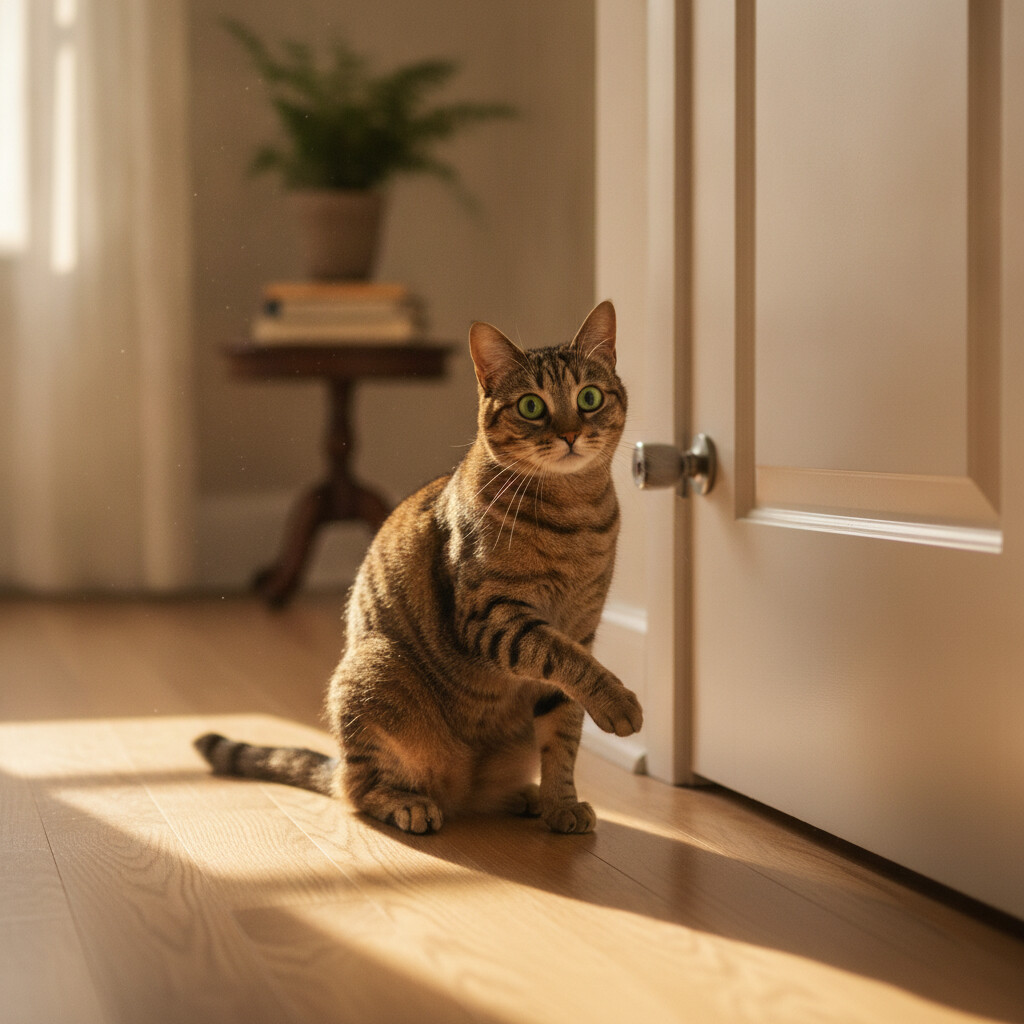
Cats hate closed doors because a shut door cuts them off from part of their territory, and cats are wired to monitor and control their space. Add in a strong preference for predictability, curiosity about whatever you’re doing on the other side, and the fact that scratching at a door reliably gets your attention, and you have a cat who will yowl at the bedroom door at 5am. The good news: most door drama is normal, and a few changes can cut it down a lot.
The short answer: it’s about territory and control
Domestic cats are territorial animals. Even an indoor cat treats the home as a set of core areas it patrols, scent-marks, and checks on through the day. A closed door doesn’t just block a room. From the cat’s point of view, it blocks a piece of their range and stops them from knowing what’s going on inside it.
The 2013 AAFP and ISFM Feline Environmental Needs Guidelines (published in the Journal of Feline Medicine and Surgery) list a sense of choice and control over the environment as a core need for cats, alongside safe spaces and predictable routines. A door that is open one minute and shut the next takes away that control. Cat behaviour researcher John Bradshaw, formerly of the University of Bristol, makes a similar point in his work on cat social behaviour: cats feel safest when they can move freely through their territory and keep tabs on it.
So when your cat sits outside the bathroom crying, they aren’t being dramatic for the sake of it. They’re responding to a change in their territory they didn’t choose.
Why does my cat want in, then immediately want out?
This is the classic complaint. You open the door, the cat walks in, sniffs around for ten seconds, and asks to leave. Then they want back in.
There are a few likely reasons:
- They wanted to check, not stay. Once they’ve confirmed nothing changed in the room, the job is done. The goal was information, not a new place to sit.
- They want the door open, not to be on one side of it. An open door means free movement. A shut door means they have to ask. Many cats simply prefer the option.
- It worked last time. If scratching or meowing at the door usually gets it opened, the cat has learned that the behaviour pays off. That’s basic reinforcement, and cats learn it quickly.
None of this means your cat is broken or spiteful. It’s ordinary cat logic.
Why does my cat scratch and meow at the door at night?
Night door battles usually come from a mix of three things.
Timing. Cats are crepuscular, meaning they’re most active around dawn and dusk. If your cat is wide awake at 4am and you’re behind a closed bedroom door, you’ve removed their main source of company and entertainment at exactly the wrong time. Our guide to night zoomies and 3am chaos goes into this rhythm in more detail.
Social attachment. Plenty of cats are more social than their reputation suggests. A 2019 study in Current Biology (Vitale, Behnke and Udell) found that most of the cats tested showed secure attachment to their owners, similar to patterns seen in dogs and human infants. A cat who’s bonded to you may simply want to be near you, which is also why so many cats follow their owners to the bathroom.
Reinforcement. If you’ve ever opened the door at 5am to stop the noise, you’ve taught the cat that persistence works. Intermittent rewards (sometimes you open it, sometimes you don’t) tend to make the behaviour more stubborn, not less.
Is it separation anxiety?
Usually not, but sometimes. Most door-scratching is normal territorial or attention-seeking behaviour. Separation-related problems in cats are real, though. A 2020 study in PLOS ONE (de Souza Machado and colleagues) estimated that around 13% of the cats in its sample showed at least one separation-related behaviour, such as excessive vocalising, destructive behaviour, or urinating in inappropriate places when the owner was away.
Signs that point more toward anxiety than ordinary door politics:
- Distress that starts as soon as you leave the house, not only when a door is shut
- Peeing or pooping on your bed, clothes, or near the door
- Over-grooming to the point of bald patches
- Not eating while you’re out
If that sounds like your cat, our article on separation anxiety in cats covers what it looks like and what helps.
How to stop your cat fighting closed doors
You have two broad options: give the cat more access, or make the closed door boring. Most households end up using a bit of both.
Give them a way through (where you can)
- Prop the door slightly open with a door stop or a hook-and-eye latch that leaves a cat-sized gap. This works well for bathrooms and home offices.
- Install a cat flap in an interior door if it’s a room the cat can safely use. Our guide to training a cat to use a cat door works for indoor flaps too.
- Let them in before you shut the door. If the cat is inside the bedroom when you go to bed, many will settle. Some will then want out, which brings us to the next point.
Make the shut door not worth the effort
- Stop rewarding the noise. If you decide the door stays closed, keep it closed. Opening it after ten minutes of yowling teaches the cat that ten minutes is the price. Expect the behaviour to get worse briefly before it fades. Behaviourists call this an extinction burst, and it’s a sign the approach is working.
- Reward quiet instead. Open the door, or give attention, when the cat is calm rather than when they’re scratching.
- Protect the door, not just your sleep. A clear plastic door protector or a strip of double-sided tape at cat height can save the paint while you work on the habit.
Meet the needs that drive it
This is the part people skip, and it’s usually the part that matters most.
- Play hard before bed. Ten to fifteen minutes of interactive play with a wand toy, finished with a small meal, mimics the hunt-eat-sleep cycle and helps many cats settle for the night.
- Give them something to do on their side of the door. Puzzle feeders, a window perch, or a few toys rotated in each evening. Our list of ideas for keeping a home-alone cat busy works for nights too.
- Keep routines predictable. If the bedroom door is always shut at night, most cats eventually accept it. If it’s shut some nights and open others, you’ve built a slot machine.
When to see a vet
Most door behaviour is normal, but a sudden change is worth taking seriously. Book a vet visit if:
- Your cat starts crying at doors at night out of nowhere, especially if they’re over about 10 years old. Increased night vocalising in older cats can be linked to hyperthyroidism, high blood pressure, or cognitive decline.
- The behaviour comes with other changes: drinking more, weight loss, changes in appetite, or litter box problems.
- Your cat seems disoriented, gets “stuck” in corners, or forgets familiar routines.
- You see signs of real distress when separated from you, such as house-soiling or over-grooming.
Your vet can rule out medical causes first. If it turns out to be behavioural, a board-certified veterinary behaviourist (a DACVB in the US) can help with stubborn cases.
The bottom line
A cat fighting a closed door is defending their territory, satisfying curiosity, or chasing your attention, and often all three. You don’t have to give in to every scratch. Decide which doors stay open and which stay shut, keep that consistent, reward quiet rather than noise, and make sure your cat’s need for play and stimulation is met before the door closes. Most cats adjust within a couple of weeks once the rules stop changing.