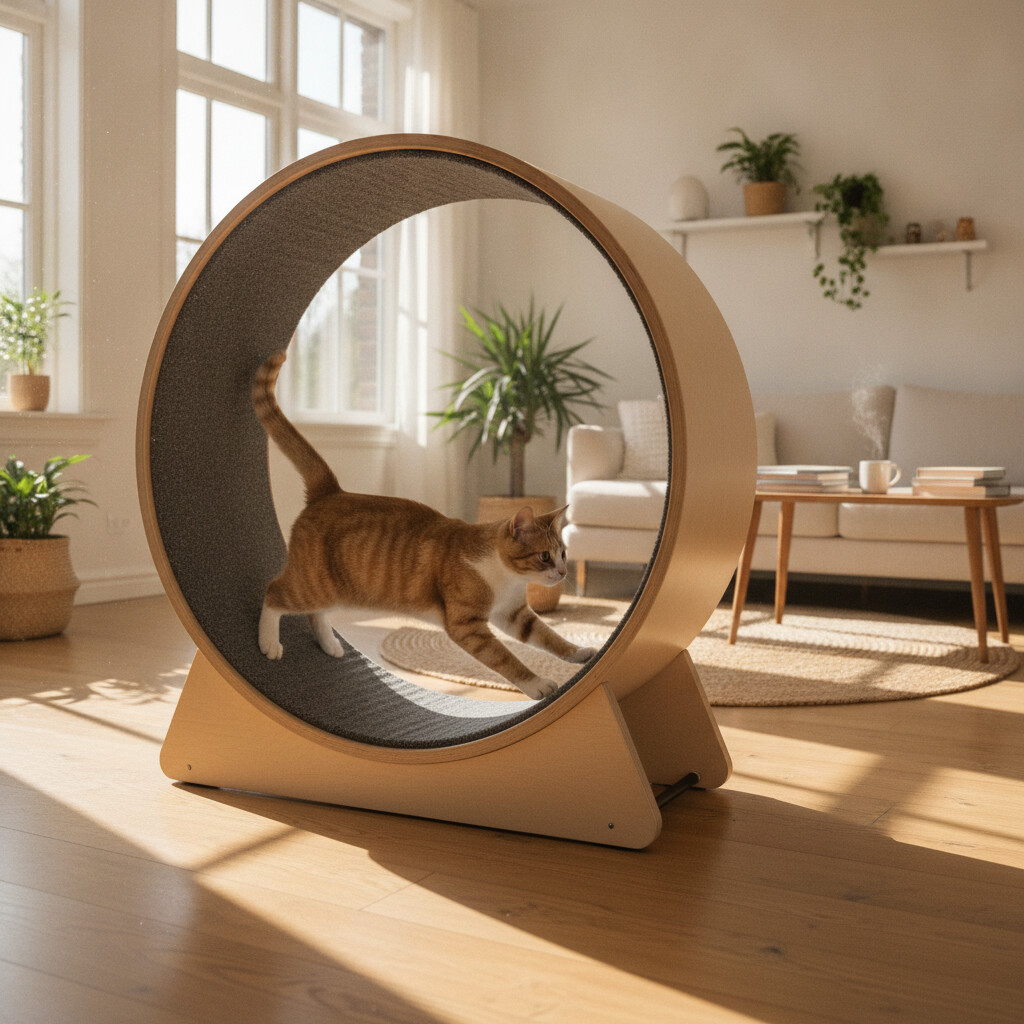
Cat exercise wheels look like a gimmick until you watch a cat actually use one — then it’s obvious why they’ve gone from novelty to a genuine fitness tool for indoor cats. Here’s what they actually do, which cats benefit most, and how to train yours to get on one without giving up.
What a cat wheel actually does
A cat wheel is a large, saucer-shaped running wheel — usually 40 to 48 inches in diameter — built for a cat to walk or sprint on, similar in concept to a hamster wheel scaled up. Unlike a treadmill, the wheel moves with the cat’s own pace rather than forcing a fixed speed, which matters because cats are built for short, explosive bursts of activity rather than sustained cardio.
The appeal is straightforward: most indoor cats are chronically under-exercised. A 2022 study in the Journal of Feline Medicine and Surgery found that indoor-only cats show significantly lower daily activity levels than cats with outdoor access, and low activity is linked to obesity, which the American Association of Feline Practitioners (AAFP) lists as one of the most common preventable health problems in cats. A wheel gives a cat a way to burn energy on their own schedule, including at 3am when most owners are asleep and not available to play.
That said, a wheel is not a replacement for play. It’s a supplement — most cats won’t use one for more than a few minutes at a stretch, and some never take to it at all.
Which cats actually use them
Not every cat will. In practice, wheels work best for:
- High-energy, younger cats — especially breeds bred for activity, like Bengals, Abyssinians, and Savannahs, who are frequently reported (by wheel manufacturers and cat behavior consultants) as the most consistent users.
- Cats already motivated by chase play — if your cat goes hard for a feather wand or laser pointer, they’re a better candidate than a cat who mostly naps.
- Younger and middle-aged cats — senior cats or cats with arthritis, hip dysplasia, or mobility issues generally aren’t good candidates; the running motion and the wheel’s curvature put more stress on joints than flat-ground play.
If your cat is older or has any joint concerns, check with your vet before introducing a wheel, and lean toward lower-impact enrichment instead — see our guide on why cats need vertical space for alternatives that don’t stress joints the same way.
How to train your cat to use one
Cats don’t intuitively understand a moving wheel, and dropping one into your living room without introduction usually gets you an expensive cat-avoidant piece of furniture. A gradual approach works far better:
- Let the wheel sit still for a few days. Put treats or food near it, then gradually on it, so your cat gets comfortable being close to something large and unfamiliar.
- Lock the wheel so it can’t move at first. Most wheels have a brake or stopping mechanism. Encourage your cat to walk on the stationary wheel using treats or a wand toy.
- Introduce slow movement gradually. Once your cat is comfortable stepping on and off, unlock the wheel and use a wand toy just ahead of them to encourage a few steps of movement. Keep sessions short — a minute or two — and stop before your cat loses interest.
- Never force it. Some cats take days to warm up, others take months, and a meaningful number never do. That’s a normal outcome, not a training failure.
Certified cat behavior consultants generally recommend food and toy-based positive reinforcement over any kind of physical placement or restraint — a cat that’s picked up and put on a wheel is more likely to associate it with stress than exercise.
Is it worth the investment?
Cat wheels are expensive — typically $250 to $600 for one sturdy enough to hold up to regular use — and there’s a real chance your cat won’t use it consistently, or at all. Before buying, consider whether cheaper enrichment might get you most of the benefit: rotating toys (see our guide on solo cat enrichment), a few short daily wand-toy sessions, and puzzle feeders that combine mental stimulation with movement cover a lot of the same ground for a fraction of the cost.
A wheel makes the most sense for owners of high-energy young cats who already show interest in chase-and-run play, have the space for a 4-foot-diameter piece of furniture, and are willing to spend weeks on slow, patient introduction. It’s a poor fit for anyone expecting an out-of-the-box solution or a cat that’s naturally low-energy.
The practical takeaway
A cat wheel can genuinely help burn off excess energy in an active, food- or toy-motivated cat — but it’s a tool for a specific type of cat, not a universal fix for an under-stimulated one. Introduce it slowly, never force your cat onto it, skip it entirely for senior or joint-compromised cats, and treat it as one part of an enrichment routine rather than the whole thing.