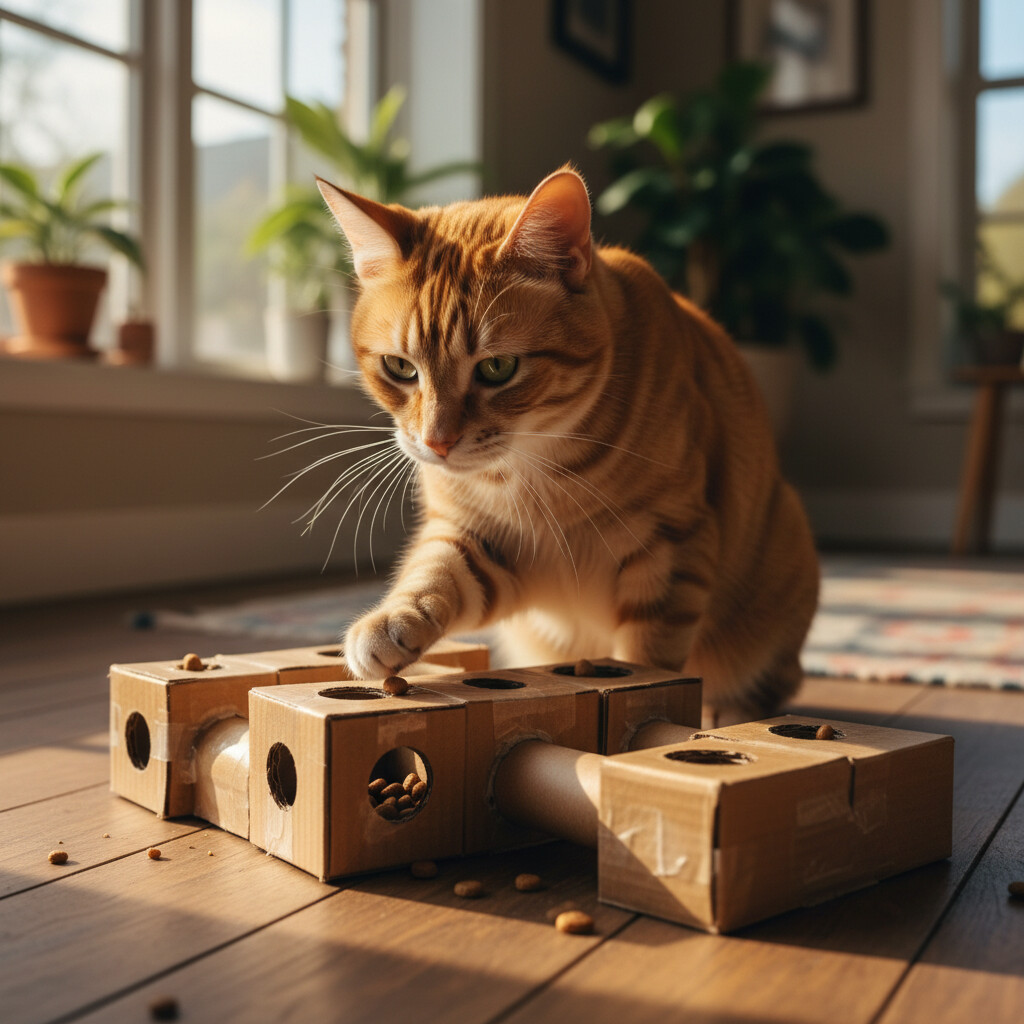
Most indoor cats finish their meals in under two minutes. In the wild, a cat would spend four to six hours a day hunting — stalking, pouncing, problem-solving. That gap is one of the main reasons indoor cats develop behaviour problems, anxiety, and obesity. Puzzle feeders close it. And you can build effective ones from things already in your recycling bin.
This guide covers why puzzle feeders matter, what makes a good one, and five DIY options you can set up this afternoon.
Why Indoor Cats Need More Than a Bowl
A cat’s brain expects to work for food. The hunting sequence — stalk, chase, pounce, catch, eat — is hardwired. When food just appears in a bowl twice a day, the cat gets the caloric input but none of the neural stimulation that comes with earning it.
Research from the UC Davis School of Veterinary Medicine has found that cats who forage for food show fewer stress behaviours and more positive social interactions than cats fed from bowls. The work itself is enriching, independent of the food reward.
Practical consequences of skipping food enrichment:
- Overeating (cats eat slower when they have to work)
- Boredom-driven behaviour problems — including excessive vocalisation and the kind of object-batting curiosity that drives owners to distraction
- Learned helplessness in cats who stop engaging with their environment
- Weight gain, which compounds quickly in under-stimulated cats
What Makes a Good DIY Puzzle Feeder
Not all puzzles work for all cats. A few principles before you start building:
Difficulty should match the cat’s ability. A puzzle that’s too hard will frustrate a cat into giving up. One that’s too easy won’t hold their interest for long. Aim for something that takes 5–10 minutes of active effort to empty.
The reward must be worth it. Puzzle feeders work best with high-value food — small pieces of wet food, freeze-dried treats, or regular kibble for a cat that’s genuinely hungry. Don’t introduce puzzle feeding immediately after a bowl meal.
Size matters. Openings need to be big enough for the cat to extract food but small enough that it doesn’t just fall out freely. For kibble, a hole slightly larger than the piece is right.
Washability. Any feeder that contacts wet food needs to be easy to clean. If it isn’t, you’ll end up with bacteria — and a cat who eventually refuses to use it.
5 DIY Puzzle Feeders You Can Make Today
1. The Muffin Tin Tower
Fill the cups of a muffin tin with kibble or treats. Cover some or all cups with tennis balls. The cat has to move the balls to access the food. Difficulty level: beginner. Excellent starting point for cats who’ve never used a puzzle feeder.
2. The Cardboard Egg Carton
Close a cardboard egg carton with a small amount of kibble in each cup. The cat has to figure out how to open it, flip it, or tear into it. This works best as a single-use item — one per meal, easy to source, zero cost. Not suitable for wet food.
3. The Paper Roll Roller
Seal both ends of a toilet paper roll with kibble inside, and punch small holes along the sides. The cat rolls it around the floor until food falls out. Variation: use a paper towel roll for more volume, or punch fewer holes for a harder challenge.
4. The Snuffle Mat
Cut fleece strips roughly 20cm × 2cm. Tie them through the holes of a rubber sink mat until the surface is covered in loops and tufts. Hide kibble throughout. The cat uses its nose and paws to forage — this is the closest thing to natural foraging behaviour of any DIY option. Wash in cold water, air dry only.
5. The Water Bottle Wobbler
Clean a plastic bottle completely. Drill or punch small holes slightly larger than the kibble. Add kibble, replace the lid. The cat bats it around to dispense food. More durable than the cardboard options, and good for cats who prefer motion-based challenges. If you want to go further, there’s a solid range of commercial interactive toys built on this same rolling-dispense principle.
How to Introduce a Puzzle Feeder Without Frustrating Your Cat
Start easy. The first few sessions, make it trivially simple — a muffin tin with no covers, or a bottle with extra-large holes. The goal isn’t to challenge them immediately; it’s to teach them that effort produces food.
Watch the first session. A cat who swipes at the puzzle and walks away needs an easier starting point. A cat who empties it in 30 seconds needs something harder.
Increase difficulty gradually. Once your cat is reliably solving the current puzzle, introduce a harder variation — smaller holes, more covered cups, tighter fleece — over one to two weeks.
Never force it. If a cat genuinely refuses all puzzle feeders after consistent attempts, a licki mat with wet food spread thin is an easy lower-stimulation alternative that still slows eating and provides some engagement.
How Often Should You Rotate Feeders?
Cats habituate quickly. A puzzle that was fascinating in week one may be solved on autopilot by week four. Rotate between two to three different types on a weekly or bi-weekly basis.
Novelty is enrichment in itself. A new shape or mechanism — even one the cat already knows how to solve in principle — requires a few minutes of investigation before they settle in to use it. That investigation is the point.
The IAABC (International Association of Animal Behavior Consultants) and AAFP both recommend using puzzle feeders as the primary delivery method for at least one meal per day, rather than as an occasional supplement. For cats with a history of boredom-related behaviour problems, two meals a day via puzzle is the target.
The Practical Summary
Puzzle feeders work. They slow eating, reduce food intake, and provide meaningful mental engagement for cats who have almost no other way to express foraging behaviour in a home environment. Most of the materials cost nothing and take twenty minutes to assemble.
Start with one puzzle feeder at your cat’s current kibble size, at beginner difficulty. If they engage with it, build from there. If they don’t, try a different type — cats have clear preferences, and some will snuffle but not roll, or bat but not dig.
The goal is a cat who works for food a little every day. That’s not a trick or an indulgence — it’s one of the most effective welfare improvements available to indoor cat owners.