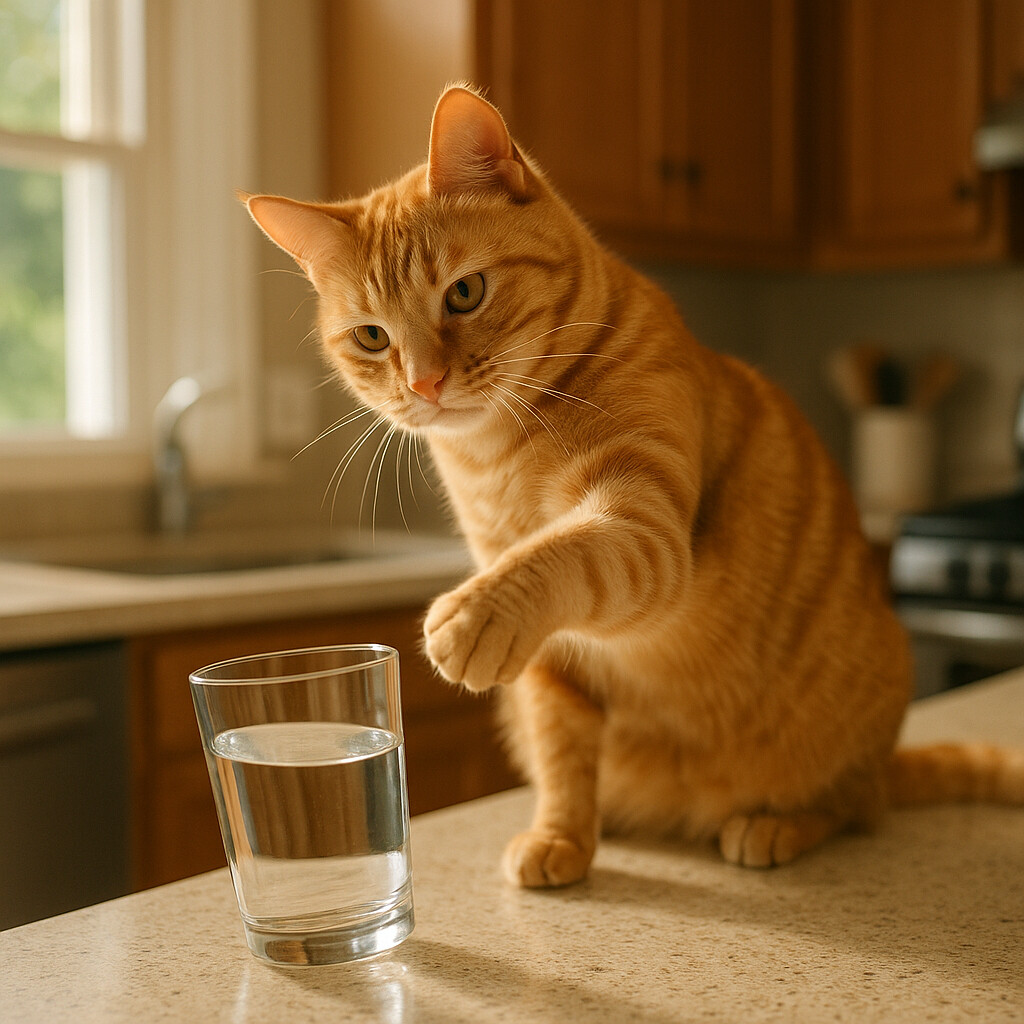
You’re sitting on the couch, minding your own business, when you hear the unmistakable sound of something crashing to the floor. You look over. Your cat is perched on the counter, staring at you with zero remorse, paw still hovering where your water glass used to be.
If this sounds familiar, you’re not alone. It’s one of the most common — and most baffling — cat behaviors out there. But your cat isn’t doing it to be a jerk (well, not entirely). There’s real behavioral science behind why cats systematically push objects off elevated surfaces, and understanding it can actually help you reduce the chaos.
It Starts With Hunting Instincts
Cats are obligate carnivores with deeply wired predatory behaviors. In the wild, a cat investigates unfamiliar objects by batting them with a paw — testing whether something is alive, edible, or dangerous. That same instinct drives your indoor cat to swat a pen, a phone, or a full coffee mug.
Dr. Mikel Delgado, a certified applied animal behaviorist at UC Davis, explains that this “object play” mimics the way cats interact with prey. The object moves when batted, which triggers the predatory sequence: stalk → pounce → bat → observe reaction. When your water glass goes flying, your cat is essentially running a miniature hunt simulation.
This is especially common in cats who don’t get enough active play. If your cat’s predatory drive isn’t being satisfied through interactive toys or outdoor time, they’ll find their own “prey” — and your belongings are the most convenient target.
Your Reaction Is Part of the Reward
Here’s the part most people don’t realize: your response is reinforcing the behavior.
When your cat pushes something off the table and you jump up, yell “No!”, or rush over to clean it up, your cat just learned something valuable: this action gets me immediate attention. Even negative attention counts. Cats are incredibly observant, and they learn cause-and-effect faster than most people give them credit for.
Behavioral studies published in the Journal of Veterinary Behavior confirm that cats who receive attention (positive or negative) after performing a behavior are significantly more likely to repeat it. Your cat isn’t being malicious — they’re being strategic.
What actually works:
- Don’t react when something falls. Walk away. Clean it up later.
- Instead, give your cat attention before they start knocking things — when they’re being calm or engaging with appropriate toys.
- Redirect immediately by tossing a toy or starting an interactive play session.
Boredom Is the Biggest Driver
This is the angle most “why does my cat knock things over” articles miss. The number one predictor of object-pushing behavior isn’t breed, age, or personality — it’s environmental enrichment (or the lack of it).
Indoor cats who don’t have enough stimulation will create their own entertainment. The ASPCA’s behavioral guidelines recommend a minimum of two 15-minute interactive play sessions daily for adult cats. Kittens and young adults need even more — closer to 30–45 minutes total.
Here’s a quick self-assessment:
| Enrichment Factor | Minimum Recommendation |
|---|---|
| Interactive play sessions per day | 2 × 15 minutes |
| Rotating toy types | 3–4 different styles weekly |
| Vertical space (cat trees, shelves) | At least 1 per cat |
| Window access for “bird TV” | At least 1 window perch |
| Puzzle feeders | 1–2 meals via puzzle per day |
If your cat’s environment checks fewer than 3 of these boxes, boredom is almost certainly contributing to the behavior.
For cats craving more stimulation, consider whether safe outdoor access might be the missing piece. Even a supervised outdoor time in a secured yard can dramatically reduce destructive indoor behaviors.
Texture and Physics Are Genuinely Interesting to Cats
Cats have incredibly sensitive paw pads — more than 200 nerve receptors per square centimeter. When they touch different objects, they’re gathering real sensory information: weight, temperature, surface friction, stability.
Watching an object slide, wobble, and fall is genuinely novel sensory input for a cat. The physics of a falling object — the trajectory, the sound on impact, whether it breaks or bounces — is unpredictable, and cats are drawn to unpredictability. It’s the same reason they prefer toys that move erratically over ones that move in straight lines.
This means your cat isn’t always seeking attention when they push things. Sometimes they’re just… doing science.
Territory Marking Plays a Role
Cats have scent glands in their paw pads. When they bat or push objects, they’re depositing pheromones — subtly marking that object (and that surface) as part of their territory. This is related to the same behavior as kneading, scratching, and bunting (headbutting).
If your cat repeatedly pushes the same items off the same surface, territorial scent marking could be part of the equation, especially in multi-cat households where cats are more actively defining boundaries.
How to Actually Stop It (Without Losing Your Mind)
Yelling doesn’t work. Spray bottles don’t work (they just make your cat afraid of you, not the behavior). Here’s what does:
1. Increase play — seriously. This is the single most effective intervention. Get a wand toy (Da Bird, Cat Dancer), and commit to two play sessions per day. Most owners underestimate how much active play their cat needs.
2. Secure your surfaces. Use museum putty or adhesive strips to secure fragile items. Move breakables behind closed cabinet doors. This isn’t admitting defeat — it’s removing the trigger.
3. Provide alternatives. Put a puzzle feeder or a treat-dispensing ball on the same surface where your cat knocks things off. Give them something more rewarding to interact with.
4. Add vertical space. Cat trees, wall shelves, and window perches give your cat legitimate elevated territory that’s theirs — reducing the need to “claim” your counters and tables.
5. Try clicker training. Yes, cats can be clicker trained. Reinforce behaviors you want (sitting on their cat tree, playing with their own toys) with treats and clicks. It takes about a week for most cats to make the connection.
When It’s More Than Just Mischief
If your cat suddenly starts knocking things over when they didn’t before, or the behavior escalates dramatically, it’s worth a vet visit. Sudden behavioral changes can signal:
- Hyperthyroidism (increased restlessness and activity in older cats)
- Pain or discomfort (cats who are hurting sometimes act out in unusual ways)
- Cognitive decline (in senior cats 12+, disorientation can cause unusual interactions with objects)
If your cat is over 10 and the behavior is new, ask your vet to run a basic thyroid panel and wellness check. It’s a $50–150 test that can catch problems early — I actually covered the early warning signs of common feline health changes in a recent post.
The Bottom Line
Your cat knocks things off tables because they’re a hunter living in a world with no prey, a scientist running physics experiments, and an attention-seeking genius who’s figured out that crashing sounds = human reaction. The fix isn’t punishment — it’s enrichment, redirection, and honestly, just moving your breakables.
— CatLady6 