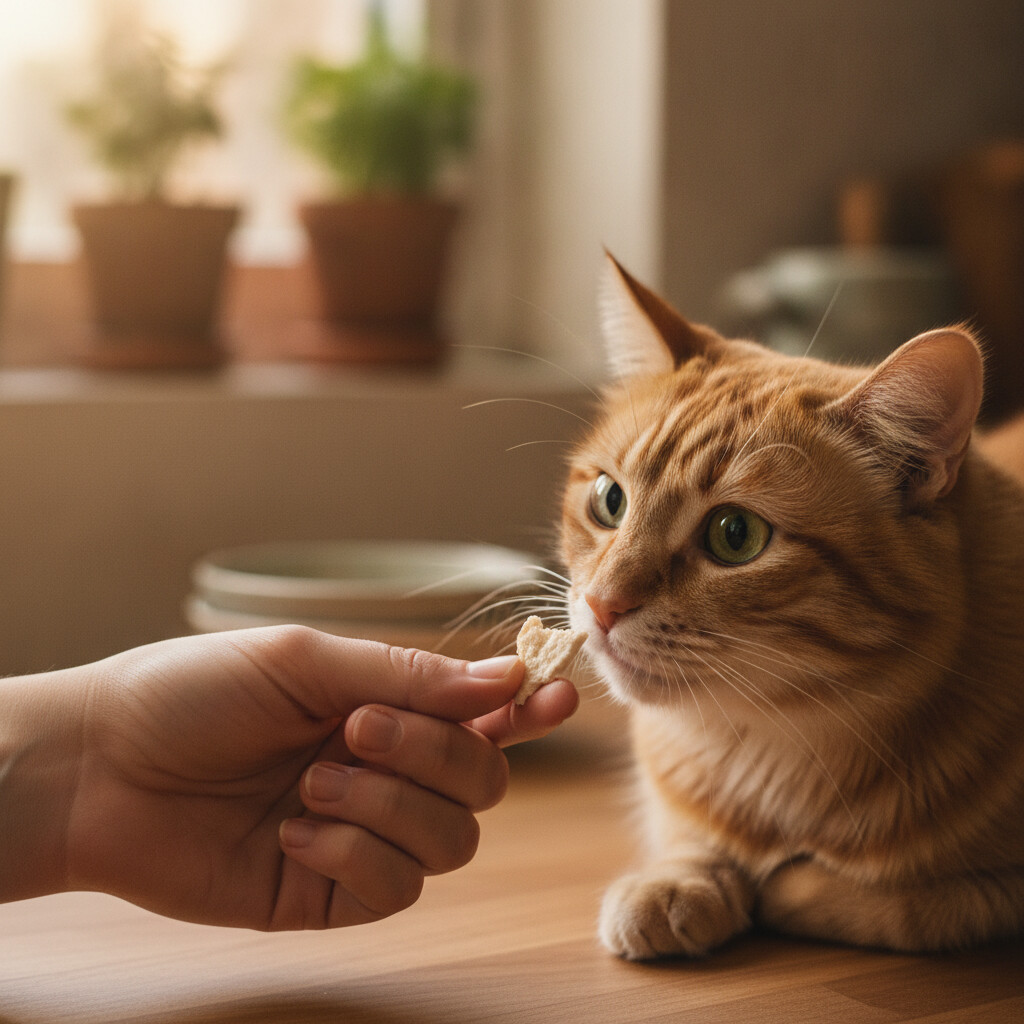
Most treats marketed to cats range from genuinely useful to essentially junk food with a cute label. Here’s how to tell the difference — and how to use treats in a way that doesn’t quietly undermine your cat’s health.
The 10% Rule (And Why Most Cat Owners Break It)
Treats should make up no more than 10% of your cat’s daily calorie intake. For an average 10-pound indoor cat eating around 200 calories per day, that’s 20 calories from treats — roughly 2–4 typical commercial treats, or one small squeeze of a liquid treat.
Most cat owners give significantly more than this. It’s easy to do: the treats look small, the cat is enthusiastic, and the bag doesn’t list calories prominently. But treats are calorie-dense relative to their volume. A handful of soft treats can add 50–80 calories before you’ve noticed. Over months, that’s real weight gain.
Before you buy any treat product, find the calorie count per treat. If it’s not on the packaging, that’s itself a flag.
Types of Treats: What They Are and What to Expect
Freeze-dried meat treats are the gold standard for ingredient quality. They’re typically a single protein — chicken breast, salmon, rabbit — with nothing added. The freeze-drying process removes moisture while preserving nutrients. They’re high in protein, low in carbohydrates, and palatable to almost every cat. Some vets use them specifically for training or medication administration because cats respond so reliably to them.
Look for: single-ingredient or very short ingredient list. Watch the sodium content on some brands — it can be higher than you’d expect.
Liquid/squeeze treats (products like Churu-style lickable treats) have become enormously popular and most cats love them. They’re typically made from chicken or tuna with water, tapioca starch, and vitamins. They work well for hydration supplementation, medication delivery, and bonding. The calorie content per tube is usually manageable (10–15 calories), but they’re easy to overuse.
Check: tapioca starch and other thickeners are fine in small amounts. Be cautious about products with carrageenan, a seaweed-derived thickener that some research links to gut inflammation in animals — the evidence isn’t conclusive, but it’s worth noting if your cat has a sensitive stomach.
Dental treats claim to reduce tartar and plaque. Some do, to a modest degree — look for the VOHC (Veterinary Oral Health Council) seal, which means the product has been independently tested and shown to work. Without that seal, the dental claim is marketing. Even VOHC-approved dental treats don’t replace professional cleanings — they’re a maintenance tool, not a treatment.
Crunchy/kibble-style treats are the most commonly given treat type and generally the lowest quality. They’re often high in carbohydrates and fillers (corn, wheat, soy), with meat listed several ingredients down. They’re not harmful in small quantities, but if you’re spending money on treats, you can do better.
What to Look for on the Label
The ingredient list is ordered by weight before cooking. You want to see a named protein source — chicken, turkey, salmon — as the first ingredient, not “poultry by-product meal” or “fish meal” as the primary item. By-products aren’t inherently bad (organ meat is nutritionally valuable), but vague terms like “meat by-product” tell you little about what you’re feeding.
Ingredients worth avoiding:
- Artificial colours (Red 40, Yellow 5) — cats don’t see colours the way humans do; the colouring is for the owner’s benefit, not the cat’s
- Artificial preservatives (BHA, BHT, ethoxyquin) — opt for products using mixed tocopherols (vitamin E) or rosemary extract instead
- Onion or garlic in any form — toxic to cats even in small amounts; check the label on flavoured treats carefully
- Excessive sugar or corn syrup — occasionally found in products designed to mimic human snack aesthetics
- Xylitol — rare in cat treats but toxic at low doses; worth a label check if the product is dual-marketed for dogs and cats
Using Treats as Enrichment and Training Tools
Cats can absolutely be trained using treats — contrary to popular belief, they respond well to positive reinforcement. The key is working in short sessions (2–3 minutes maximum), using tiny pieces (a fraction of a freeze-dried treat), and stopping while they’re still interested. Freeze-dried meat treats work best for this because they’re easy to break into small pieces and the strong smell keeps cats engaged.
Treats are also excellent for feeding enrichment — hiding them around the house or using puzzle feeders gives indoor cats a mental workout that satisfies the hunting instinct rather than just the appetite. This is a far better use of treat calories than hand-feeding in front of the TV.
The “Premium” Label Problem
Treats labelled “natural,” “organic,” “grain-free,” or “superfood” aren’t necessarily better — these are marketing terms with limited regulatory meaning in pet food. What matters is the ingredient list, the calorie content, and the protein-to-filler ratio.
The short version: freeze-dried single-ingredient proteins are generally the best option for cats who’ll eat them. Liquid treats are useful for hydration and medication delivery. Everything else is situation-dependent — fine in small amounts, but not worth letting dominate your cat’s diet.
When to Check In With Your Vet
If your cat has started gaining weight and their main diet hasn’t changed, treats are often the hidden culprit — it’s worth tracking exactly how many you’re giving over a week. Our article on recognising and managing cat weight gain covers the signs and how to assess whether your cat is at a healthy weight.
If your cat develops vomiting, diarrhea, or skin and coat changes after starting a new treat, stop giving it and let your vet know. Cats can have protein sensitivities — treats are often the overlooked variable when a cat’s health shifts.
For cats on prescription diets (kidney disease, urinary health, diabetes), always check with your vet before introducing any treat. Many therapeutic diets need careful control, and certain treat ingredients can interfere with the nutritional goal.