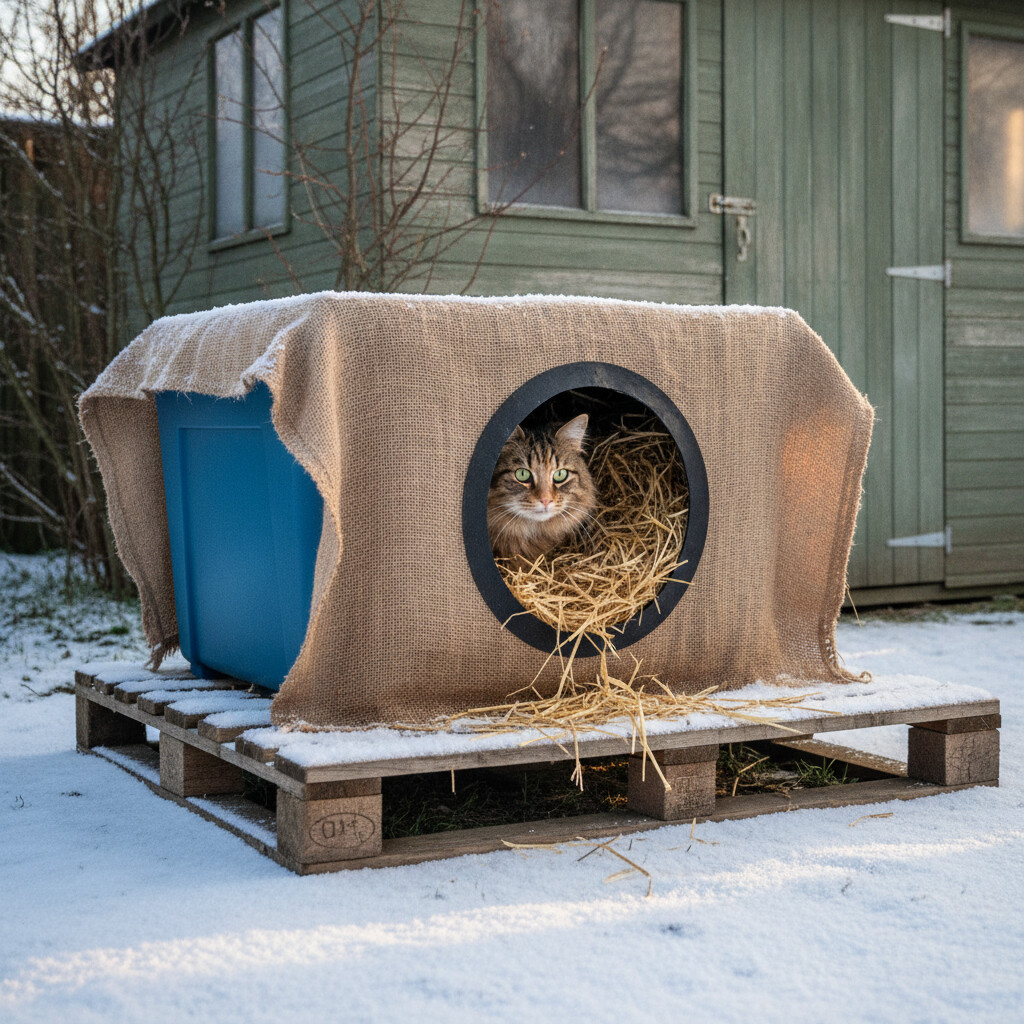
A good winter shelter for outdoor cats is small, insulated, raised off the ground, and filled with loose straw, not blankets. You can build one in an afternoon from two plastic storage tubs and a sheet of foam board for about $40–60. Here’s how to do it, plus the mistakes that make a shelter colder rather than warmer.
This guide is for anyone looking after cats who live outside: community or feral cats, a barn cat, a stray who’s adopted your porch, or your own cat who won’t come in. If the cat is yours and willing to come inside, that’s still the warmest shelter there is.
What makes a winter cat shelter actually work
A shelter doesn’t heat a cat. The cat heats the shelter. Everything about a good design comes down to helping a cat’s own body heat stay put.
That means four things:
- Small inside. A big box has more air to warm up. Alley Cat Allies, the US advocacy group for community cats, recommends an interior of roughly 2 feet by 3 feet and about 18 inches high for a shelter used by up to three to five cats. For one or two cats, smaller is fine.
- Insulated. Walls, floor and lid all need a layer that slows heat loss. Rigid foam board or a styrofoam cooler both work.
- Off the ground. Frozen or wet ground pulls heat out of the floor. A pallet or a couple of bricks underneath makes a real difference.
- Dry. Wet bedding is worse than no bedding. Damp fur loses its insulating value, which is why so much of this guide is about keeping water out.
Cats tolerate cold better than people often expect, but they’re not immune. A healthy adult cat’s normal body temperature is around 100.5–102.5°F, and frostbite on the ear tips, tail and toes is a real risk in a hard freeze, especially for cats who are thin, old, sick or very young.
Straw, not hay, blankets or towels
This is the single most common mistake, so it gets its own section.
Use straw. Straw is the dry, hollow stalk left after grain is harvested. It doesn’t hold moisture well, so it stays dry, and cats can burrow into it and push it into a nest around themselves. The Humane Society of the United States and Alley Cat Allies both recommend straw as bedding for outdoor cat shelters.
Don’t use hay. Hay looks similar but it’s dried grass meant as animal feed. It soaks up moisture, packs down, and can go mouldy. Garden centres and farm stores sometimes label things loosely, so check: straw is usually golden and hollow; hay is greener and leafier.
Don’t use blankets, towels or folded newspaper. They feel cosy to us, but they absorb moisture from the air and from the cat’s breath, then get cold and can freeze. A shelter full of a damp towel is colder than an empty one.
Fill the shelter loosely, about halfway to two-thirds full, so cats can dig into it. Check it every few weeks and replace any straw that’s damp, flattened or dirty.
How to build a storage-tub shelter (step by step)
This is the most popular DIY design because it’s cheap, weatherproof and doesn’t need power tools beyond a box cutter.
What you need:
- One large plastic storage tub with a lid (around 30–35 gallons)
- One smaller tub that fits inside the large one with a gap of an inch or two on all sides, or a sheet of 1-inch rigid foam insulation board
- A box cutter or utility knife
- Duct tape or outdoor-rated tape
- Straw
- Optional: a pallet, bricks or cinder blocks to raise it
Steps:
- Mark the doorway. On one of the long sides of the large tub, mark a circle or square about 5½ to 6 inches across. Place it a few inches above the bottom, not flush with the floor, so rain and snow don’t run straight in. A doorway this size lets cats in but keeps out most larger animals.
- Cut the doorway. Cut slowly with the box cutter. Plastic can crack if you force it, so score the line a few times rather than pushing through in one go. Tape any sharp edges.
- Insulate. If you’re using the two-tub method, set the small tub inside the big one, cut a matching doorway in it, and stuff the gap between them with straw or foam offcuts. If you’re using foam board, cut panels to line the floor and each wall, leaving the doorway clear, and cut one more panel to sit just under the lid.
- Line the floor. Put a layer of foam board on the floor even in the two-tub design. The floor loses heat fastest.
- Add straw. Fill loosely, as above.
- Put the lid on. The lid on top acts as the roof. In windy spots, tape it down or weigh it with a brick so it doesn’t blow off.
- Raise it. Set the finished shelter on a pallet or bricks so it’s a few inches off the ground.
A styrofoam cooler from a fish market or pharmacy supplier is an even quicker version: cut a doorway, put straw inside, tape the lid on, and set it inside a plastic tub or under cover to protect it from cats’ claws and the weather.
Where to put it
Placement matters nearly as much as construction.
- Face the doorway away from the prevailing wind. If you’re not sure which way that is, put the door facing a wall or fence, with a few inches of gap so cats can still get in.
- Choose a quiet spot. Behind a shed, under a deck or porch, or alongside the house, away from foot traffic and dogs.
- Think about a second exit. Some designs add a second door so a cat can’t be cornered by another animal. This is a judgement call: two doors means more drafts, so many people stick with one and use an L-shaped baffle or a flap of heavy plastic just inside the entrance to block wind.
- Clear snow after storms. A buried doorway is a trapped cat.
For a colony, several small shelters usually work better than one big one. Not every cat will share.
Food and water in freezing weather
Cats burn more energy keeping warm, so outdoor cats often eat more in winter. Feed regularly and keep an eye on body condition.
- Keep food and water outside the shelter. Spilled water inside a shelter soaks the bedding.
- Wet food freezes; dry food doesn’t. Offer wet food when you’re there to watch it eaten, and leave dry food as the steady supply.
- Stop water freezing. Deep, wide, thick-walled plastic bowls freeze more slowly than shallow ones. Placing bowls somewhere sunny helps. Electric heated bowls made for outdoor pets solve it properly. Avoid metal bowls, which can freeze to a tongue.
- A covered feeding station — two tubs, a box tipped on its side, or a sheltered corner under a porch — keeps snow off the food.
Heat sources: what’s safe and what isn’t
Most well-built shelters don’t need added heat. If you want extra warmth for a particularly cold spell or a vulnerable cat:
- Microwavable heat discs (the solid kind designed for pets) are the simplest option. Depending on the product, they stay warm for several hours. Follow the manufacturer’s heating instructions exactly and put them under a layer of straw, never directly under a cat.
- Electric heated pads made specifically for outdoor pet use, with a chew-resistant cord, can work if you have a safe outdoor outlet. Read the outdoor and wet-location ratings carefully. Our guide to heated cat beds covers how to judge whether a heated product is safe.
- Never use space heaters, heat lamps, candles or anything with an open flame. They’re fire risks in a box full of straw.
- Avoid hand warmers and chemical heat packs. They’re not designed for this, they can get hotter than labelled, and a cat might chew them.
Other winter hazards for outdoor cats
A shelter fixes the cold. These are the other winter risks worth knowing about.
Antifreeze. Ethylene glycol antifreeze tastes sweet and is highly toxic to cats. The ASPCA Animal Poison Control Center warns that even a very small amount can cause fatal kidney failure. Wipe up drips on driveways, store containers tightly closed, and if you can, choose a propylene glycol–based product, which is considerably less toxic. If you think a cat has drunk antifreeze, it’s an emergency: go to a vet immediately, because treatment works best within hours. Our room-by-room guide to household chemicals that are toxic to cats covers the rest of the garage shelf.
Car engines. Cats sometimes climb into a warm engine bay. Before you start the car on a cold morning, knock on the hood or honk the horn and give a cat time to get out.
De-icing salt. Rock salt can irritate paws and upset stomachs if licked off. Pet-safe ice melt is easy to find.
If it’s your own cat
Everything above works for an owned outdoor cat too. But if your cat would happily come in, the simplest winter plan is bringing them inside at night, when temperatures drop furthest, and keeping them busy indoors (our guide to winter cat enrichment has ideas). If your cat goes outside and you’d like them to have daytime fresh air while staying on your property, a catio or a fence-top containment system such as Oscillot are two ways people do it. Make sure any outdoor cat of yours is microchipped and wearing ID, and that you know what to do if they go missing.
When to get help from a vet or rescue
Contact a vet, or a local trap-neuter-return (TNR) group or rescue for community cats, if you see:
- A cat who is shivering, very lethargic, unsteady, or unusually cold to the touch. These can be signs of hypothermia.
- Ear tips, tail or toes that look pale, grey, very red or blistered, or that the cat won’t let you touch. These can be signs of frostbite, which often shows up more clearly a few days later.
- Any cat who stops eating, seems to be losing weight quickly, or has trouble breathing.
- A cat who may have licked or drunk antifreeze, even if they seem fine.
Many TNR groups also loan humane traps, give out shelter supplies, or run winter shelter-building days, so they’re worth contacting even if nothing is wrong. And if one of your outdoor visitors starts waiting at your door every evening, you might find what other people have: that a cat who “lives outside” sometimes decides otherwise, like the cat in The Barn Cat Who Decided She Wanted to Be a House Cat.