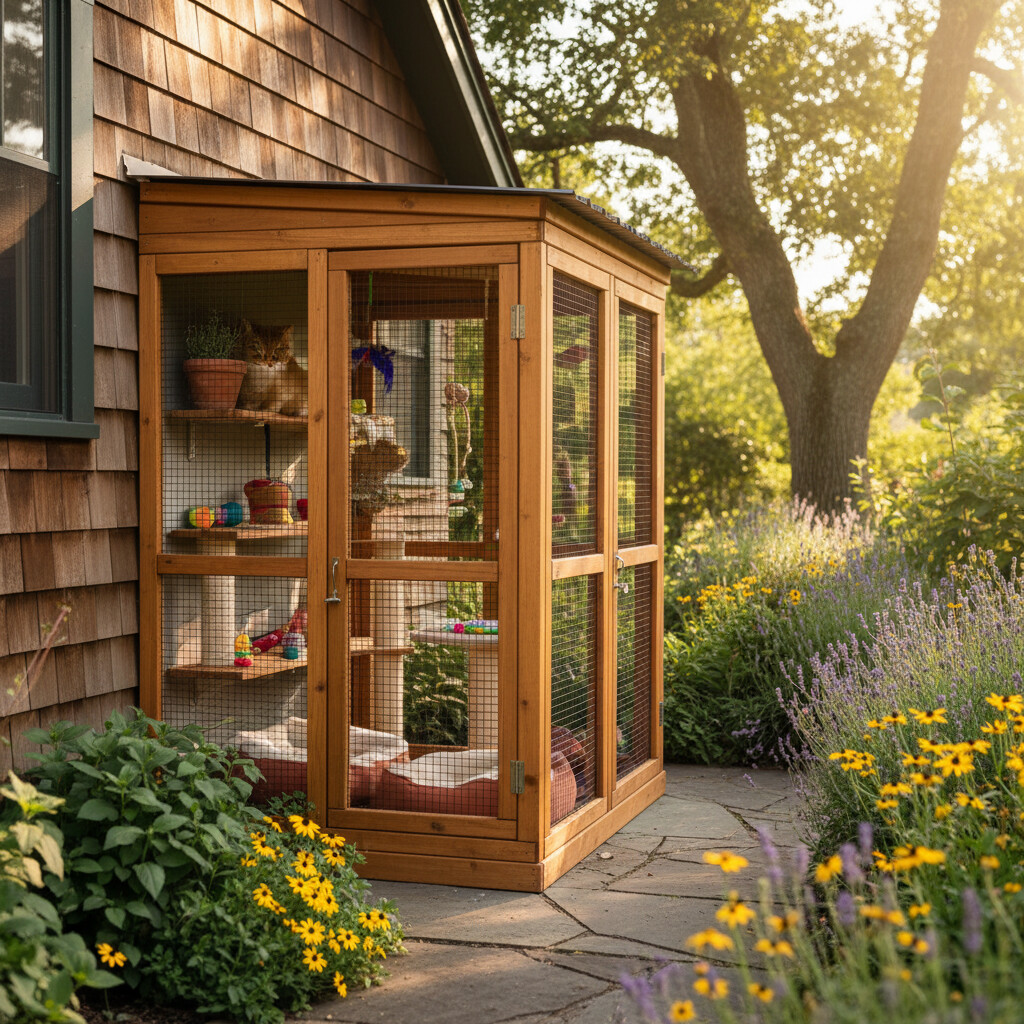
Building a catio is one of the most impactful things you can do for your indoor cat’s quality of life. Here’s everything you need to know to build one — even if you’ve never picked up a power drill.
A catio (short for cat patio) is an enclosed outdoor space that gives your cat access to fresh air, sunlight, and natural stimulation without the risks of free-roaming. You can build a window-box version for under $150 or a full walk-in enclosure for a few hundred dollars. Most intermediate DIYers can complete a basic build over a single weekend.
What Size Catio Does Your Cat Actually Need?
Bigger is better — but don’t let “I don’t have room for a big one” stop you from building anything. Even a small window-box catio delivers meaningful enrichment.
Three broad categories to choose from:
- Window box (2–6 sq ft): Attaches directly to a window frame. Perfect for apartments or when you have no yard. Your cat can bask, watch birds, and smell outdoor air without you needing any outdoor space at all.
- Lean-to / attached enclosure (10–30 sq ft): Attached to an exterior wall or door. Cats access it through a pet door or existing doorway. This is the most popular beginner build — solid weekend project with basic tools.
- Freestanding enclosure (30+ sq ft): A standalone structure in your yard. Walk-in size, most versatile for enrichment. More complex to build — budget a full weekend plus setup time.
As a rough guide, aim for enough space that your cat can fully stretch out, reach a shelf above floor level, and walk a few paces in each direction. Cats in cramped enclosures often don’t use them.
Materials and Tools: What You’ll Actually Need
For a lean-to catio (the recommended beginner build):
- 2×4 lumber for the frame
- Welded wire mesh — 16- or 19-gauge, 1×1 or 1×2 inch openings. Avoid chicken wire: it’s too weak, cats push through it, and it rusts
- Roofing material — clear polycarbonate panels are the most popular choice (lets light through, keeps out rain)
- Staple gun with heavy-duty staples, screws, and a drill
- L-brackets and hinges for the access door
- Exterior wood stain or non-toxic paint (must be fully cured before your cat uses the enclosure — check the manufacturer’s drying time, typically 48–72 hours)
The mesh gauge matters more than most beginner guides admit. Welded wire at 16-gauge holds its shape under sustained pawing, keeps out larger wildlife, and doesn’t leave the sharp wire burrs that chicken wire creates at cut edges.
Step-by-Step Build Guide
1. Measure and plan — then check permits
Sketch your footprint before buying materials. Check whether your local council or HOA requires a permit for enclosed outdoor structures. Most small builds (under a certain square footage) don’t need one, but five minutes of checking beats a notice-to-comply later.
2. Anchor the frame to the house
For a lean-to, your top beam attaches to the house wall. Drive structural screws into wall studs — not just siding. This structure will have an enthusiastic cat throwing itself at it for years; it needs to be solidly fixed.
3. Build the wall and roof frame
Cut 2×4s to size and assemble using L-brackets at every corner. Pre-drill before screwing to prevent wood splitting. For a lean-to, the roof slopes away from the house at a shallow angle to shed rain.
4. Attach the mesh
Staple welded wire mesh to the outside of the frame. Work in sections — pull it taut before stapling. Overlap sections by at least 2 inches and staple along every edge. Cats find gaps larger than 2 inches and will use them — check the entire perimeter carefully.
5. Build the door
A simple inward-swinging door with a latch works well. Make sure the latch mechanism can’t be pawed open from inside. Some cats figure out simple latches within a week; use a secondary latch if needed.
6. Fit the roof
Screw polycarbonate panels to the top frame using roofing screws with rubber washers to prevent leaks. Aim for at least 50% roof coverage — enough to give your cat shade and a dry spot during rain. In hot climates, more shade coverage is better.
7. Add enrichment before your cat goes in
An empty box isn’t enriching. Before the first session, add:
- One or two platforms or shelves at different heights — cats want to be up high
- A weather-sheltered resting spot (a covered box with a cushion)
- A cat grass or catnip planter
- A scratch-friendly surface (a sisal post or rough timber)
How to Introduce Your Cat to the Catio
Don’t carry your cat out and deposit them in it on day one. That’s a reliable way to make the catio a stressful place.
The patient approach works better:
- Leave the connecting door or window open with you nearby. Let your cat choose when to go out.
- Place a familiar-smelling item inside from the start (a used blanket or toy).
- Most cats explore within a few sessions. Shy cats may take a week.
- Increase unsupervised time gradually once you’re confident the structure is secure.
Catio vs. Full Yard Access: Which Is Right for You?
A catio is the right choice for apartments, small gardens, urban properties near traffic, or cats who’ve always been indoor-only and need a gentle introduction to the outdoors.
If you have an existing fence and want to give your cat the whole yard rather than an enclosed structure, fence-top containment is the other main option. Systems like Oscillot mount on top of standard fencing and use spinning paddles that prevent cats from getting the purchase needed to climb over. It’s a different solution to the same problem — and for some yards and cats, a better fit than an enclosure. The Indoor vs. Outdoor Cats: What the Research Actually Says article covers the evidence on outdoor access across the whole spectrum.
The Most Common Mistakes to Avoid
Using chicken wire. It looks fine in photos and costs less, but it fails under real use. Use welded wire mesh.
Skipping the weatherproofing. Untreated timber rots fast. Treat or paint all wood before the cat uses the space, and allow full curing time.
No shade. A roofless catio in a sunny climate turns into an oven. Make sure your cat can get out of direct sun.
Not testing for escape routes. Before the first unsupervised session, get down to your cat’s level and check every corner, the door frame perimeter, and where the structure meets the house wall. Cats can compress to fit through gaps you’d dismiss as too small.
The Payoff
Cats with any outdoor access — even limited, enclosed outdoor access — show lower stress indicators and higher engagement with their environment. A catio delivers sunlight, fresh air, natural smells, and the visual stimulation of birds and insects that no amount of indoor toys can fully replicate.
For more ideas on enriching your indoor cat’s environment beyond the catio, Indoor Cat Enrichment: How to Keep an Indoor Cat Stimulated has a full breakdown of what actually moves the needle.