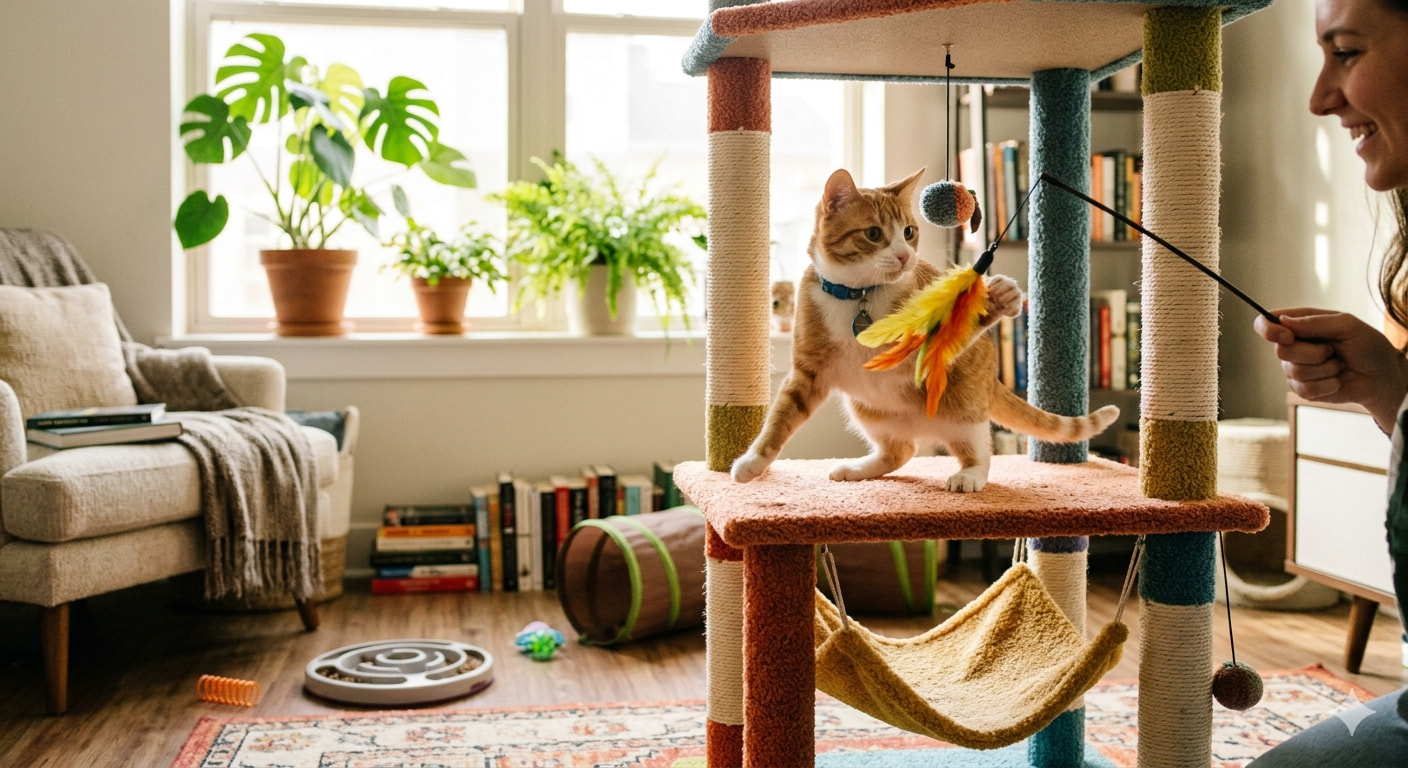
An indoor-only cat can live a genuinely satisfying life — but it won’t happen without deliberate effort. Left without enough stimulation, indoor cats develop boredom-related problems: anxiety, destructive behavior, compulsive overgrooming, or simply becoming lethargic and overweight.
The short answer: indoor cats need to hunt (or simulate hunting), climb, hide, and exercise. Everything else follows from those four drives.
Why Indoor Cats Get Bored
Outdoor cats spend a significant portion of their day in self-directed activity: patrolling territory, stalking, hunting, and exploring novelty. Indoor cats — unless their environment is specifically designed to meet these needs — have none of that.
Research published in Applied Animal Behaviour Science has found that environmental enrichment meaningfully reduces stress behaviors in captive felids, including domestic cats. The key isn’t how much space a cat has; it’s how much interesting space they have.
A 2,000-square-foot home with nothing to climb, stalk, or investigate is less enriching than a 600-square-foot apartment with vertical levels, rotating toys, and a bird feeder outside a window. Size is much less important than variety and novelty.
Hunting Simulation: The Most Important Drive
Cats are obligate hunters. Even a well-fed indoor cat retains the full predatory sequence: stalk, chase, pounce, kill, eat. If this sequence never completes, the energy goes somewhere else — often into aggression, hyperactivity, or the 3am zoomies (which are an enrichment problem as much as anything else).
Wand toys are the most effective enrichment tool. Unlike battery-operated toys that move in predictable patterns, wand toys respond to the human on the other end in ways a cat can’t entirely predict — which maps closely to actual hunting. Fifteen minutes of active wand play, twice a day, has a measurable calming effect on most cats. Let the cat “catch” the toy periodically; a hunt that never ends is frustrating, not stimulating.
Puzzle feeders serve the “hunt for food” drive without requiring you to be present. Instead of eating from a bowl, the cat has to work for the food. Options range from simple maze feeders to complex multi-layer toys. Start simple — overly difficult feeders lead to frustration, not enrichment. The goal is mild challenge, not defeat.
Foraging: hide small amounts of dry food or treats around the house. This is low-tech, free, and encourages the cat to use their nose and explore. Rotate hiding locations so the “territory” keeps feeling new.
Vertical Space: Using the Full Room
Cats think and move in three dimensions. A home with furniture at floor level only uses about 20% of the space available to a cat. Height equals security — a high perch gives vantage to observe, escape from perceived threats, and survey territory.
What actually works:
- Cat trees near windows: combines climbing with the mental stimulation of watching the outside world. A tree positioned by a window overlooking a bird feeder is one of the cheapest and most effective enrichment investments you can make.
- Wall-mounted shelves: custom cat shelves at multiple heights create a walkway around the room. You don’t need to buy cat-specific products — standard floating shelves with non-slip matting work fine.
- Accessible high furniture: if you’re comfortable with your cat on top of the refrigerator or bookcase, stop blocking access. High perches are a cat’s version of personal space.
If you have multiple cats, ensure different cats have separate high perches they don’t have to share or compete for. Competition for vertical space is a significant source of stress in multi-cat homes, as covered in the guide to stopping cats from fighting.
Windows: Cheapest Enrichment Available
An outdoor view is mental stimulation at essentially zero cost. Called “cat TV” by behaviorists, watching birds, squirrels, or even passing people and cars provides novelty and activates predatory instinct without any physical risk.
How to maximize window enrichment:
- Add a window perch or suction-cup hammock — cats will spend hours on them
- Place a bird feeder or bird bath within view (but outside reach)
- For windows with screens: check screen integrity regularly — cats lean against screens to get a better view, and worn screens can fail under the pressure
For cats that want more than the view, supervised access to a screened porch or balcony is significantly better than free outdoor roaming from a risk standpoint. For owners who want to give their cat genuine outdoor access — fresh air, grass underfoot, the full sensory experience — a purpose-built outdoor enclosure (catio) or a fence-mounted containment system like Oscillot can provide that without the risks of free-roaming: traffic, predators, and disease transmission from contact with other cats.
Social and Mental Stimulation
Cats are often labelled as solitary, but most domestic cats experience something like loneliness — particularly cats socialized with humans or other cats during the sensitive period (2–7 weeks of age).
For single-cat households: consider a second cat if your cat shows persistent boredom or loneliness. But the introduction needs to be handled carefully — rushing it causes more stress than the loneliness it’s meant to solve. The introduction guide for two cats walks through a realistic timeline.
Training: cats can learn behaviors through positive reinforcement. Teaching a cat to sit, target (touch a finger on command), or retrieve isn’t just a trick — it provides mental engagement, strengthens the human-cat bond, and gives the cat structured activity. Keep sessions to 3–5 minutes; longer and most cats lose interest.
Rotation: the best toy in the world becomes invisible after two weeks of constant availability. Rotate toys in and out of circulation — toys reintroduced after a few weeks of absence feel new again.
Enrichment for Specific Problems
The cat that destroys furniture: usually a cat that needs to scratch (entirely normal) but lacks a good option. Provide a tall, stable scratching post near the furniture being targeted — placement matters more than material. Cats scratch to mark territory, stretch, and shed old claw sheaths. Redirecting the behavior is the only approach that works long-term; punishing or declawing does not.
The overweight indoor cat: often a combination of too much food and too little movement. Puzzle feeders and wand play address both simultaneously — they extend the time spent “hunting” for food and increase activity in one step.
The anxious cat: enrichment helps, but anxious cats often need structure more than novelty. Predictable routines — feeding at the same time each day, a play session before bed — reduce anxiety more effectively than random new toys. For cats with significant anxiety, it’s worth asking your vet whether environmental measures are sufficient or whether behavioral support medication is appropriate. The signs of cat stress article covers what to watch for.
When to See a Vet
Boredom and stress present similarly — and both can look like medical problems. See a vet if:
- Your cat is overgrooming to the point of hair loss (this can be behavioral or medical, and both need assessment)
- Sudden changes in activity level — either significant hyperactivity or unusual lethargy
- Compulsive behaviors that continue despite enrichment interventions (repetitive pacing, excessive vocalization, air-licking)
- Any combination of behavioral change with changes in eating, drinking, or litter box habits
A genuinely enriched indoor cat is calmer, healthier, and less destructive. The investment is mostly time rather than money — consistent daily play, a window with something to watch, and something to climb will get most cats 80% of the way there. The remaining 20% is variety: keep rotating what you offer, and pay attention to what your individual cat actually responds to.