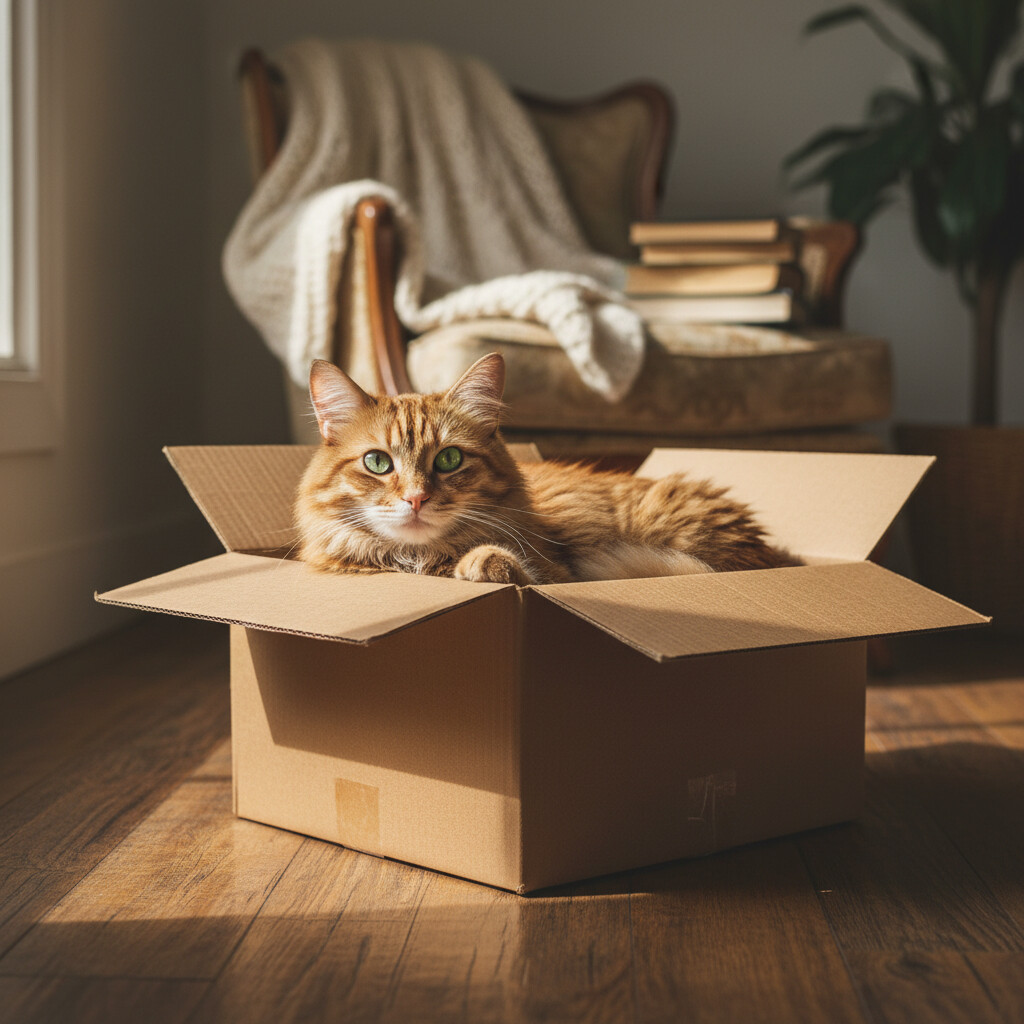
Put a box on the floor and your cat will be in it within minutes. This isn’t random quirk — it’s behaviour rooted in your cat’s instincts around security, thermoregulation, and hunting. Here’s what’s actually going on.
Boxes Feel Safe — Literally
Cats are both predators and prey animals. In the wild, an enclosed space means no surprises from behind. A box with walls on three sides ticks every instinctive requirement: limited entry points, outward visibility from inside, and no angle from which a threat can approach undetected.
This isn’t just theory. A 2014 study published in Applied Animal Behaviour Science (Scholten et al.) found that shelter cats given hiding boxes had measurably lower cortisol levels and recovered from the stress of rehoming significantly faster than cats without hiding options. The researchers concluded that hiding is a core coping strategy for domestic cats — not a sign of fear, but an active stress-management tool.
For a cat that chooses a box over open floor space, it usually means: “This is where I feel safest right now.”
Cardboard Keeps Them Warm
Cats’ thermoneutral zone — the temperature range where they don’t need to burn extra energy to stay warm — sits between roughly 86°F and 97°F (30–36°C). That’s well above room temperature for most humans. Cardboard is an effective insulator, and the small internal space of a box traps body heat quickly.
Part of what draws cats to boxes is pure thermodynamics: a snug cardboard box in a 70°F room is meaningfully warmer than the surrounding air. If your cat seems especially drawn to boxes in cooler months, that’s almost certainly why.
Note: if your cat is always seeking heat — vents, heating pads, sunny patches exclusively — and seems restless or uncomfortable at normal room temperature, it can occasionally flag metabolic issues like hyperthyroidism worth discussing with your vet.
The Ambush Hunter Logic
Cats are stalking predators. A box with a single opening functions like a hunting blind: your cat can observe movement without being observed in return. Even in a house with no prey more interesting than a wand toy, that instinct hasn’t gone anywhere.
Watch what happens when your cat sits in a box near foot traffic. They’re not ignoring you — they’re watching. Those slow-tracking eyes have a purpose. You are, essentially, a slow-moving wildebeest to a cat with a cardboard fortress.
This also explains why cats tend to prefer boxes with smaller openings over open trays. More cover equals a better ambush position.
New Box, New Smell
Cats rely heavily on scent to map their environment. A box that just arrived carries unfamiliar smells — warehouse, delivery vehicle, whatever was packed inside. For a curious cat, that’s genuinely interesting information to investigate. Once the novelty fades, the box either gets abandoned or claimed as territory (which, in cat terms, is a compliment).
Why Some Cats Prefer Bags or Laundry Over Boxes
Same principle, different container. Paper bags, laundry baskets, open suitcases, the gap behind the sofa — cats choose spaces that offer the same combination of enclosure, familiar or novel scent, and a clear exit route. If your cat ignores boxes but consistently disappears into your overnight bag, it’s the same instinct finding a different outlet.
Should You Leave Boxes Out?
Yes — especially for indoor-only cats. Hiding spots and enclosed spaces are considered essential enrichment by the Indoor Cat Initiative at Ohio State University’s College of Veterinary Medicine, which recommends every cat have access to at least one private hiding space at all times.
You don’t need to buy anything. Rotate cardboard boxes, tuck in a folded blanket for warmth, and place them in quieter corners rather than high-traffic areas. Cats value options: two or three boxes in different rooms beats one perfect box in one spot.
If you want to go further, the forum’s indoor cat enrichment guide covers the full setup — vertical space, play stations, and how to give indoor cats the environmental variety they actually need.
When Normal Box-Sitting Becomes a Warning Sign
Normal: cat uses the box regularly, comes out to eat, play, and interact as usual.
Worth watching: cat retreats to the box or another hiding spot for hours at a time, skips meals, doesn’t emerge for interaction, seems different than usual. Prolonged hiding that represents a change in your cat’s normal pattern — especially paired with reduced appetite or lethargy — is one of the quieter signs that something is off. Cats are skilled at masking pain and illness, and “hiding more than normal” is a classic early signal.
If the hiding seems out of character, a vet check is the right call. The forum’s guide to stress and behaviour changes in cats can help you separate normal hiding behaviour from genuine withdrawal.
The Bottom Line
Your cat sits in boxes because boxes are warm, enclosed, and strategically excellent. Every instinct a cat carries — ambush predator, temperature-seeker, stress avoider — points straight toward cardboard. Leave the boxes out. Your cat will show appreciation by sitting in the box for hours while ignoring everything else you’ve bought them.