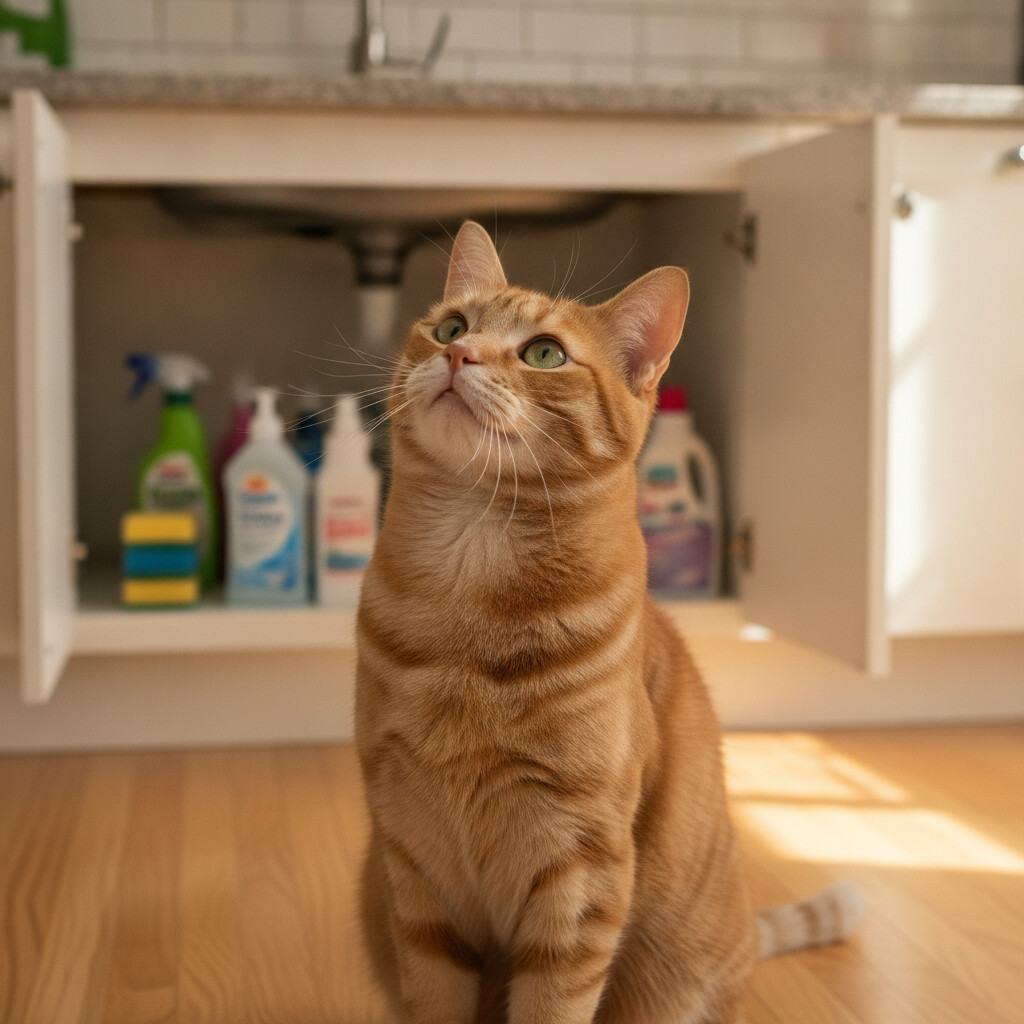
Your cat just walked across the freshly mopped floor and is now licking their paws clean. That’s how most household chemical exposures happen — not from a cat drinking bleach, but from residue on paws, fur, or surfaces being transferred via grooming.
Here’s what to keep away from them, and what to do if something goes wrong.
Why Cats Are Especially Vulnerable
Two things make cats particularly susceptible to household chemicals compared to dogs or humans.
They groom constantly. Anything on their fur, paws, or a surface they walk on gets ingested. A cleaner you might consider safe “because it dries” can still cause problems if a cat walks through a wet floor, or rubs against a recently cleaned surface.
Their liver works differently. Cats are obligate carnivores with a metabolic system that evolved to process meat — not plant compounds or many synthetic chemicals. Specifically, cats lack the glucuronidation pathway that most mammals use to neutralise and excrete certain toxins. This means substances that are harmless to dogs can accumulate to dangerous levels in cats. Essential oils are the most well-known example, but phenol-based disinfectants work the same way.
The ASPCA Animal Poison Control Center handles household product exposures year-round — they’re consistently among the most reported categories.
Kitchen
Bleach and chlorine-based cleaners are the most common household disinfectants and among the most dangerous for cats. Ingestion causes drooling, mouth irritation, and vomiting; in larger amounts, serious harm. Paw contact with undiluted bleach is a concern too. If using bleach solutions on surfaces, allow the area to dry and ventilate before letting your cat back in.
Oven cleaners contain highly caustic alkaline compounds that cause chemical burns on contact. Keep cats out of the kitchen during and after use until surfaces are thoroughly rinsed and dry.
Dishwasher detergent pods are particularly hazardous — brightly coloured, squishy, and interesting to bat around. The concentrated detergent inside is far stronger than liquid dish soap. Store these in a closed cabinet, not loose on the counter.
Ammonia-based cleaners produce fumes that irritate eyes, nose, and throat. Most cats avoid the smell, but residue on surfaces is still a risk.
Safe swaps: Diluted white vinegar is an effective general disinfectant and non-toxic to cats once dry. Baking soda handles odours and mild scrubbing. Several commercial brands now make explicitly pet-safe kitchen cleaners — look for products free from bleach, ammonia, and quaternary ammonium compounds (“quats”).
Bathroom
Toilet bowl cleaners and tank tablets are highly caustic. Cats who drink from the toilet — more than you’d expect — risk chemical ingestion. Keep the lid closed.
Mold and mildew sprays typically contain bleach or quaternary ammonium compounds (quats). These cause respiratory tract and skin irritation in cats at relatively low concentrations. Ventilate bathrooms well after use and keep cats out until surfaces are fully dry.
Phenol-based disinfectants — check labels of spray disinfectants and floor cleaners for ingredients ending in “-phenol.” These are acutely toxic to cats due to the metabolic limitation mentioned above. Some popular multi-surface sprays contain phenols even though they’re marketed as safe for general home use.
Living Room and Laundry
Dryer sheets and fabric softener sheets contain cationic detergents that are toxic when ingested. Some cats chew on them. Even used sheets retain enough product to cause mouth irritation and gastrointestinal symptoms. Keep them in a closed bin, not on top of or inside the laundry.
Mothballs are highly toxic. Both main active ingredients — naphthalene and paradichlorobenzene — cause serious harm including liver damage and neurological effects. Use cedar blocks in sealed garment bags instead. If you have mothballs in the house, store them where your cat absolutely cannot access.
Plug-in air fresheners and solid fresheners release volatile organic compounds (VOCs) that can irritate the respiratory system, particularly in cats with asthma or existing breathing issues. Solid fresheners placed on floor level or low shelves can coat paws on contact.
Garage
Antifreeze (ethylene glycol) is one of the most dangerous substances a cat can encounter. It has a sweet taste that cats find attractive. A very small amount — fractions of a teaspoon — can be fatal. It causes rapid kidney failure, and without immediate treatment there’s often a very short window.
If you suspect antifreeze ingestion, don’t wait for symptoms to develop. Treat it as an emergency and go to a vet immediately.
Where possible, switch to propylene glycol-based antifreeze — it’s substantially safer for pets, though still not harmless in large amounts.
Motor oil, paint, and solvents — keep cats out of garages where these are used. If a cat gets paint or solvent on their fur, do not use turpentine or mineral spirits to clean it — these are toxic themselves. Use dish soap and warm water, and see a vet if significant skin contact occurred.
Essential Oils: A Special Warning
Essential oils have become ubiquitous — in diffusers, cleaning products, air fresheners, and personal care products. For cats, they present a specific and serious risk.
The same metabolic limitation that makes cats sensitive to phenols applies to terpene compounds in essential oils. The liver simply cannot process them efficiently, so they accumulate.
High-risk essential oils for cats:
- Tea tree (melaleuca)
- Eucalyptus
- Peppermint
- Clove, thyme, and oregano
- Cinnamon
- Citrus oils (d-limonene)
Passive diffusers (reed diffusers, wax warmers) carry lower risk than active steam or ultrasonic diffusers, but they’re still worth keeping out of rooms where cats spend most of their time.
Active/ultrasonic diffusers disperse tiny droplets into the air that land on fur and get groomed off. Cats in rooms with active diffusers running for extended periods have developed essential oil toxicity without any direct contact with the oil itself.
Signs of essential oil toxicity: drooling, pawing at the mouth, wobbliness, vomiting, and lethargy. Some effects — particularly liver involvement — may not show up immediately. If your cat has been in a room with a running diffuser and is acting unwell, mention it to your vet.
Signs Your Cat Has Been Exposed to Something Toxic
Watch for:
- Excessive drooling or foaming at the mouth
- Vomiting
- Tremors, muscle twitching, or seizures
- Difficulty breathing or open-mouth breathing
- Wobbly, uncoordinated gait
- Sudden lethargy or unresponsiveness
Some exposures cause immediate dramatic symptoms; others cause more subtle deterioration over hours. If your cat is acting unwell and you’ve recently used any cleaning products, mention it to your vet — it’s a detail that can change the diagnosis entirely. For a guide to spotting illness and pain in cats, see how to tell if your cat is in pain.
What to Do If Your Cat Is Exposed
- Don’t induce vomiting unless specifically instructed by a vet. With corrosive substances like bleach or oven cleaners, vomiting causes additional tissue damage.
- Call the ASPCA Animal Poison Control Center: (888) 426-4435 — available 24/7, though a consultation fee applies. Alternatively: Pet Poison Helpline at (855) 764-7661.
- Have the product label ready — the vet or helpline will ask about active ingredients.
- If the product is on your cat’s fur, flush with water and mild dish soap. Wear gloves if it’s a caustic product.
- Go to an emergency vet clinic immediately if you suspect ingestion of antifreeze, concentrated cleaning products, or mothballs — don’t wait to see how your cat responds.
The best outcome is a home that removes these hazards before your cat encounters them. Locked cabinets, lids on toilets, diffusers only in rooms cats don’t access — these aren’t paranoid measures. They’re how you share a home safely with an animal whose liver has different limits than yours.
For a related guide on safe and toxic plants, see our article on common houseplants that are toxic to cats — a hazard list worth keeping alongside this one.