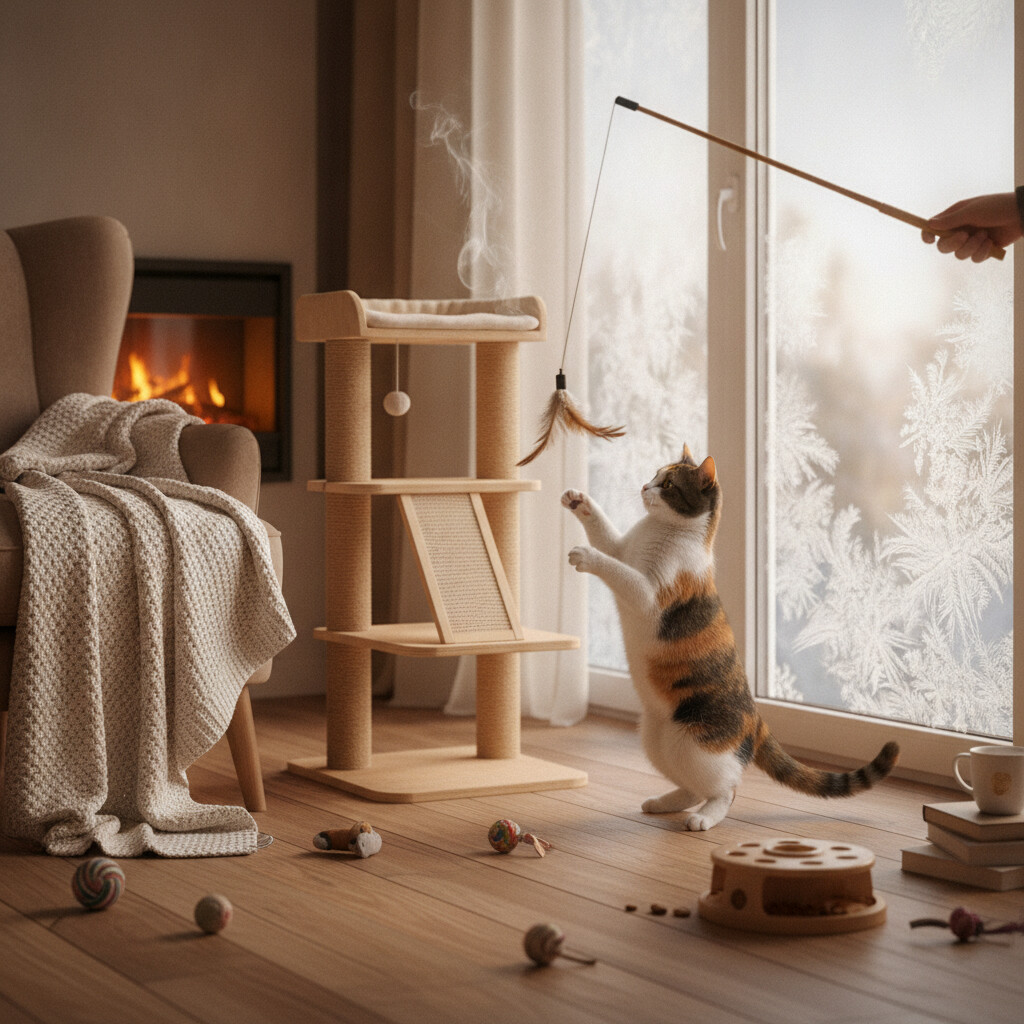
Shorter days and cold weather don’t just make things harder for you — they change what your indoor cat’s day looks like too. Less daylight through the windows, fewer birds and squirrels to watch, and less time you spend near home if you work outside it all add up to a duller stretch for a cat who relies on stimulation you might not realize you’re providing the rest of the year. The fix isn’t complicated: more structured play, more reasons to use their senses, and a bit more attention to the parts of the house that get colder and darker.
Why Winter Actually Changes an Indoor Cat’s Routine
Cats are crepuscular — most active around dawn and dusk — and shortened daylight hours shift when and how much natural light-driven activity they get. Less time with windows open also means less of the sound, scent, and visual stimulation that outdoor-facing windows normally provide for free. The AAFP and ISFM’s joint feline environmental needs guidelines (published in the Journal of Feline Medicine and Surgery) identify environmental variety and the ability to exhibit species-typical behavior — hunting, climbing, scratching, hiding — as core welfare needs, not luxuries. Winter is when a lot of that variety quietly disappears if you don’t replace it.
The practical result: cats often sleep more, play less, and in some households, gain weight or get more irritable during the winter months. None of that is unavoidable.
Replace the Window Time You’re Losing
If your cat spends a lot of the year parked at a window watching the yard, winter is when that entertainment thins out. A bird feeder positioned outside a favorite window (out of any predator’s reach) gives them something to track even when there’s less general outdoor activity. Rotating which window perch gets used — moving a cat bed to whichever window still gets afternoon sun — keeps things from going stale.
If your cat has outdoor access in warmer months and that access shrinks in winter, some owners bridge the gap with a heated, enclosed catio space they can still use safely in cold weather; for cats who free-roam a yard the rest of the year, a secure fence-top system like Oscillot’s is one way people keep that access available even when conditions outside are less forgiving.
Structured Play Matters More When Days Are Short
Two 10–15 minute play sessions a day — one closer to when you get up, one in the evening — do more for an indoor cat’s activity levels in winter than leaving toys scattered around and hoping. Pairing sessions with the extra vertical space a cat tree or shelf provides gives them somewhere to direct that energy between sessions, too. Wand toys that mimic prey movement (darting, pausing, retreating) work better than toys that just move in a straight line, because they trigger the actual hunting sequence: stalk, chase, pounce, catch.
End every session by letting your cat “catch” something — a toy, a treat — rather than stopping mid-chase. Cats that don’t get a resolution to the hunting sequence can become more frustrated, not less, which sometimes shows up as pouncing on ankles or knocking things over.
Use Food as Enrichment, Not Just Fuel
Puzzle feeders and scattered treat-hunting slow down eating and add mental work to a meal that would otherwise take ninety seconds. This matters more in winter if your cat’s overall activity has dropped — the same portion of food eaten more slowly, with more effort involved, helps offset the extra calories a less active cat isn’t burning off elsewhere.
Rotate between two or three feeding-enrichment methods rather than relying on one puzzle feeder daily; cats habituate to a single device faster than owners expect, and the enrichment value drops once it becomes routine rather than a small challenge.
Watch for Signs Winter Is Wearing on Your Cat
A cat that’s sleeping noticeably more than their usual baseline, grooming excessively, or becoming withdrawn isn’t necessarily “just adjusting to winter.” Those are also early signs of pain, thyroid changes, or stress that happen to show up more visibly when a cat’s other stimulation drops away and you’re paying closer attention. If increased sleep or appetite changes last more than a couple of weeks, or come with any vomiting, weight change, or litter box changes, it’s worth a vet visit rather than assuming it’s seasonal.
Keep an Eye on Cold and Holiday Hazards
Space heaters, fireplaces, and holiday candles introduce burn and fire risks that don’t exist most of the year — keep cats away from unattended flames and check that heating equipment is cat-proofed against curious paws. If your cat does get occasional supervised time on a porch or balcony in winter, check the surface temperature isn’t dangerously cold for paw pads on frosty mornings.
The Practical Takeaway
Indoor cats don’t need less from you in winter — they need the stimulation that disappeared with the shorter days replaced somewhere else. Two real play sessions a day, food-based enrichment that makes them work a little, and a refreshed window setup cover most of what’s lost. If your cat still seems off after a few weeks of trying that, treat it as a signal to check in with your vet rather than a season to just wait out.