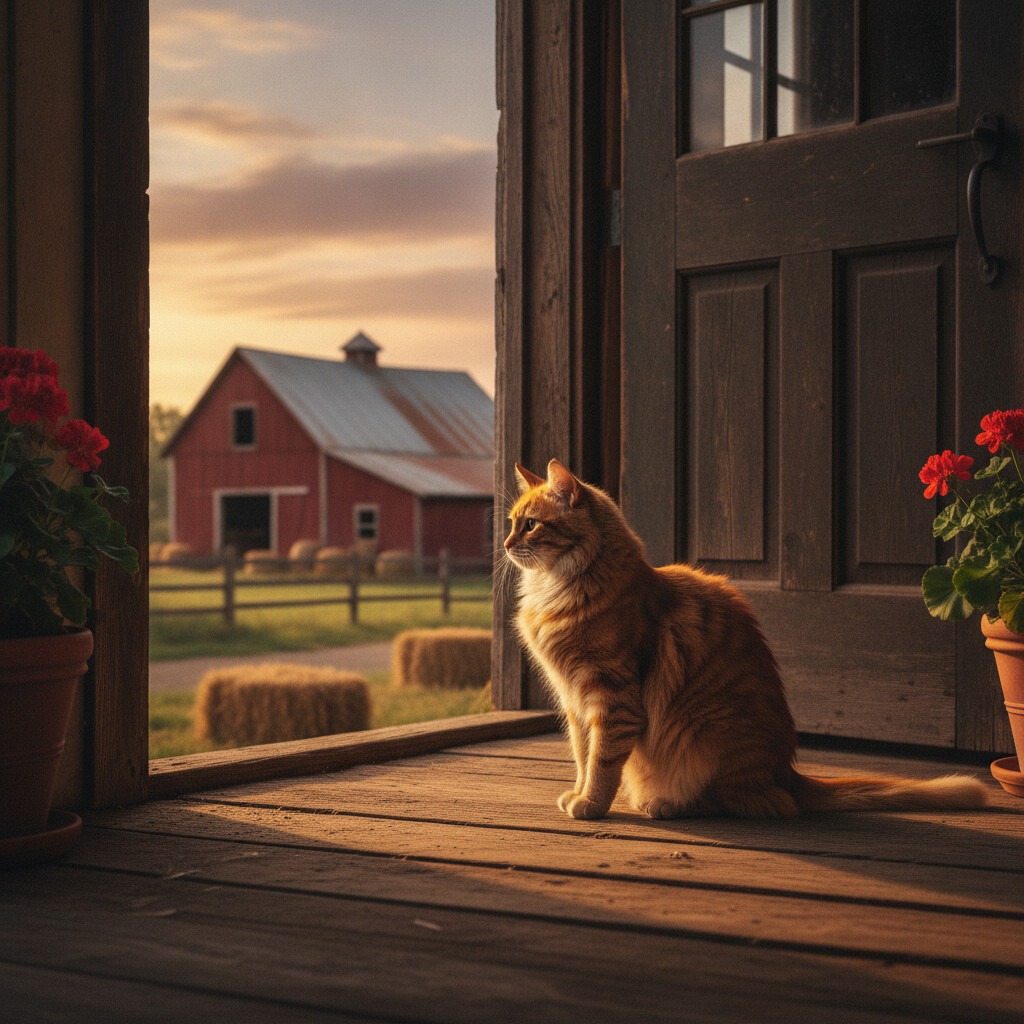
Marge had lived in the hay barn for six years before she ever set a paw inside our house. She showed up as a half-grown stray the first winter we owned the property, and the deal was simple and unspoken: she kept the mouse population down, we kept a bowl of kibble by the tack room door, and neither of us expected anything more from the arrangement. Barn cats aren’t pets in the traditional sense — they’re colleagues. Until, six years in, Marge decided she wanted to renegotiate.
The First Sign Something Had Changed
It started small. Marge began meeting me at the barn door instead of waiting by the feed bowl. Then she started following me back toward the house — not the whole way, just a little further each week, like she was testing how far the invitation extended. By late fall she was sitting on the porch steps in the evenings, and by the time the first hard frost hit, she was sitting against the door, which a barn cat with any self-respect does not do unless something has shifted.
Cat behaviorists describe this kind of gradual approach as a cat “testing the threshold” of a relationship — a slow accumulation of small, low-risk interactions that let the cat control the pace. It’s the same pattern seen in feral and semi-feral cats who eventually approach humans for food or warmth: proximity increases only as long as nothing bad happens. Nothing bad had ever happened with Marge, which is probably why, at six years old, she’d apparently decided the risk calculus had changed.
We almost missed it, honestly. It’s easy to read a barn cat sitting near the door as “wanting food” rather than “wanting in,” because for six years that’s exactly what it had meant.
Why We Didn’t Just Let Her In Right Away
The instinct is to fling the door open the first cold night and call it done. We didn’t, for two reasons.
First, an outdoor cat that’s never had a real veterinary exam is an unknown quantity, however healthy they look. Barn cats are exposed to other strays, wildlife, and parasites in ways indoor cats aren’t, and conditions like fleas, ear mites, intestinal worms, ringworm, or feline leukemia virus (FeLV) can be present with no obvious outward signs. The American Association of Feline Practitioners recommends testing any cat of unknown origin for FIV/FeLV and getting a full wellness exam before treating them as a resident household cat, especially if there’s any chance of exposure to other animals inside. If you’re starting that search from scratch, here’s what to actually look for in a good vet.
Second, six years of living entirely outdoors doesn’t just disappear because a door opens. Litter boxes, being handled, sleeping indoors, other pets, the sound of a dishwasher — all of it was going to be new, and rushing it risked undoing the trust that took six years to build in the first place.
The Vet Visit Told Us More Than We Expected
Marge tested negative for FIV and FeLV, which was a relief, but she wasn’t in the shape her thick coat suggested. She had a moderate flea burden, mild dental disease consistent with never having her teeth checked, and was about two pounds underweight for her frame — not starving, but running lean the way a lot of working barn cats do. None of it was an emergency. All of it was easier to treat now that she was willing to be handled and transported in a carrier, which itself was a small miracle six months earlier.
The vet’s advice was to treat her exactly like a new-to-household adult cat with unknown history, not like “the barn cat, but indoors now.” That meant a parasite treatment plan, a dental recheck in a few months, and a slow reintroduction of regular meals to get her back to a healthy weight without overfeeding a cat whose stomach had adjusted to sporadic feeding.
Making the Actual Transition Indoors
We didn’t move her in all at once. She got one room first — a spare bedroom with a litter box, food, water, a bed, and a window — for about two weeks, the same slow-introduction approach we’d have used for any new cat settling into a household. Litter training an adult cat who has never used one sounds harder than it is: most cats take to a clean box with unscented litter almost immediately, because digging and burying is instinctive, not taught. Marge used hers on day one.
The bigger adjustment was noise and closed spaces. She startled at the refrigerator compressor kicking on for a week straight. She slept in a closet for the first several nights. We didn’t force anything — we let her retreat when she needed to and just kept her world small and predictable until she expanded it herself.
What Six Months Indoors Looks Like Now
Marge sleeps on the bed now, which is the detail that still doesn’t feel real. She still goes through phases of wanting to sit by the window and watch the barn, and we don’t read anything sad into that — it was her territory for six years, and curiosity about it hasn’t hurt her. She’s gained the weight back, her coat has actual shine to it instead of the flat, slightly greasy look outdoor cats get, and her dental recheck came back clean.
The barn still has a cat — a younger one who showed up the spring after Marge moved in, in what felt like an almost too-tidy changing of the guard. We’re doing the same slow, no-pressure relationship with him, on his own timeline, with zero expectation he’ll ever choose differently. That was always the deal with Marge, too. She’s just the one who decided to renegotiate.
If you’re in a similar spot — a barn cat, a colony cat, or a long-term outdoor stray who’s started showing up at the door more than usual — the short version is: get them checked by a vet before anything else, don’t rush the indoor transition, and let them set the pace. Cats who’ve spent years managing their own risk assessment outdoors are good at it. Trust that they know what they’re doing when they finally decide to come in.