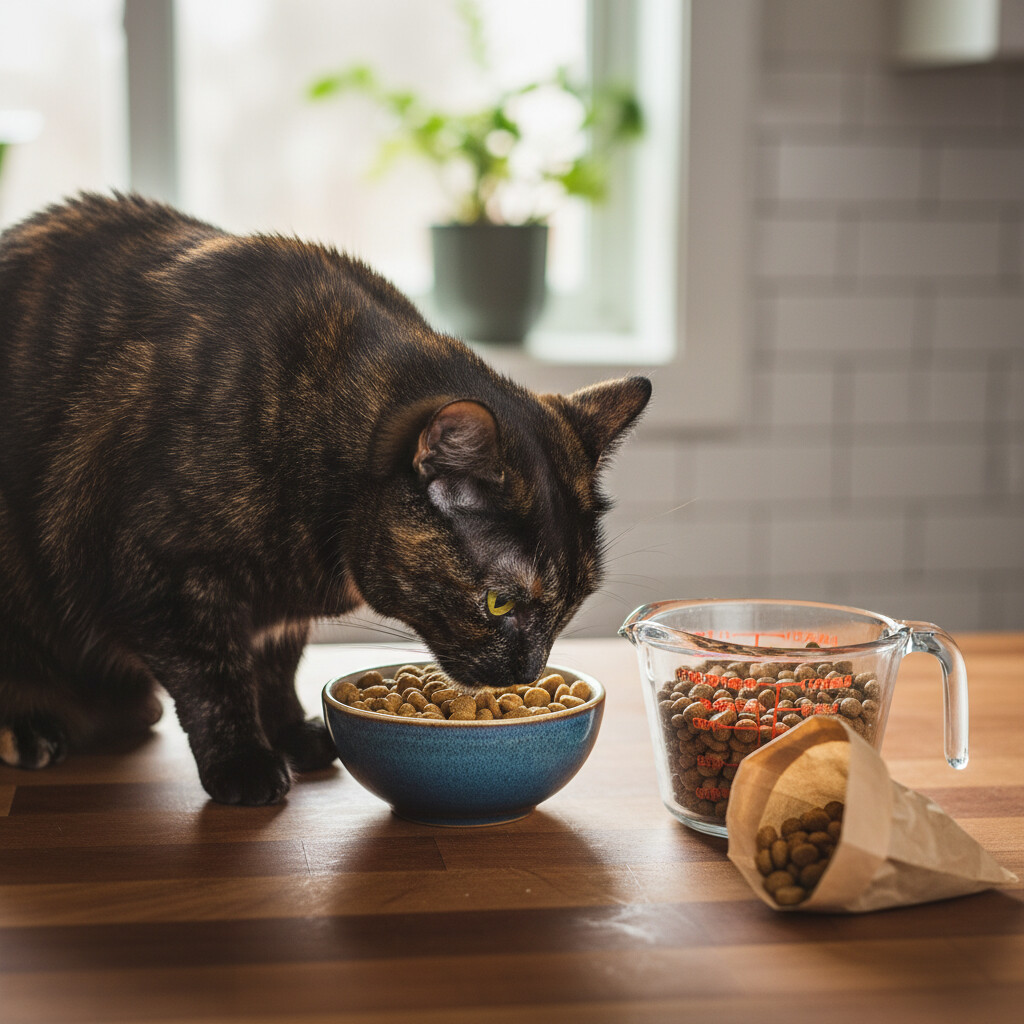
Most cat owners are overfeeding their cats. The average indoor cat needs between 180 and 300 calories a day — and most food packaging is designed to make you feed more than that. Here’s how to work out exactly what your cat needs.
The short answer: daily calorie needs depend on body weight, activity level, and life stage. A neutered adult indoor cat needs roughly 20 calories per pound of ideal body weight per day. For a 10-pound cat, that’s around 200 calories — which is probably less food than you’re currently giving.
How to Calculate Your Cat’s Daily Calories
The formula used by veterinary nutritionists is the Resting Energy Requirement (RER), adjusted for life stage:
Step 1 — Calculate RER:
RER (kcal/day) = 70 × (body weight in kg)^0.75
For a 4.5 kg (10 lb) cat: 70 × (4.5)^0.75 ≈ 216 kcal/day
Step 2 — Apply a multiplier for your cat’s situation:
| Life stage / condition | Multiplier | Daily kcal (10 lb cat) |
|---|---|---|
| Neutered adult indoor cat | × 1.2 | ~260 kcal |
| Intact adult | × 1.4 | ~300 kcal |
| Active young adult | × 1.4–1.6 | ~300–345 kcal |
| Senior cat (7+) | × 1.1–1.3 | ~240–280 kcal |
| Weight loss (overweight cat) | × 1.0 (RER only) | ~216 kcal |
| Kitten (under 1 year) | × 2.0–3.0 | ~430–650 kcal |
So a typical neutered 10 lb indoor cat needs roughly 260 calories per day. Most are getting 300–350.
Why Packaging Feeding Guides Aren’t Reliable
The feeding guidelines on commercial cat food bags are set by manufacturers — and they tend to skew generous, because overestimating portion sizes sells more food.
The more reliable approach: calculate your cat’s daily calorie target using the formula above, then divide by the calorie content listed on the packaging. Dry food typically shows kcal per cup; wet food shows kcal per can or per 100g.
Worked example:
- Target: 260 kcal/day
- Dry food calorie density: 370 kcal/cup
- Daily portion: 260 ÷ 370 = 0.7 cups
If you’ve been free-feeding or pouring roughly a cup without measuring, that comparison may be confronting.
Wet Food vs. Dry Food: Calorie Density Is Very Different
One of the most common feeding errors is switching between wet and dry food without adjusting portions. The calorie density is dramatically different:
- Dry food: Typically 300–450 kcal per cup
- Wet food: Typically 25–80 kcal per 3 oz serving (varies significantly by brand and formula)
“One meal” of dry food and “one meal” of wet food are not interchangeable portions. If you’re switching food types, recalculate based on the actual kcal density of the new product. The Wet vs. Dry Cat Food: The Honest Comparison article covers the nutritional trade-offs in detail.
How to Tell If Your Portions Are Right
The formula gives you a starting point. Your cat’s body tells you whether it’s working.
What a healthy weight looks like:
- You can feel the ribs easily when you run your hands along the sides, without pressing hard — but you can’t see them
- There’s a visible waist when viewed from above
- A gentle abdominal tuck visible from the side
- No “fat pad” hanging under the belly (common in overweight cats)
Weigh your cat monthly — a kitchen scale plus a cardboard box works fine. If weight is trending up over 4–6 weeks of measured meals, reduce by 10% and reassess. If it’s dropping faster than expected, increase slightly.
If you’re not sure where your cat currently sits, Is Your Cat Overweight? Signs to Look For and How to Help has a full body condition scoring guide with photos.
Common Feeding Mistakes to Avoid
Free-feeding dry food. Leaving kibble out all day works fine for cats who self-regulate — and many don’t. If your cat is gaining weight, switch to twice-daily measured meals.
Ignoring treat calories. Treats count toward the daily total. Most vet guidelines suggest treats shouldn’t exceed 10% of daily calories. At 2–5 kcal per treat, that adds up faster than it seems.
Measuring by volume instead of weight. “Half a cup” varies with how tightly kibble packs. A cheap kitchen scale removes the guesswork.
Not adjusting as your cat ages. A one-year-old active cat needs significantly more calories than the same cat at ten. Reassess at least once a year, or any time there’s a noticeable weight change.
Changing food without recalculating. Different brands have dramatically different calorie densities. Always check the kcal per cup or per can when you switch, and recalculate the portion.
When to Talk to a Vet About Feeding
General formula guidance gets most cats to a healthy weight. These situations warrant a proper consultation:
- Weight loss despite adequate food intake — unexplained weight loss in cats can signal hyperthyroidism, chronic kidney disease, diabetes, or IBD, all of which need diagnosis, not just more food
- Refusing food for more than 24–48 hours — cats who stop eating can develop hepatic lipidosis (fatty liver disease) quickly; this is a genuine emergency
- Diagnosed health conditions — cats with kidney disease, diabetes, or IBD often have specific nutritional requirements that are part of their treatment plan. A board-certified veterinary nutritionist (DACVN) is the right resource for these cases
- You want to feed raw or homemade — home-prepared diets carry real risk of nutritional deficiencies if not properly formulated; a consultation with a veterinary nutritionist before you start is worth it
For most healthy cats, the formula above combined with monthly weigh-ins is all you need. If the scale is moving in the wrong direction after 4–6 weeks of measured meals, that’s when to get a vet’s eyes on it.