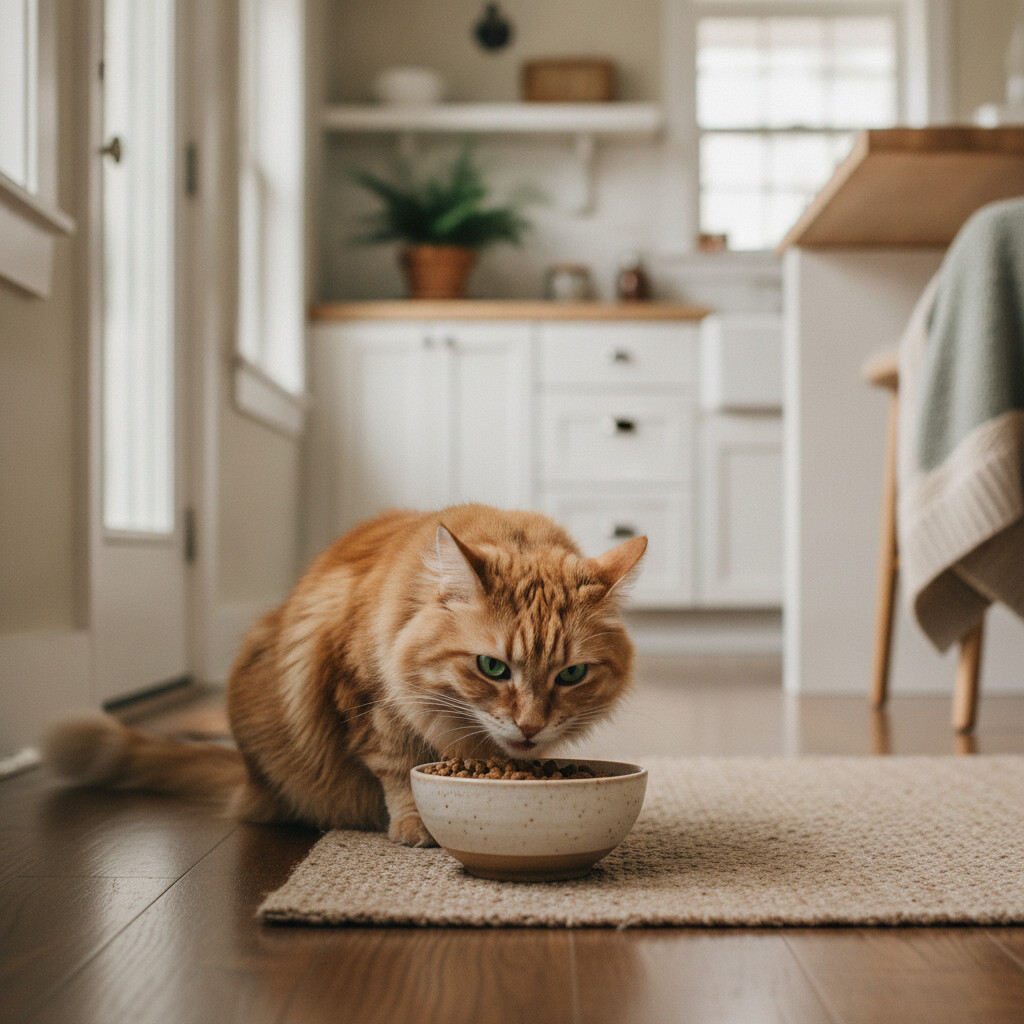
Most cats do better on scheduled meals than free-fed kibble left out all day — but the honest answer depends on your cat, your household, and how much willpower your cat has around a full bowl (usually: none). Here’s how to figure out which approach actually fits your situation, and how to switch without a hunger-strike protest.
What Free-Feeding Actually Means (and Why It Became the Default)
Free-feeding — leaving a bowl of dry food out all day for your cat to graze on whenever they want — became the norm mostly because it’s convenient, not because it’s optimal. Dry kibble doesn’t spoil sitting out, so it became the path of least resistance for a lot of households.
It does mirror something real about cat biology: in the wild, cats are natural grazers. A feral cat might make 10 to 20 small kills a day, eating in short bursts rather than two big meals. So the idea that cats “should” nibble throughout the day isn’t wrong in principle.
The problem is that a bowl of dry kibble isn’t a mouse. It doesn’t run out after your cat catches it, and it’s usually far more calorie-dense than what a cat would burn catching real prey. Free access to unlimited food, without unlimited exercise to match, is one of the more consistently cited contributors to feline obesity in veterinary nutrition literature — and obesity in cats is linked to a long list of downstream problems, from diabetes to joint disease.
The Case for Scheduled Meals
Scheduled, portion-controlled meals — typically two to four times a day — give you something free-feeding doesn’t: control. You know exactly how much your cat is eating, which makes it much easier to catch problems early. A cat who suddenly skips a scheduled meal is an obvious signal. A cat who’s been quietly eating less from an always-full bowl can go unnoticed for days, because the bowl still has food in it.
Portion control also makes weight management dramatically easier. The American Association of Feline Practitioners (AAFP) has flagged feline obesity as one of the most common preventable health issues in cats, and portion-controlled feeding is a core part of managing it. If you’ve ever tried to get weight off a free-fed cat, you already know how hard it is to “just feed a bit less” of a food that’s always available.
There’s a behavioral upside too. Scheduled feeding times can reinforce a predictable daily rhythm, which many cats find genuinely reassuring — cats are creatures of routine, and mealtime becomes a low-stakes anchor point in their day.
What About Multi-Cat Households?
This is where free-feeding tends to fall apart fastest. With more than one cat sharing a bowl (or even separate bowls in the same room), it’s nearly impossible to know who’s actually eating how much. A more assertive cat can out-compete a shier one, or a cat with early kidney disease that needs more calories can get muscled out of the bowl by a healthy housemate who doesn’t need them.
Scheduled, separated meals solve this directly — you can feed cats in different rooms or at different stations and actually track individual intake. If you’re managing a cat with a health condition that requires a special diet, this isn’t optional; it’s the only way to make sure the right cat eats the right food.
Making the Switch Without a Fight
If your cat has been free-fed for years, don’t go cold turkey on the schedule. Cats protest change loudly, and a sudden switch from all-day access to two meals can trigger begging, counter-surfing, or 5 a.m. wake-up calls.
A few things that help:
- Transition gradually. Reduce the amount left out over a week or two while introducing set mealtimes, rather than switching overnight.
- Use a slow-feeder or puzzle feeder for the scheduled portions. This slows down cats who’ve gotten used to fast, constant access and adds mental stimulation back into the meal.
- Feed close to when your cat naturally wakes up and winds down — early morning and early evening tend to line up with a cat’s natural activity peaks, which can reduce nuisance begging at other times.
- Don’t give in to protest meowing outside of mealtime. It’s the fastest way to teach a cat that noise gets food, which makes the transition longer and harder than it needs to be.
If you’re working out exactly how much to put in the bowl at each scheduled meal, our guide on how much to feed your cat based on weight walks through the calorie math.
When to Loop In Your Vet
Changing how a cat eats is generally low-risk, but a few situations are worth a vet conversation first:
- Your cat has diabetes, kidney disease, or another condition where feeding timing affects medication schedules.
- Your cat is already overweight — a vet can help you set a target calorie range rather than guessing.
- Any sudden, unexplained change in appetite (eating much more or much less than usual) deserves a check-up before you assume it’s just a feeding-style issue. Appetite changes are one of the more reliable early signals of illness in cats, precisely because cats are good at hiding pain and discomfort otherwise.
If you’re not sure whether your cat’s current weight is a concern, this guide on the signs of an overweight cat is a good place to start before you change anything about feeding.
The Practical Takeaway
There’s no universal rule that free-feeding is bad or scheduled feeding is always right — but for the average household, scheduled meals give you more control, make weight problems easier to catch and manage, and work far better once you have more than one cat. If your cat is lean, healthy, and self-regulates well around a full bowl, free-feeding isn’t a crisis. If you’ve never been quite sure how much your cat actually eats in a day, that uncertainty alone is a good reason to switch.