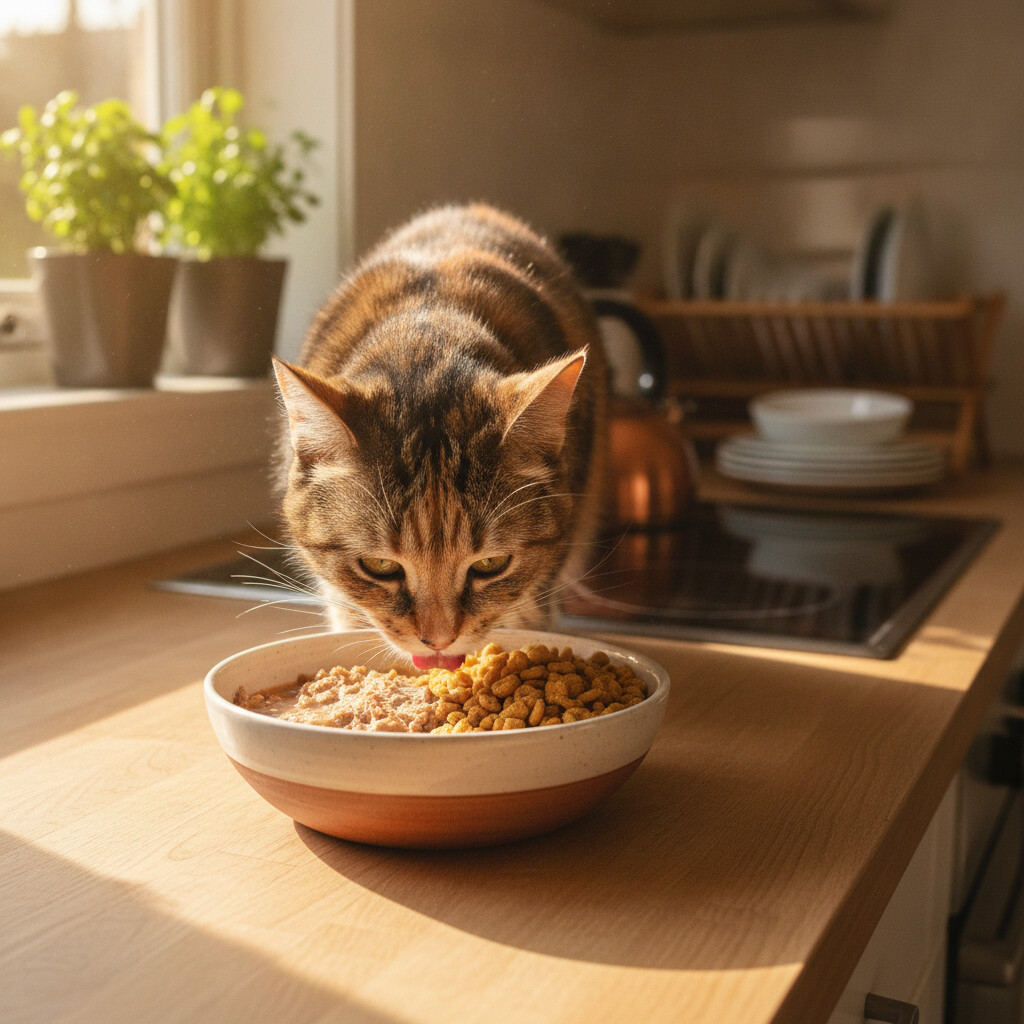
Yes — mixing wet and dry cat food is safe for the vast majority of healthy cats, as long as both foods are labeled “complete and balanced” and you’re accounting for the total calories from both. The bigger question isn’t whether you’re allowed to mix them. It’s whether you’re doing the math on how much you’re actually feeding once you combine two calorie-dense foods in one bowl.
Why mixing isn’t a nutritional problem
Under AAFCO (Association of American Feed Control Officials) standards, any cat food labeled “complete and balanced for [life stage]” has to meet the same minimum nutrient profile regardless of whether it comes in a can or a bag. A complete-and-balanced wet food and a complete-and-balanced dry food are each formulated to cover a cat’s needs on their own — which means combining two foods that individually meet the standard doesn’t create some kind of nutritional gap. There’s no rule, vet consensus, or research suggesting a cat’s digestive system needs foods to be kept “pure” by format.
The WSAVA (World Small Animal Veterinary Association) Global Nutrition Guidelines, which most veterinary nutritionists use as a reference point, focus on total diet quality and appropriateness — not on whether that diet comes from one source or two. If anything, offering both formats gives you more flexibility to manage weight, hydration, and palatability than committing to just one.
The part people actually get wrong: portion math
Here’s where mixed feeding goes sideways. Dry food is calorically dense — often 300-400 calories per cup — while wet food is mostly water and typically runs 70-100 calories per small can. If you’re free-feeding a bowl of kibble and adding a full can of wet food on top “as a treat,” you’re very likely overshooting your cat’s daily needs, and that’s how a lot of mixed-feeding cats end up overweight without an obvious single culprit.
The fix isn’t to stop mixing. It’s to treat the two foods as one combined ration instead of two separate ones. If your cat’s daily target is roughly 200 calories, and you want to feed both formats, you split that 200 calories across wet and dry rather than feeding a full ration of each. Our calorie guide by weight walks through how to calculate a cat’s actual daily needs — do that math first, then decide how to split it between formats.
Where mixing actually helps
Hydration. Dry food runs about 6-10% moisture; wet food runs 70-80%. Cats evolved from desert-dwelling ancestors and generally have a weak thirst drive relative to their fluid needs, meaning many cats on all-dry diets take in less total water than cats getting at least some wet food. For cats prone to urinary issues or mild kidney concerns, adding wet food into the mix — even without eliminating dry entirely — can meaningfully increase total water intake in a way that plain water bowls often don’t fully replace.
Palatability and appetite. Some cats go through phases of food boredom or reduced appetite, particularly seniors or cats recovering from illness. Offering both formats gives you a way to keep intake up without switching foods entirely, which matters because appetite loss in cats can turn serious quickly (more on that below).
Feeding logistics. If you’re gone longer than a wet-food meal should sit out, dry food left down as a base with a wet-food meal at times you’re home is a reasonable middle ground — better than leaving wet food out for hours in warm weather, where it can spoil and grow bacteria within just a couple of hours at room temperature.
When mixing is not the right call
If your cat is on a prescription or therapeutic diet — renal support, urinary formulas, diabetic management, hydrolyzed protein for food allergies — these diets are formulated to be the cat’s entire intake, with the therapeutic effect depending on consistency. Casually mixing in regular wet or dry food alongside a prescription diet can undercut the reason it was prescribed in the first place. If your cat has a diagnosed condition and you want to add variety or improve hydration through mixed feeding, loop in your vet first — this is one of the few genuine exceptions to “mixing is fine.”
It’s also worth checking that both foods you’re mixing are actually labeled complete and balanced for your cat’s life stage. Some wet food “toppers” and treat-style pouches are explicitly not intended as a full meal, and building a chunk of daily calories around one of those, rather than a genuine wet-food meal, is where gaps can actually show up.
When to check in with your vet
Mixed feeding itself rarely needs veterinary sign-off for a healthy adult cat. But loop your vet in if: your cat is on any prescription diet, your cat has unexplained weight gain or loss after switching to a mixed routine, you’re feeding a kitten or senior cat and aren’t sure how life-stage formulas interact, or your cat is drinking noticeably less water than you’d expect even with wet food added — that’s worth ruling out alongside a physical exam rather than assuming the food mix alone will fix it.
The practical takeaway
Mixing wet and dry food is safe, and for a lot of cats it’s genuinely the best of both — better hydration than dry alone, easier portion logistics than wet alone. The one job it puts on you is doing the calorie math for the combined diet instead of treating each format as a separate, uncounted ration. Get that part right, and there’s no nutritional reason to pick a side. For a deeper look at how the two formats compare on their own merits, our wet vs. dry comparison and guide to free-feeding vs. scheduled meals are good next reads.