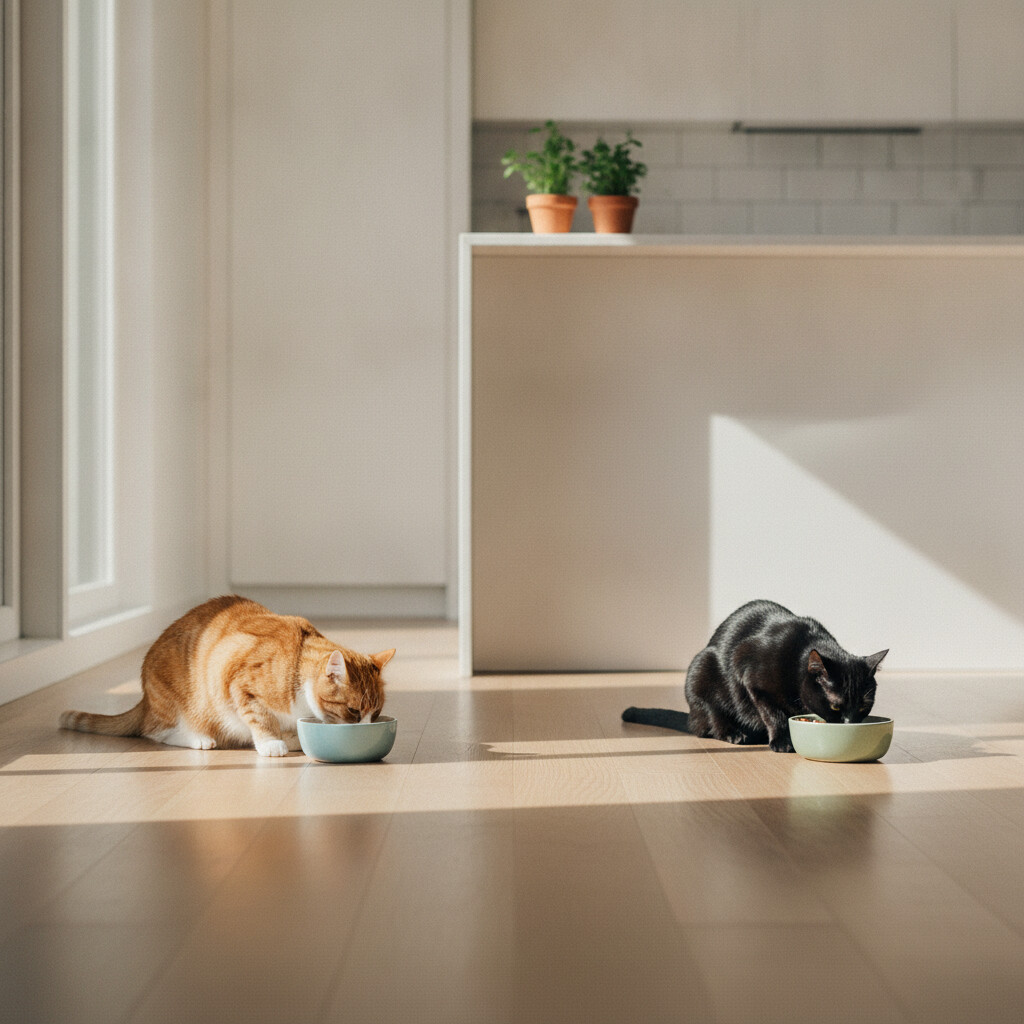
If you have more than one cat and even one of them needs a different diet — a senior formula, a prescription kidney food, a weight-management plan — free-feeding from shared bowls stops working immediately. The fix isn’t a smarter bowl. It’s separating when and where cats eat, not just what’s in the bowl. Here’s how to actually make it stick.
Why Shared Bowls Break Down the Moment Diets Differ
Cats are fast, motivated, and not remotely interested in your meal plan. A prescription renal diet cat will happily eat a housemate’s regular kibble if it’s within reach, and a cat on a weight-loss plan will out-hustle a slower senior cat for the good stuff every time. This isn’t a training problem — it’s a structural one. According to feeding guidance from the World Small Animal Veterinary Association (WSAVA) Global Nutrition Committee, multi-cat households with different nutritional needs require physical separation during feeding, not just different food in the same room.
The stakes vary by situation. If it’s just two adult cats on slightly different maintenance formulas, a little cross-eating is usually low-risk. If one cat is on a prescription diet for kidney disease, diabetes, or a food allergy, cross-eating can actively undermine treatment — which is the scenario this guide focuses on most.
Feeding Station Strategies That Actually Stop the Swap
Separate rooms or spaces, not just separate bowls
The simplest fix is also the most effective: feed cats in different rooms, or in the same room but far enough apart with a visual barrier (a piece of furniture, a baby gate, a closed door) that neither cat can see or reach the other’s bowl. Close the doors during mealtimes and open them once both cats have finished and bowls are cleared.
Microchip or RFID feeders for tighter control
For households where separate rooms aren’t practical, microchip-activated feeders (which open only for the chip or collar tag registered to them) are worth the investment. They’re not foolproof — a determined cat can sometimes nose in behind a housemate before the lid closes — but they remove most of the guesswork, especially for overnight or unsupervised feeding.
Timed, supervised meals instead of free-feeding
Free-feeding (food available all day) is often the actual root problem in multi-diet households, independent of whose food is whose. Switching to two or three scheduled, supervised meals a day makes it far easier to control who eats what, and lets you physically stand between cats during the vulnerable few minutes when diets could get crossed. It also gives you a daily read on each cat’s appetite, which is one of the simplest early-warning signs of a health problem.
Elevate or separate by height
For cats without mobility issues, feeding one cat on a stable elevated surface (a cat tree platform, a windowsill, a sturdy shelf) while the other eats on the floor adds a physical barrier that discourages food-stealing without needing a closed door. This doesn’t work for senior cats with joint pain or cats on weight-restricted diets who shouldn’t be jumping for food — for those, stick to spatial separation instead.
When You’re Managing a Prescription or Medical Diet
If one cat is on a therapeutic diet — for chronic kidney disease, diabetes, urinary crystals, or a diagnosed food allergy — the stakes of cross-eating go up considerably. A renal diet’s entire value comes from controlled protein and phosphorus levels; a few stolen bites of regular food here and there won’t cause acute harm, but a pattern of it can blunt the whole point of the prescription. The same logic applies to weight-loss plans: a cat quietly finishing a housemate’s bowl can erase a week of calorie control without you noticing.
In these cases, treat feeding separation as non-negotiable rather than a nice-to-have. Talk to your vet about which feeding method fits your specific cats — some clinics can recommend microchip feeder models they’ve seen work well, and some will suggest short-term confinement feeding (a spare bathroom or crate at mealtimes) while you get a new routine established.
Common Mistakes That Undo a Good Setup
- Leaving bowls down after a meal. Pick up all bowls once cats are done, even if one finished before the other — a half-empty bowl left out is an invitation.
- Assuming a food-motivated cat will “just know” which bowl is theirs. They won’t. Physical separation, not trust, is what works.
- Switching diets without a transition period. Whenever you move a cat to a new food — prescription or not — do it gradually over 7 to 10 days, mixing increasing ratios of new food into the old, to avoid digestive upset.
- Giving up after one failed attempt. Most cats adjust to a new feeding routine within one to two weeks. The first few days of separated feeding are often the loudest and most chaotic — that’s normal, not a sign it isn’t working.
When to Loop In Your Vet
Talk to your vet if a cat on a prescription diet is losing weight, gaining weight unexpectedly, or if you suspect they’ve been eating a housemate’s food consistently — these can all signal the diet isn’t being followed as prescribed, even with the best intentions at home. Sudden appetite loss, refusal to eat for more than 24 hours, or vomiting after meals in any cat, prescription diet or not, also warrants a call rather than a wait-and-see approach.
The Takeaway
Multi-cat households with different dietary needs aren’t solved by better bowls — they’re solved by better logistics: separated space, a schedule instead of free access, and a plan for the specific risk level of each cat’s diet. If weight management is part of what’s driving the different diets in your house, it’s worth reading up on how to tell if your cat is overweight and on what prescription cat food actually does so you know what you’re protecting when you separate the bowls. And if free-feeding has been part of the problem, scheduled meals versus free-feeding is a good next read.
It takes about two weeks to build a new feeding routine that sticks. After that, it stops feeling like a project and just becomes how your household eats.