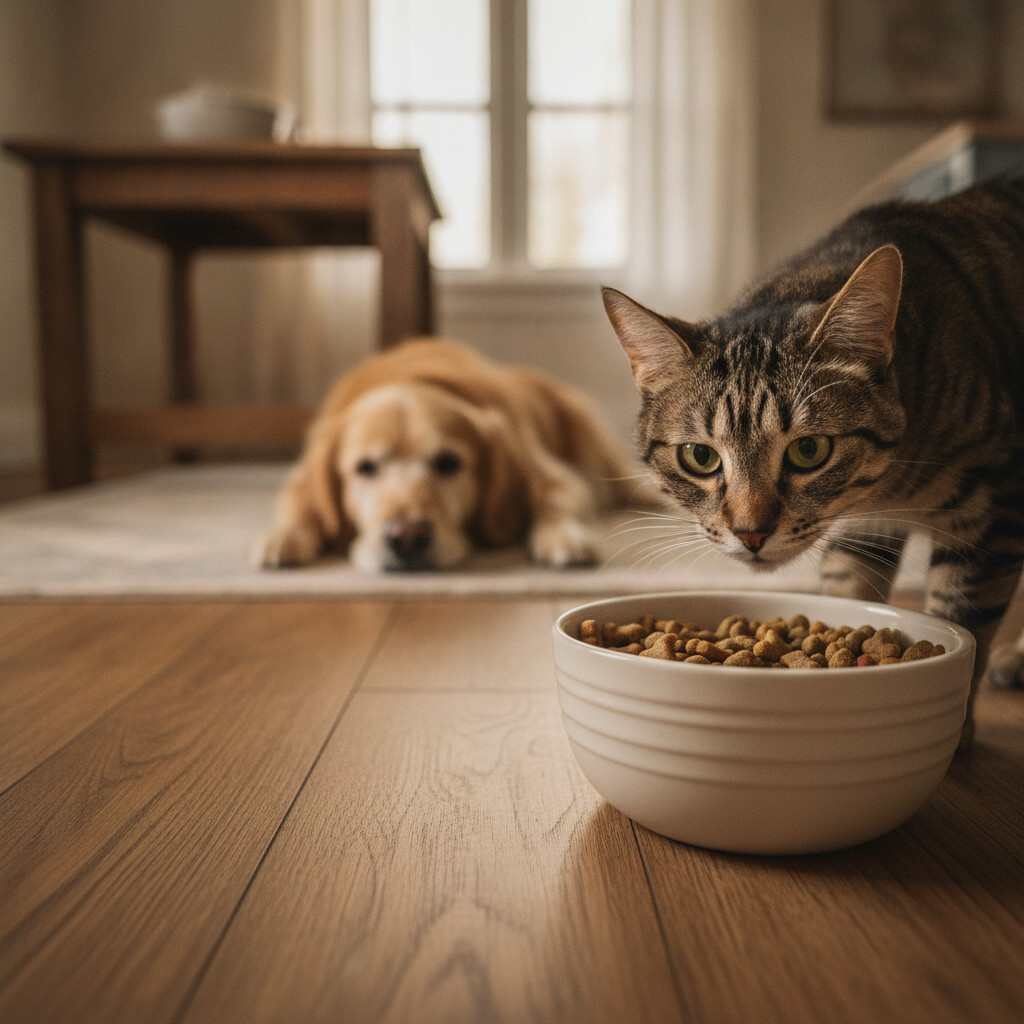
A cat who eats some dog food will almost certainly be fine. Dog food isn’t toxic to cats. The trouble starts when it turns into a regular part of their diet, because it isn’t built for a cat’s body and leaves out several nutrients cats can’t do without. Here’s what’s actually missing, how long it takes to matter, and how to keep each animal eating from its own bowl.
The Short Answer
- One raid on the dog bowl: Not an emergency. At worst you might see some vomiting or loose stool if the food is new to them.
- Dog food now and then over a few weeks: Probably harmless, but it’s time to stop the habit before it becomes the cat’s main meal.
- Dog food as the main diet for weeks or months: That’s a real problem. Book a vet visit and switch back to a complete cat food.
The reason comes down to biology. Dogs are omnivores in practice. They can make several nutrients from other building blocks in their diet. Cats are obligate carnivores, which means they’ve lost a lot of that ability over evolution and have to get those nutrients ready-made from animal tissue.
What’s Missing From Dog Food (for a Cat)
In the US, pet food is formulated against the AAFCO (Association of American Feed Control Officials) nutrient profiles, and the cat profile and dog profile are different documents for good reason. A dog food labeled “complete and balanced” has met the dog standard. That tells you nothing about whether it meets the cat one. If you want to check your own bags, our guide to reading a cat food label shows where that statement sits.
These are the gaps that matter most:
Taurine. This is the big one. Cats can’t make enough taurine on their own, so AAFCO sets a minimum for cat food. There’s no taurine requirement for dog food at all, though some brands add it. Long-term taurine deficiency in cats causes dilated cardiomyopathy, a serious heart muscle disease, and degeneration of the retina that can end in blindness. The heart link was proven in a landmark 1987 study in Science by Pion and colleagues. After that, manufacturers raised taurine levels and feline dilated cardiomyopathy became much rarer. We cover the details in Taurine Deficiency in Cats: Why It’s a Big Deal.
Protein. AAFCO’s minimum for adult cat food is about 26% protein on a dry-matter basis. For adult dog food it’s 18%. Cats burn protein for energy all the time and can’t easily turn that down when protein in the diet is low. If they don’t get enough, they break down their own muscle.
Arachidonic acid. This is an omega-6 fatty acid. Dogs can make it from vegetable oils, but cats can’t do that efficiently, so it has to come from animal fat. Without enough of it, cats can end up with skin and coat problems, poor wound healing, and reproductive problems.
Vitamin A. Dogs can turn beta-carotene from plants into vitamin A. Cats can’t. They need preformed vitamin A from animal sources such as liver, and dog food may not supply enough.
Niacin (vitamin B3). Most mammals can make niacin from the amino acid tryptophan. Cats do this very poorly, so their niacin requirement is several times higher than a dog’s.
Overall balance. Dog foods tend to be higher in carbohydrate and lower in fat than cat foods. That isn’t dangerous in a single meal, but as a steady diet it’s a poor match for how cats get their energy.
How Long Before It Causes Problems?
There’s no exact number, and it depends on the dog food and what else the cat is eating. Taurine deficiency usually builds up slowly, over months rather than days, because cats have some reserves. A cat who eats mostly cat food and steals dog kibble on the side is in a very different position from a cat whose only food is the dog’s bowl.
The tricky part is that early deficiency signs are subtle or invisible. Heart changes from low taurine can progress quietly before you see any symptoms. That’s why sustained dog-food eating calls for a vet check even if your cat seems perfectly well.
What About Dogs Eating Cat Food?
That’s the more common household problem, and it’s the opposite issue. Cat food is richer in protein and fat than most dogs need. An occasional stolen bowl usually just causes an upset stomach. Regular cat-food raids can add weight, and dogs prone to pancreatitis can have a flare after a high-fat meal. Either way, the fix is the same: separate feeding.
How to Stop Food Swapping
Most cats eat dog food for simple reasons. It’s there, it’s at their level, and the dog eats on a schedule while the cat wanders past later. These fixes work:
- Feed the cat up high. Most dogs can’t reach a counter, shelf, or cat tree platform, and most cats can. A raised feeding station is usually the cheapest fix that works.
- Use a door or gate the dog can’t get through. A baby gate with a cat-sized gap, or a door held open with a latch strap just wide enough for the cat, gives the cat a dog-free dining room.
- Switch to scheduled meals. If food is left out all day, someone else is going to eat it. Pick the dog’s bowl up after 15–20 minutes and the temptation disappears.
- Try a microchip feeder. These open only for the registered pet’s microchip or collar tag. They’re the best option when one animal is on a prescription diet. Our article on feeding multiple cats different diets walks through the setup, and it works the same way with a dog in the mix.
- Look at why the cat prefers it. A cat who keeps choosing dog food over their own bowl may not like their food’s texture, temperature, or bowl shape, or may be avoiding a spot where they feel cornered. Fixing that often stops the stealing.
If your cat and dog are still getting used to each other, mealtimes are a common flashpoint. Our Cat and Our Rescue Dog: Eleven Weeks to Sharing the Couch is a real example of how one household worked it out.
What If You’ve Run Out of Cat Food?
One or two meals of dog food is fine in a pinch. It’s better than letting your cat go without food, since cats who stop eating for several days are at risk of hepatic lipidosis (fatty liver disease). Plain cooked chicken or turkey with no seasoning is a reasonable short-term alternative too (see our list of human foods that are safe for cats). Get proper cat food as soon as you can. Neither option is a complete diet.
When to See a Vet
Call your vet if:
- Your cat has been eating mostly or only dog food for several weeks or longer. Ask whether a heart check and eye exam make sense.
- You notice breathing changes (fast breathing at rest, open-mouth breathing), lethargy, or collapse. Breathing trouble at rest is an emergency.
- Your cat seems to have vision problems: bumping into things, hesitating at jumps, or dilated pupils in normal light.
- There’s vomiting or diarrhea lasting more than a day after a dog-food binge, or your cat stops eating.
- Their coat looks dull, greasy, or flaky, or they’re losing weight or muscle despite eating.
Here’s the takeaway. Don’t worry about a stolen mouthful, but don’t let dog food become your cat’s main food. Cats need the nutrients that only a cat-formulated diet reliably provides, and separating mealtimes is easier than fixing a deficiency later.