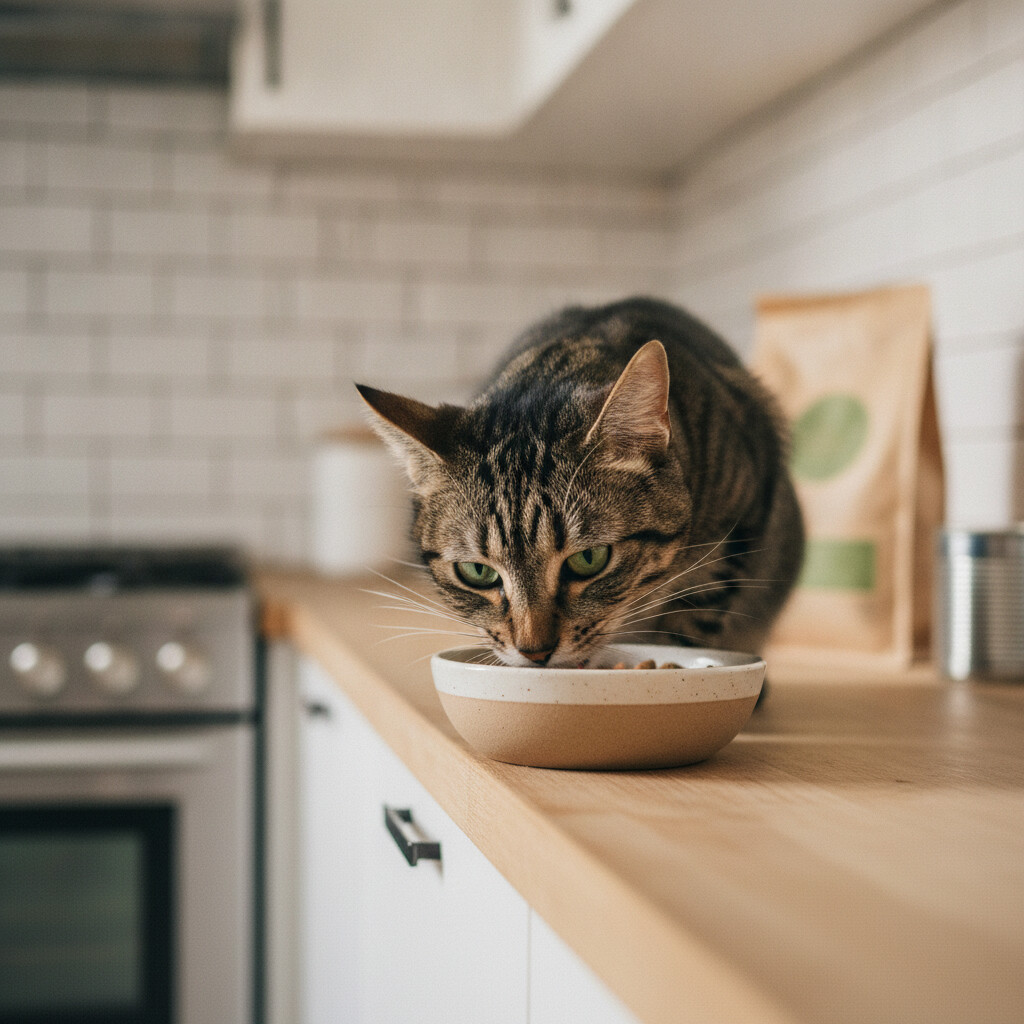
Taurine is the one nutrient cats cannot live without and cannot make enough of on their own — which is why it’s the reason “complete and balanced” isn’t just marketing language on a cat food label. If a diet is chronically short on taurine, the consequences show up in the heart and the eyes, sometimes years later and sometimes irreversibly. Here’s what taurine actually does, why cats are uniquely vulnerable to running short of it, and how to tell if your cat’s food actually has enough.
What Taurine Actually Does
Taurine is an amino acid involved in bile acid formation, vision, digestion, and — most critically — normal heart muscle function. Most mammals synthesize enough taurine from other amino acids (methionine and cysteine) in the liver. Cats can’t. Their liver enzymes for that conversion pathway are far less active, and cats also lose taurine faster than other species because of how they excrete bile acids. The result: cats are obligated to get taurine directly from their diet, in meaningful amounts, every single day. There’s no stockpiling it for later.
This is a big part of why cats are obligate carnivores in the truest sense — taurine occurs almost exclusively in animal tissue, particularly muscle meat, heart, and dark meat. Plant-based proteins essentially don’t contain it.
What Happens When Cats Don’t Get Enough
Taurine deficiency in cats is well documented in veterinary literature, and it causes two serious, distinct problems:
Dilated cardiomyopathy (DCM). The heart muscle weakens and the chambers enlarge, reducing the heart’s ability to pump effectively. This can progress to congestive heart failure. Taurine-deficiency DCM was actually the reason commercial cat food formulations changed dramatically in the 1980s — before manufacturers began supplementing taurine adequately, it was a leading cause of heart failure in cats, identified through veterinary cardiology research at UC Davis in the mid-1980s. The encouraging part: taurine-responsive DCM can often be reversed with supplementation if it’s caught before permanent heart damage sets in.
Central retinal degeneration. Taurine deficiency also damages photoreceptor cells in the retina, causing progressive and — unlike the cardiac form — largely irreversible vision loss. It tends to develop before cardiac symptoms become obvious, which is one reason vets take unexplained vision changes in cats seriously.
Both conditions are slow-building. A cat on a taurine-deficient diet doesn’t show symptoms after a week or a month — it can take a year or more of inadequate intake before problems surface, which makes the diet itself the thing worth scrutinizing rather than waiting for symptoms.
Why Grain-Free and Boutique Diets Became a Flashpoint
In 2018, the FDA opened an investigation into a possible link between certain “BEG” diets — boutique, exotic-protein, and grain-free formulations, many of them heavy in legumes like peas and lentils — and reports of DCM in dogs, and cats were mentioned in related case reports as well. The mechanism isn’t fully settled; it may relate to how certain legume-heavy recipes affect taurine bioavailability or absorption rather than the raw taurine content of the food itself. The FDA’s investigation didn’t conclude that grain-free diets are inherently unsafe, but it’s a useful reminder that “grain-free” and “nutritionally complete” aren’t the same claim, and that trendy formulations aren’t automatically better formulations.
Homemade and raw diets carry a separate, more direct risk: unless a recipe has been formulated by a veterinary nutritionist and includes measured taurine supplementation, it’s very easy to fall short, even when the ingredients look “natural” and meat-heavy. Cooking also degrades taurine, so a home-cooked diet needs it added back in after cooking, not assumed to survive the process. If you’re considering a homemade or raw approach, our guide on raw cat food diets and on homemade cat food both go into what proper supplementation actually requires.
How to Tell If a Food Has Enough Taurine
Any commercial cat food labeled as “complete and balanced” and formulated to meet AAFCO (Association of American Feed Control Officials) nutrient profiles is required to meet minimum taurine levels — 0.1% on a dry matter basis for dry food, 0.2% for canned food, since wet food’s higher moisture and processing method both affect taurine retention differently. Look for the AAFCO statement on the label; if it’s missing, that’s a bigger red flag than the ingredient list itself.
A few practical notes:
- Canned and wet foods generally need — and legally require — more taurine than dry food, so don’t assume a wet diet is automatically taurine-rich just because it’s “meatier.”
- Treats and toppers don’t count toward a complete diet’s taurine total. If more than 10% of daily calories come from treats, the rest of the diet needs to be doing the nutritional heavy lifting.
- Prescription or veterinary therapeutic diets are formulated and monitored specifically for this, so if your cat is on one, taurine typically isn’t something you need to independently verify.
When to See a Vet
Taurine-responsive heart disease and retinal degeneration are two of the reasons routine veterinary checkups matter even for cats who seem perfectly fine. See a vet promptly if you notice:
- Lethargy, rapid or labored breathing, or reduced appetite (possible signs of heart strain)
- Sudden reluctance to jump, disorientation in dim light, or bumping into furniture (possible vision changes)
- Any of the above in a cat eating a boutique, grain-free, homemade, or raw diet that hasn’t been formulated by a veterinary nutritionist
A vet can check taurine status through blood or plasma testing and, if a cardiac issue is suspected, an echocardiogram. If deficiency is caught early, particularly the cardiac form, prognosis with supplementation and a diet change is often good.
The Bottom Line
You don’t need to become an amino acid chemist to feed your cat well. The practical takeaway is simpler: stick to foods carrying an AAFCO “complete and balanced” statement, be skeptical of homemade or exotic-protein diets that haven’t been professionally formulated, and don’t assume “natural” or “grain-free” is a proxy for “nutritionally complete.” For more on decoding what’s actually in the bag or can, see our breakdown of how to read a cat food label.