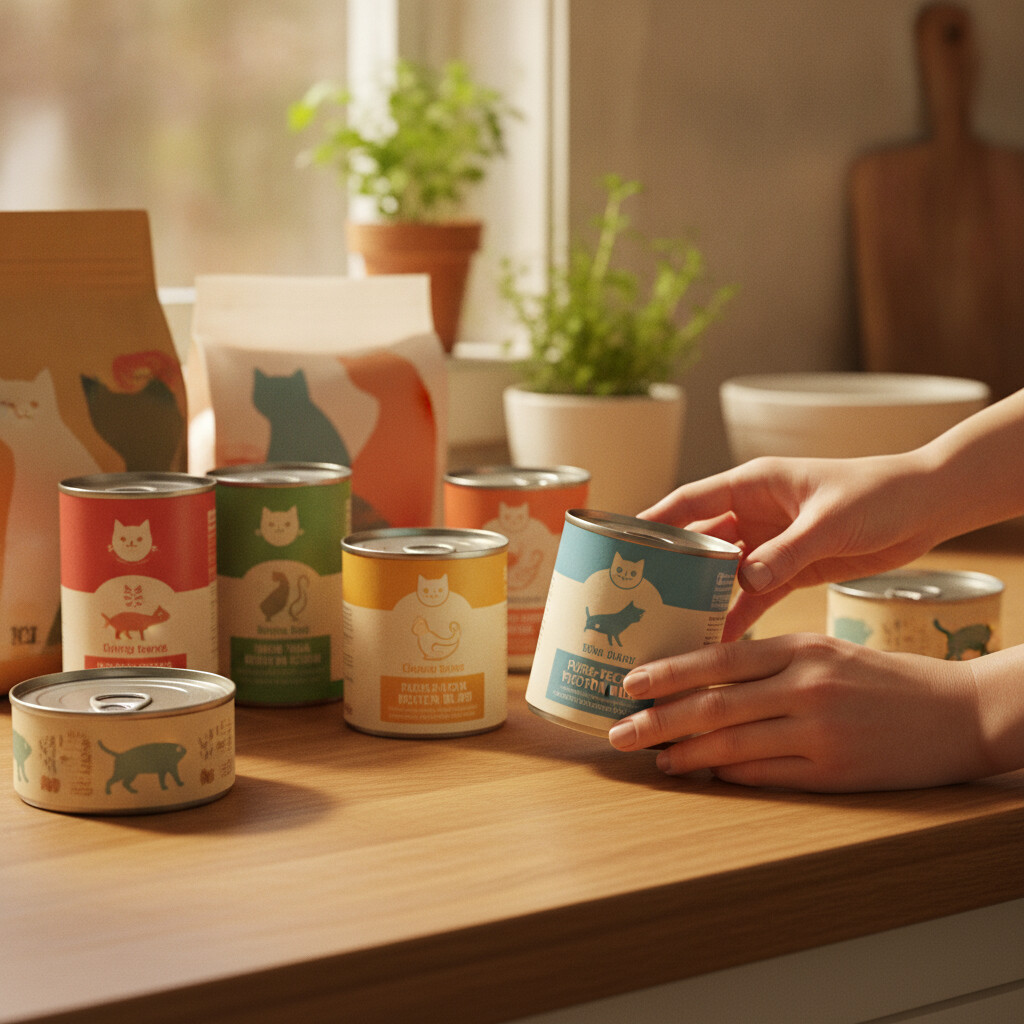
The average cat food label is a wall of text designed to sound impressive while telling you as little as possible. Terms like “premium,” “natural,” and “gourmet” are completely unregulated — they mean nothing. But buried underneath the marketing, there is real information. Here’s how to find it.
Three things matter most on any cat food label: the ingredient list, the guaranteed analysis, and the AAFCO nutritional adequacy statement. Get those three right and you’ve done 90% of the work.
The Ingredient List: What It Actually Tells You (And What It Doesn’t)
Ingredients are listed by weight before processing — which sounds useful, but has a significant catch. Water weight counts. So “chicken” listed first might actually be less chicken (by dry weight) than you think once the moisture is cooked out, while something like “chicken meal” — which sounds less appetising — is actually a concentrated protein source with the moisture already removed.
Named proteins beat vague proteins. “Chicken,” “salmon,” and “turkey” are more transparent than “poultry,” “fish,” or “meat.” The more specific the label, the more accountable the manufacturer. “Poultry by-product meal” sounds alarming, but by-products include organs like liver and kidney — nutrient-dense parts that cats in the wild eat routinely. The AAFCO defines by-products precisely; they’re not scraps. That said, named organ meats (like “chicken liver”) are still preferable to generic “by-products” if you want to know exactly what’s in the food.
Ingredients near the bottom of the list are present in tiny amounts. If a preservative or mineral supplement is listed in the last five ingredients, its actual quantity is negligible. The first five to eight ingredients are what you’re really eating.
Watch for ingredient splitting. Manufacturers sometimes divide a single ingredient across multiple entries to push it down the list. “Ground corn,” “corn gluten meal,” and “corn syrup” are all corn — listed separately, they each appear further down than if they were combined. This is legal. It’s also a red flag.
The Guaranteed Analysis: Reading the Numbers
The guaranteed analysis gives you minimum and maximum percentages for crude protein, crude fat, crude fibre, and moisture. For cat food, focus on protein.
Cats are obligate carnivores. Unlike dogs and humans, they can’t synthesise certain amino acids and must get them from animal protein — particularly taurine, which is essential for heart and eye function. (More on this in Why Cats Need So Much Protein: The Obligate Carnivore Explained.) High protein from animal sources is non-negotiable.
The moisture problem: Comparing a wet food to a dry food using the guaranteed analysis percentages on the label is apples to oranges. Wet food is 70–80% water; dry food is 10%. A wet food with 10% crude protein and a dry food with 30% crude protein might actually contain similar amounts of protein by dry weight.
To compare them fairly, you need to convert to a dry matter basis:
Dry Matter % = (Nutrient % ÷ (100 − Moisture %)) × 100
So a wet food with 10% protein and 78% moisture: 10 ÷ (100 − 78) × 100 = 45.5% protein on a dry matter basis. That’s substantially more protein per calorie than most dry foods.
For wet food, aim for at least 8–10% crude protein as-fed (which translates to 35–50%+ dry matter). For dry food, 30%+ crude protein as-fed is reasonable. Fat should be 15–20%+ in most adult formulas. Carbohydrates aren’t listed but can be estimated: 100 minus (protein + fat + moisture + ash + fibre).
The AAFCO Statement: The Only Claim That Actually Matters
The Association of American Feed Control Officials (AAFCO) sets nutritional standards for pet food in the US. Look for this statement on every food you buy.
“Complete and balanced” is the key phrase. A food labelled “complete and balanced for maintenance of adult cats” has been formulated to meet AAFCO nutritional profiles — meaning it can serve as a sole diet. Some foods are only formulated “for supplemental or intermittent feeding,” which means they’re not nutritionally complete on their own and shouldn’t be your cat’s only food.
The statement also specifies life stage. “All life stages” means it’s suitable for kittens, pregnant cats, and adults. “Adult maintenance” means it meets adult cat needs but may not have the higher protein and calorie density kittens require. Kitten food labelled “for growth” or “for all life stages” is appropriate for cats under 12 months.
Ingredients Worth Scrutinising
Artificial preservatives: BHA, BHT, and ethoxyquin are synthetic antioxidants used to extend shelf life. They’re approved for use in pet food by the FDA, but mixed concerns exist in the research literature. Many owners prefer foods preserved with natural alternatives like mixed tocopherols (vitamin E) or rosemary extract.
Carrageenan: A thickening agent derived from seaweed, used in many wet foods. It’s generally recognised as safe at food levels, but some veterinary nutritionists suggest caution for cats with inflammatory bowel issues.
Plant proteins as primary sources: Corn gluten meal, soy protein, and pea protein all boost the crude protein number on the label without adding the amino acid profile cats need from animal sources. A food where the first protein source is a plant ingredient is a red flag for cat nutrition — check that animal proteins top the list.
What the Label Won’t Tell You
A lot. The label won’t tell you about palatability (whether your cat will actually eat it), real-world ingredient quality and sourcing, digestibility (how much of the listed protein your cat actually absorbs), or manufacturer quality control practices.
For context on how different food types affect cats’ health long-term, see Wet vs. Dry Cat Food: The Honest Comparison — it covers hydration, dental effects, and caloric density in more depth. And if you’re managing your cat’s weight alongside food quality, Is Your Cat Overweight? Signs to Look For and How to Help is worth pairing with this.
The Practical Summary
When you pick up a bag or can, run through this:
- First ingredient: Is it a named animal protein? If yes, good start.
- AAFCO statement: Does it say “complete and balanced”? If not, it’s supplemental only.
- Life stage: Matches your cat?
- Crude protein: 8%+ for wet food (or 35%+ dry matter), 30%+ for dry food.
- Anything suspicious? Lots of plant proteins at the top, or artificial preservatives you’d rather avoid?
You don’t need to memorise every ingredient. You need to understand what the label is showing you — and what it’s designed to obscure. Now you do.