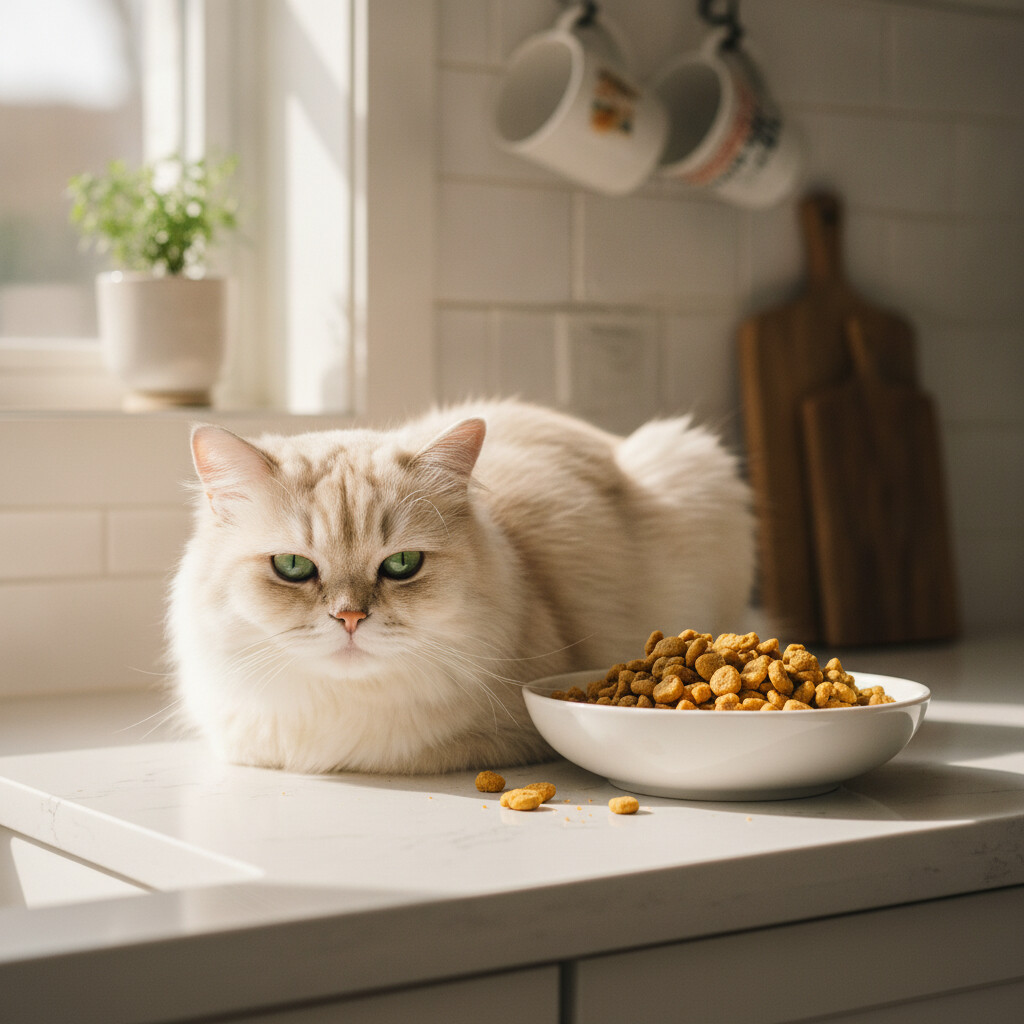
Freeze-dried cat food isn’t a gimmick, but it’s also not the nutritional upgrade the packaging implies. The honest answer: it’s raw-adjacent nutrition with most of the bacterial risk removed, at three to five times the price of kibble — worth it for some cats and some budgets, unnecessary for most.
Here’s how to figure out which camp you’re in.
What Freeze-Dried Cat Food Actually Is
Freeze-drying removes moisture from raw meat under vacuum at low temperature, which preserves nutrients — including heat-sensitive ones like taurine and certain vitamins — far better than the high-heat extrusion used to make kibble. The result is a shelf-stable product that’s rehydrated with water before serving, or fed as crunchy nuggets.
Dehydrated food is a related but different process: it uses low, steady heat over a longer time to remove moisture. It’s cheaper to produce than freeze-drying and slightly more processed, but the nutritional gap between the two is small in practice.
Both are frequently confused with raw food, and marketing doesn’t always help. The meaningful difference is this: freeze-drying and dehydrating don’t reliably eliminate pathogens like Salmonella or Listeria the way cooking does. A 2018 FDA survey of raw and freeze-dried pet food found detectable pathogen contamination in a small but real percentage of samples — lower than fresh raw diets, but not zero. If a product doesn’t carry a “high-pressure processing” (HPP) label, treat it with the same hygiene precautions you’d use for raw meat: separate utensils, hand-washing, and no serving to households with immunocompromised members.
The Case For It
The strongest argument for freeze-dried food is for cats who do better on a species-appropriate, high-protein, low-carbohydrate diet but whose owners don’t want to handle raw meat. Cats are obligate carnivores — they have a limited ability to metabolize carbohydrates and a biological requirement for high dietary protein and specific amino acids like taurine and arginine. Freeze-dried diets, when formulated to AAFCO standards, tend to hit those targets more closely than most dry kibble, which relies on starch as a binding agent.
It’s also genuinely useful as a topper. Sprinkling freeze-dried food or crumbled treats over kibble is one of the more reliable ways to get a picky eater interested in a bowl, since the aroma and texture are closer to what a cat’s nose and instincts respond to.
The Case Against It
Cost is the obvious one. Freeze-dried and dehydrated diets routinely run $15–$25 per pound, compared to $2–$4 for quality dry food. For a full-time diet in a multi-cat household, that adds up fast — often into hundreds of dollars a month.
The second issue is completeness. Not every freeze-dried product on the shelf is formulated as a complete and balanced diet — some are explicitly labeled as toppers or treats, meant to be used alongside a base diet, not as the only thing your cat eats. Feeding an incomplete formula exclusively can create real nutritional gaps over time.
Third: freeze-drying doesn’t inherently make food safer than raw. If pathogen control matters to your household, look specifically for products that state they’ve undergone high-pressure processing, which does kill most bacteria without the heat that would otherwise cook the food.
How to Tell If It’s Actually a Complete Diet
Check the label for an AAFCO (Association of American Feed Control Officials) statement — something like “formulated to meet the nutritional levels established by the AAFCO Cat Food Nutrient Profiles for [life stage].” If that statement is missing, the product is a supplement or treat, not a full diet, regardless of how good the ingredient list looks.
Beyond that:
- Life stage matters. A diet balanced for adult maintenance isn’t necessarily appropriate for a kitten or a cat with kidney disease. Check that the label matches your cat’s actual life stage.
- Look for named protein sources (“chicken,” “salmon”) rather than vague ones (“meat,” “poultry by-product meal” without further detail isn’t automatically bad, but named sources give you more information).
- If your cat has a diagnosed health condition — kidney disease, pancreatitis, a history of urinary crystals — talk to your vet before switching to any high-protein diet, freeze-dried or otherwise. Renal diets in particular are formulated with reduced phosphorus and protein for a reason, and freeze-dried food generally runs in the opposite direction.
The Practical Verdict
If your cat is healthy, you can afford it, and you’re buying a product with a clear AAFCO statement (ideally with HPP treatment noted), freeze-dried food is a legitimate, high-quality option — full-time or as a mixer with kibble. If budget is a real constraint, a good quality wet food gets you most of the same benefits — high moisture, high protein, low carbohydrate — for a fraction of the cost. Freeze-dried is a “nice to have,” not a “have to have.”
For more on reading past the marketing on any cat food bag, see our guide to reading a cat food label without going cross-eyed. If you’re dealing with a cat who turns their nose up at everything, our picky-eater guide covers the same topper trick in more detail, along with what to do when it doesn’t work.
Bottom line: freeze-dried isn’t a health necessity, but it isn’t hype either. Treat it as a premium option worth the cost if it fits your budget and your cat’s needs — not a diet you need to feel guilty about skipping.