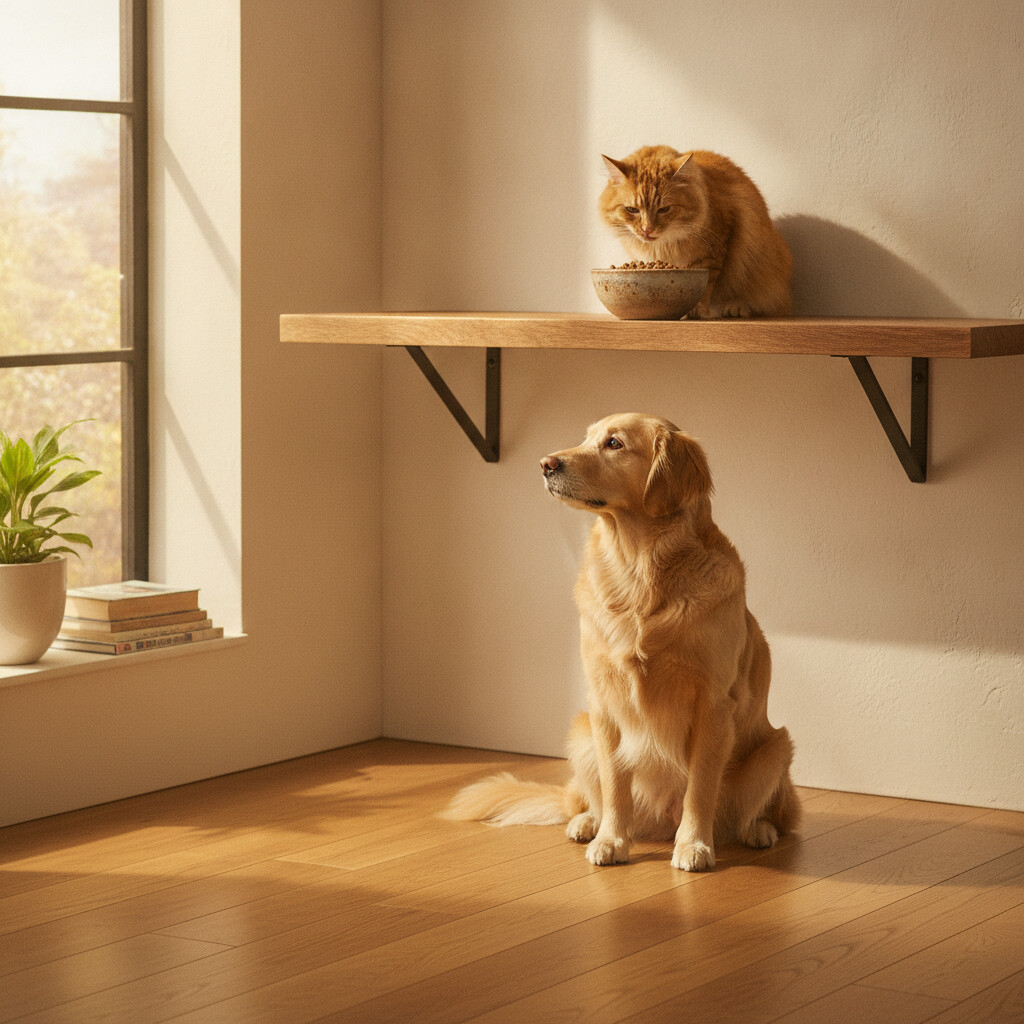
The easiest way to keep a dog out of the cat’s food is to put the food somewhere the cat can reach and the dog can’t: up high, or behind an opening too small for the dog. You can build either in an afternoon with a shelf, a storage box or a pet gate, and it usually costs less than a bag of food.
Here’s how to build three versions, which one suits your household, and the mistakes that send cats off their food.
Why it’s worth separating the food
Dogs find cat food irresistible because it’s richer: cat food is formulated for an obligate carnivore, so it’s typically higher in protein and fat than most adult dog foods. A dog that regularly raids the cat bowl is eating extra calories, and rich, fatty food can upset some dogs’ stomachs. Veterinary sources such as the Merck Veterinary Manual list high-fat meals among the risk factors for pancreatitis in dogs. Our article on cats eating dog food covers the reverse problem.
The cat loses out too. The AAFP and ISFM Feline Environmental Needs Guidelines (2013) list food, water, litter, scratching and resting spots as a cat’s core resources, and recommend that each be in its own safe place where the cat can use it without being ambushed or crowded. A cat who gets stared down by a dog at every meal may eat too fast, eat less, or start skipping meals. All three are worth avoiding, especially in an older or underweight cat.
Option 1: The high shelf (cheapest and fastest)
Most cats can jump several times their own height, and most dogs can’t climb. A wall-mounted shelf or a sturdy piece of furniture is the simplest feeding station there is.
What you need:
- a wall shelf at least 12 inches deep and 20 inches wide, rated for well over your cat’s weight
- heavy-duty brackets, screwed into wall studs rather than just plasterboard
- a non-slip mat or a strip of rubber shelf liner
How to set it up:
- Pick the height. Measure how high your dog can reach standing on their hind legs, then add at least 6 inches. For a large dog, that might mean 5 feet or more.
- Give the cat a way up. Unless your cat is young and athletic, add a step: a cat tree, a lower shelf or a sturdy piece of furniture nearby. Our guide to DIY cat shelves shows how to build a staircase of shelves that also doubles as climbing space.
- Anchor everything. A shelf that wobbles once will rarely be trusted again.
- Add the mat, then the bowls, set well back from the edge.
Best for: agile cats and dogs that can’t climb. It’s also a quick way to add vertical space, which cats value anyway.
Not ideal for: senior cats, cats with arthritis or very large jumping dogs. If your cat has started hesitating before jumps, choose one of the floor-level options below.
Option 2: The cat-door box (works for any age)
This is a covered box with an entrance sized for a cat but too small for your dog. It keeps food at floor level, which suits older cats.
What you need:
- a large lidded plastic storage tub (around 100 quarts / 95 litres works for most cats), or a wooden crate, or a cabinet you’re happy to modify
- a jigsaw or a sharp utility knife for plastic
- a file or sandpaper, plus edging trim or heavy tape to cover the cut edge
How to build it:
- Measure your cat at the widest point of the shoulders and from the floor to the top of the shoulders. The opening should be just large enough for the cat to walk in comfortably. For many adult cats, that’s somewhere around 6 to 8 inches across, but always size it to your own cat.
- Measure your dog’s head. If the dog’s head fits through the opening, a determined dog will try to force the rest of themselves through or simply clear the bowl with their tongue. This option works best when the dog is clearly bigger than the cat.
- Place the hole high on the side, a few inches off the floor, and set the bowls at the far end, out of reach of a dog’s tongue or paw.
- Smooth every cut edge. Cracked plastic is sharp. File it, then cover it with trim or tape.
- Make it stable. Weigh down the base or fix the box to the wall, so the dog can’t tip it over.
- Leave the lid off at first, or prop it open, so the cat can see in and out while they learn the new spot.
Best for: senior cats, households with a medium or large dog.
Not ideal for: small dogs that are about the same size as the cat, or dogs that dig and chew.
Option 3: The gated room
If you have a laundry, spare room or bathroom, you can turn it into a cat-only dining room.
- A pet gate with a built-in cat door. Several gates include a small swinging or open flap at the bottom. Check the opening size against your dog, not just the cat.
- A gate raised a few inches off the floor. The cat slips underneath and the dog can’t. This only works if the dog can’t squeeze under too, so test it.
- A door strap or latch that holds the door open just a few inches. Wide enough for a cat, too narrow for most dogs.
Gated rooms work well because you can put water and a litter box in the same room, which also solves the problem of dogs raiding the litter box. Keep food and litter at opposite ends, though: cats generally prefer not to eat near where they toilet, as the AAFP/ISFM guidelines point out.
If you have a small dog or a determined one
When the dog and cat are about the same size, size-based barriers stop working. Options worth knowing about:
- Microchip-activated feeders. These open only for a pet whose microchip (or collar tag) they recognise. They cost more, but they’re one of the few things that work when the dog is cat-sized, and they’re also useful when cats in the same house eat different diets.
- Scheduled meals instead of free feeding. If the cat eats meals at set times while the dog is in another room or out on a walk, there’s nothing left to steal. Pick up the bowl after 20 to 30 minutes.
- Training. A solid “leave it” helps, but it won’t stop a dog that’s home alone with a full bowl.
Mistakes that put cats off their food
- Changing everything at once. Move the bowl into the new station but keep the same bowl and food. Change one thing at a time.
- Taking the old feeding spot away overnight. For a few days, put food in both places, then phase out the old one once you’ve seen the cat eating at the new station.
- Openings that are too tight. Many cats dislike their whiskers brushing the sides. If the cat pokes their head in and backs out, the hole is probably too small.
- No escape route. A box with one entrance can feel like a trap if the dog waits outside. Place it where the cat can see the room, or add a second exit.
- Water left behind. Put a water bowl in the cat’s area too, not just food.
If your cat eats noticeably less after you move their food, go back to the old setup and move more slowly. Any cat that has gone 24 hours without eating needs a call to your vet, especially an overweight or older one, because skipping meals can trigger liver problems in cats.
Which one should you build?
- Young, agile cat and a big dog: the high shelf.
- Older cat or a cat with stiff joints: the cat-door box or a gated room.
- Small dog: a gated room with a narrow opening, a microchip feeder or scheduled meals.
- Brand-new household: start with a gated room. It doubles as the cat’s safe space while you introduce the cat and dog.
Whatever you build, the goal is the same: your cat gets to eat in peace, and the dog stops treating the cat bowl as a second dinner.
What’s your dog’s best trick for getting at the cat’s food?