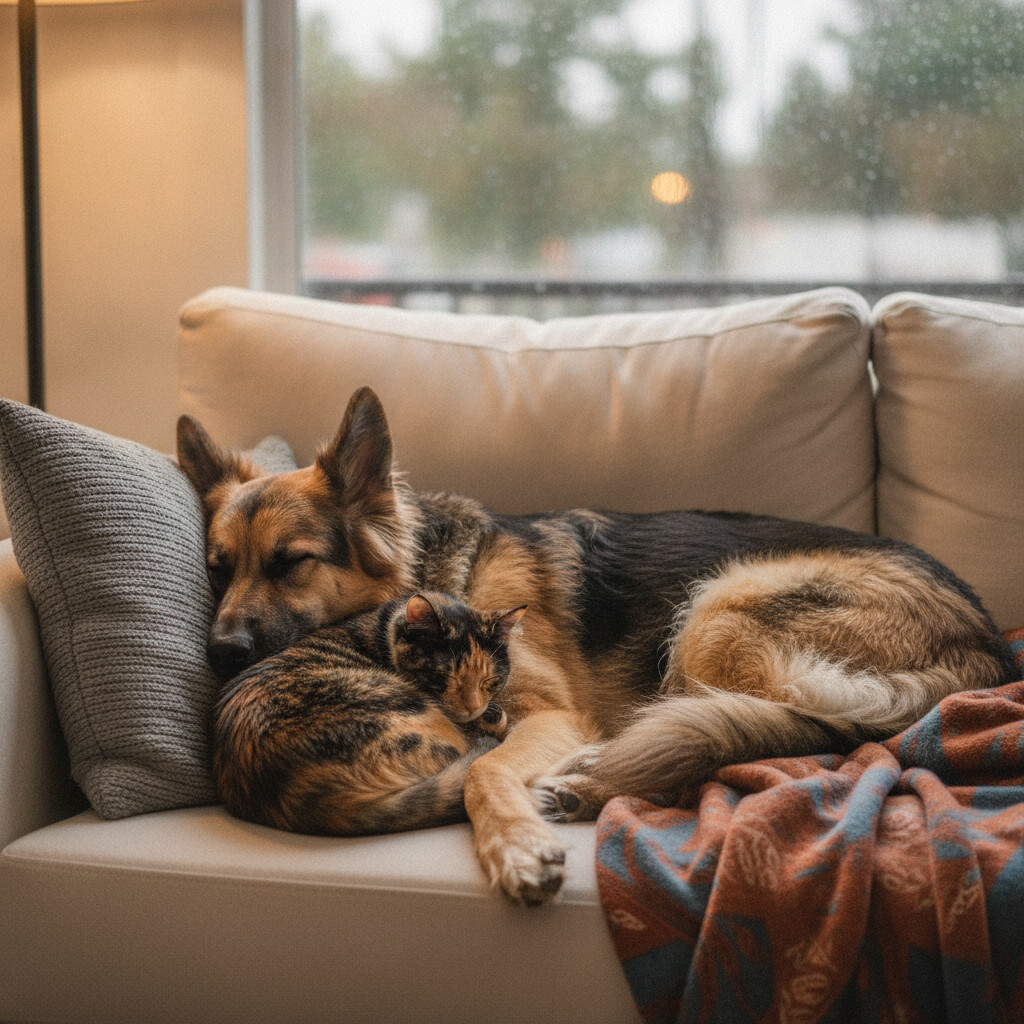
For eleven weeks, our cat Pepper treated our new rescue dog like a piece of furniture she’d decided to hate. Then one wet Sunday afternoon she climbed onto the couch and curled up against his back. Here is how we got from one to the other, including the parts that went wrong.
Week one: the baby gate and the hiss
Biscuit, a three-year-old shepherd mix, came home on a Friday. Pepper, our eight-year-old tortie, had been the only animal in the house since she was a kitten. She took one look at him through the kitchen doorway, fluffed to twice her size, and vanished under the bed for the weekend.
We had read the usual advice and, for once, followed it. Biscuit stayed on one side of a baby gate in the hallway, Pepper kept the bedroom and the upstairs, and neither of them was forced to meet. We swapped blankets so they could learn each other’s smell. Feeding them on opposite sides of a closed door, a little closer each day, was the step that seemed to matter most.
Our forum guides on introducing a new cat to your dog and the step-by-step version lay out the same sequence, and it matches what shelter behavior teams generally recommend: scent first, sight second, contact last.
Weeks two to five: the staring phase
The first sight-lines through the gate were not pretty. Biscuit fixated. Pepper stared back, tail low and twitching. Neither lunged, but the tension was obvious.
What helped was interrupting the stare before it escalated. Every time Biscuit locked on, we said his name and tossed a treat the other way. Every time Pepper stayed calm, she got something good too. It was boring and repetitive, and it worked slowly. Trainers and veterinary behaviorists commonly describe this as counter-conditioning: pairing the other animal’s presence with something pleasant so the reaction changes over time. I can’t promise it works for every pair, and I know households where it never did.
Two things we got wrong:
- We rushed the first leash-on meeting. Biscuit pulled toward her, Pepper bolted, and we lost about ten days of progress.
- We took her hiding as “settling in.” Hiding isn’t the same as relaxed. It was a stress response, and it was only when we gave her high perches that she began coming out on her own terms.
Vertical space turned out to be the whole game. Once Pepper had a shelf and a tall cat tree in the living room, she could watch Biscuit from above, where she felt safe.
Weeks six to ten: separate but sharing
By week six, the gate was open for short supervised stretches. Biscuit wore a leash for the first few of these, and I kept it loose. Pepper sat on her shelf and ignored him with great dignity. That was fine. Ignoring is a perfectly good outcome.
I checked in with our vet at about this point, because Pepper had stopped eating her usual amount and had started over-grooming her belly. She was fine physically, and the vet’s read was that stress was the likely cause. Her advice was simple: keep her food, water, and litter box somewhere the dog can’t reach, and don’t count a quiet cat as a coping cat. If a cat stops eating completely for more than a day or two, that is a reason to call, not wait.
Week eleven: the couch
I wish I had a dramatic moment to describe. There wasn’t one. On that wet Sunday, Biscuit was asleep on the couch, Pepper came down from her shelf, walked past him twice, sat for a minute, and then pressed herself against his back like she’d done it all her life. Biscuit opened one eye and went back to sleep.
They are not best friends. She still swats him when he sniffs her food bowl, and he still gets over-excited when she runs. But they share the house now, and most days they share the couch.
What I would tell anyone doing this
- Go slower than feels necessary. Our timeline was eleven weeks. Some pairs need longer, and some get along in days.
- Give the cat height and an exit. A cat who can leave the room and get above the dog is a cat who doesn’t have to fight.
- Reward calm, not just contact. Treating the moment each animal looked away from the other did more than any amount of “let them work it out.”
- Watch for stress signs. Not eating, hiding for long periods, over-grooming, and litter box changes all deserve attention. Our stress signs guide is a good checklist.
- Know when to ask for help. If either animal is genuinely trying to hurt the other, stop the introductions and talk to your vet or a qualified behaviorist. Some cat-dog pairings need professional support.
Pepper still gets the best spot on the couch. Biscuit has accepted this.