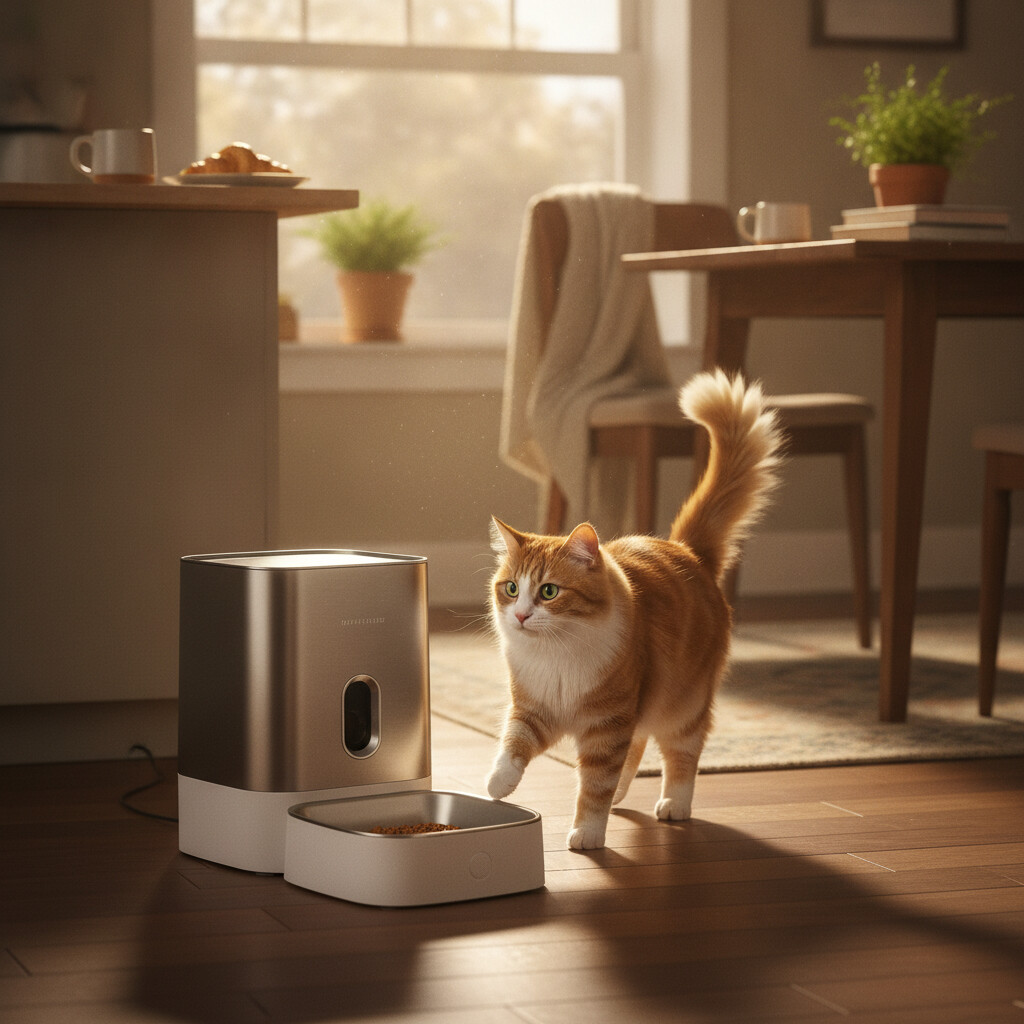
An automatic cat feeder is worth it if you struggle with consistent meal timing, have a cat who does better on smaller frequent meals, or are regularly out of the house at feeding time — but it’s not a fix for overeating on its own, and the cheap ones cause more problems than they solve. Here’s how to tell if one actually fits your situation, and what to look for if it does.
What an Automatic Feeder Actually Solves
The honest case for an automatic feeder isn’t “convenience” in the vague sense — it’s timing precision. Cats are natural little-and-often eaters; in the wild, a cat’s ancestors ate roughly 10–20 small meals a day. Most owners feed twice, which is a reasonable compromise, but some cats — especially ones prone to vomiting on an empty stomach, or ones who get pushy and vocal for hours before a meal — do noticeably better with three or four smaller portions spread through the day. Getting up at 2 a.m. and 5 a.m. to feed a cat isn’t realistic for most people. A timed feeder is.
It also solves a specific multi-cat problem: if you have one cat on a prescription or weight-management diet and another who isn’t, a microchip- or RFID-activated feeder that only opens for the correct cat prevents the healthy cat from eating the other’s food (and vice versa) without you having to supervise every meal.
What it doesn’t solve is a cat who’s overweight because the daily calorie total is too high. A feeder that dispenses the wrong amount, split into four servings instead of two, is still the wrong amount. If your cat’s weight is a concern, that’s a portion-size problem before it’s a scheduling problem — our guide on how to tell if your cat is overweight is a good place to start before you invest in new hardware.
Gravity Feeders vs. Timed Feeders vs. Portion-Controlled Feeders
These get lumped together as “automatic feeders,” but they solve different problems:
- Gravity feeders just refill a bowl from a hopper as your cat eats. They’re cheap and simple, but they don’t control portions at all — for a cat who self-regulates well, that’s fine; for a cat who eats until the bowl is empty, this is the worst option on the market for weight management.
- Timed feeders dispense a pre-set portion at pre-set times, usually via a rotating tray or auger. This is the category most people mean when they say “automatic feeder,” and it’s the right tool for meal-timing problems specifically.
- Portion-controlled, app-connected feeders add finer-grained control — smaller portion increments, feeding history logs, and sometimes camera or microchip integration. They cost more, but for multi-cat households or cats on strict diets, the precision is often worth it.
If your only goal is spacing out meals for a single, healthy-weight cat, a mid-range timed feeder does the job. The premium app-connected features matter more as your situation gets more complex.
What Actually Matters When Choosing One
- Portion accuracy. Auger-style (screw-drive) dispensers are generally more consistent for dry kibble than rotating-tray designs, which can jam or under/over-dispense with irregularly shaped kibble. If you feed wet food, you need a feeder with an ice pack compartment or refrigeration — most budget models don’t have this, and wet food left out for hours is a real spoilage and food-safety issue in a way dry kibble isn’t.
- Battery backup. A feeder that resets its schedule or fails to dispense during a power outage defeats the purpose. Look for one with battery backup as standard, not an add-on.
- Easy manual override. You’ll want to feed by hand sometimes — vet visits, travel, treats. A feeder that’s a hassle to manually trigger or refill will annoy you daily.
- Cleanability. Food residue builds up in the hopper and dispensing mechanism over time, especially with wet or semi-moist food. Removable, dishwasher-safe parts matter more than most buyers expect until they own one.
- Noise. Some auger motors are loud enough to startle a nervous cat at each feeding — worth checking reviews specifically for noise level if your cat is skittish.
The Multi-Cat Consideration
In a multi-cat household, a standard timed feeder just opens on schedule — it doesn’t stop the faster or more dominant cat from finishing both portions. If your cats need genuinely separate meals (different diets, different amounts, or one cat is a food-guarder), you need a feeder with per-cat access control, typically via a microchip or RFID collar tag reader that only unlocks for the registered cat. These cost more, but they’re the only version of “automatic feeding” that actually functions in a household where free access to shared food is the problem you’re trying to solve. If competition over food and resources is a broader issue in your household, it’s worth reading about setting up resources for multi-cat households alongside any feeder purchase — a feeder alone won’t fix territorial resource guarding.
When an Automatic Feeder Isn’t the Right Answer
Skip it — or at least don’t rely on it as the whole solution — if:
- Your cat needs to be observed while eating (for medical reasons, medication timing, or monitoring appetite changes)
- Your cat is anxious around mechanical noises and a sudden dispensing sound is likely to cause stress
- You’re using it to avoid diagnosing why your cat is begging for food constantly — sudden increased appetite in an adult or senior cat can be a sign of an underlying medical issue and is worth mentioning to your vet rather than just feeding around it
- You’re feeding wet food and don’t want to deal with the refrigerated-compartment requirement
The Takeaway
An automatic feeder earns its cost when it solves a real timing or access-control problem — spacing meals for a cat who does better eating often, or keeping cats on different diets from raiding each other’s bowls. It doesn’t replace figuring out the right total daily portion for your cat’s actual weight, and the cheapest gravity-style options are genuinely the wrong tool if weight management is part of why you’re considering one. Match the feeder type to the specific problem you have, not the other way around.