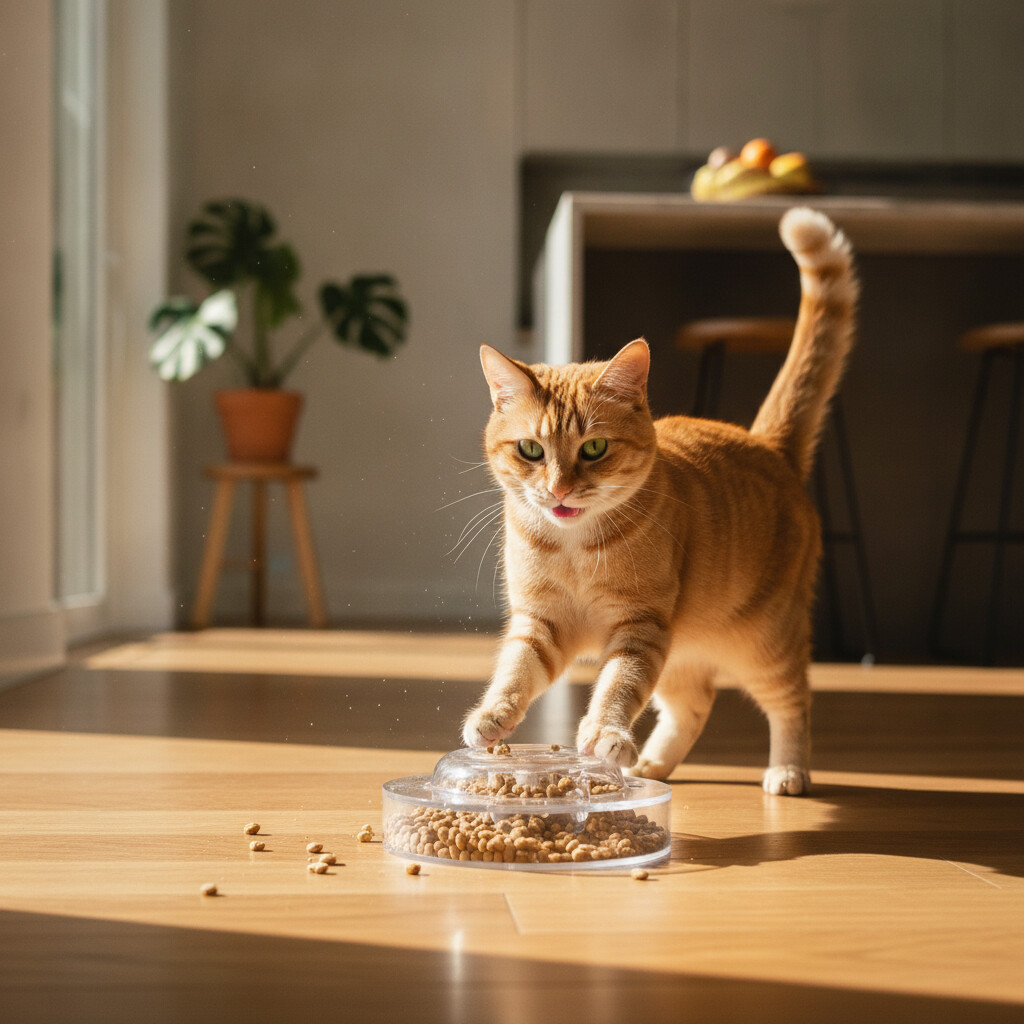
Our cat Otis weighed 23 pounds at his heaviest — nearly three times what a cat his frame should carry. This is the story of how we let it happen without noticing, what finally made us pay attention, and what a year of slow, unglamorous changes actually looked like.
How a Cat Gets to 23 Pounds Without Anyone Noticing
Otis came to us at four years old, a rehomed cat from a family who’d had a baby and couldn’t manage him anymore. He was already big then — a solid, dense cat you felt more than lifted. We told ourselves it was his build. Big-boned. A “unit,” as my husband liked to say, fondly.
For the next five years he free-fed from a bowl that was never allowed to go empty, got table scraps because he begged with real conviction, and slept about eighteen hours a day on a heated perch by the window. None of this felt like neglect. It felt like spoiling a cat we loved. That’s the part nobody warns you about — obesity in cats rarely arrives as a dramatic event. It arrives as a thousand small, affectionate decisions that add up.
The moment it stopped being abstract was during a routine nail trim. Otis, who used to leap onto the bathroom counter without thinking, tried twice and couldn’t make it. He sat on the floor afterward, breathing harder than a cat sitting still should. Our vet weighed him that week: 23 pounds. For a cat with Otis’s frame, a healthy weight was closer to 10–11 pounds. He wasn’t big-boned. He was carrying more than double his ideal body weight.
Why We Didn’t See It Coming
Veterinary organizations, including the World Small Animal Veterinary Association (WSAVA), list obesity as the most common nutritional disorder seen in cats today, and one of the most under-recognized by owners. Part of the reason is visual — indoor cats don’t have a “normal” for comparison the way we do with people, and a slow gain over years doesn’t register the way a sudden change would.
The bigger part is emotional. Feeding is one of the primary ways we express care for animals we can’t talk to. Saying no to a cat who’s asking to be fed — loudly, physically, at 6 a.m. — feels unkind in the moment, even when it’s the opposite. Our vet put it plainly: “You’re not withholding love. You’re withholding a health problem.”
Excess weight in cats isn’t cosmetic. It’s a real driver of diabetes, arthritis, urinary tract issues, and a measurably shorter lifespan. Our vet was honest that Otis’s joint stiffness and breathlessness weren’t separate problems from his weight — they were symptoms of it.
What Actually Changed (And What Didn’t Work)
Our first instinct was to just feed him less of the same food. That backfired — Otis is a vocal, food-motivated cat, and cutting portions without changing anything else just made him miserable and loud, and we caved within a week.
What worked was slower and less intuitive:
We switched from free-feeding to scheduled meals. No more bowl that refilled itself. Two measured meals a day, weighed on a kitchen scale, not eyeballed. This alone did more than anything else — see our calorie guide by weight for how we actually calculated his target intake, since “less food” isn’t a number you can act on.
We moved to a higher-protein, lower-calorie-density food, on our vet’s recommendation, rather than just less of his old food. Cats are obligate carnivores who do better losing weight on food that keeps them full on fewer calories, not on portion-restricted versions of a food built to be free-fed.
We made him work for calories. Puzzle feeders instead of a bowl. Kibble scattered across a room instead of poured in one place. It sounds like a small thing, but it turned eating from a thirty-second event into fifteen minutes of actual activity, several times a day.
We stopped the scraps entirely, which was harder on us than on him, honestly. He begged for about three weeks. Then he mostly stopped.
We tracked weight monthly, not daily. Cats should lose weight slowly — roughly 0.5–2% of body weight per week is the range most vets recommend. Faster than that risks hepatic lipidosis, a serious and sometimes fatal liver condition that can develop when a cat, especially an overweight one, loses weight too quickly or stops eating altogether. This is not a diet you rush.
Eleven Months Later
Otis is 13 pounds now, still a big cat, still not where our vet ultimately wants him, but transformed. He makes the bathroom counter every time. He plays for real — chasing, not just batting halfheartedly at a toy before flopping over. His breathing sounds like a cat’s again, not like effort.
What surprised me most wasn’t the physical change. It was watching a cat who’d essentially been dozing through the back half of his life wake back up. He’s the same cat, personality-wise, but there’s more of him present now — more curiosity, more mischief, more of the things that made us love him in the first place.
When to See a Vet
If you’re looking at your own cat and wondering, weight loss should never be self-managed without a vet involved, for one serious reason: sudden loss of appetite or a crash diet in an overweight cat can trigger hepatic lipidosis, a life-threatening liver condition. Any weight-loss plan for a cat should be vet-supervised, with a target rate of loss and regular weigh-ins.
See a vet promptly if your cat is significantly over their ideal weight, if they’ve stopped grooming areas they can’t comfortably reach, if they’re reluctant to jump or seem to tire quickly, or if you notice increased thirst or urination — a possible sign of diabetes, which is strongly linked to feline obesity. If you’re not sure whether your cat is actually overweight or just solidly built, our guide on how to tell if your cat is overweight walks through the body-condition checks vets actually use.
The Takeaway
Cat obesity almost never happens on purpose, and it almost never gets fixed by willpower alone — ours or the cat’s. What worked for Otis was structure: measured meals, a vet-guided target, food that made him work a little, and patience measured in months, not weeks. If your cat is carrying more than they should, you’re not a bad owner for not noticing sooner. Most of us don’t, until something makes us look.