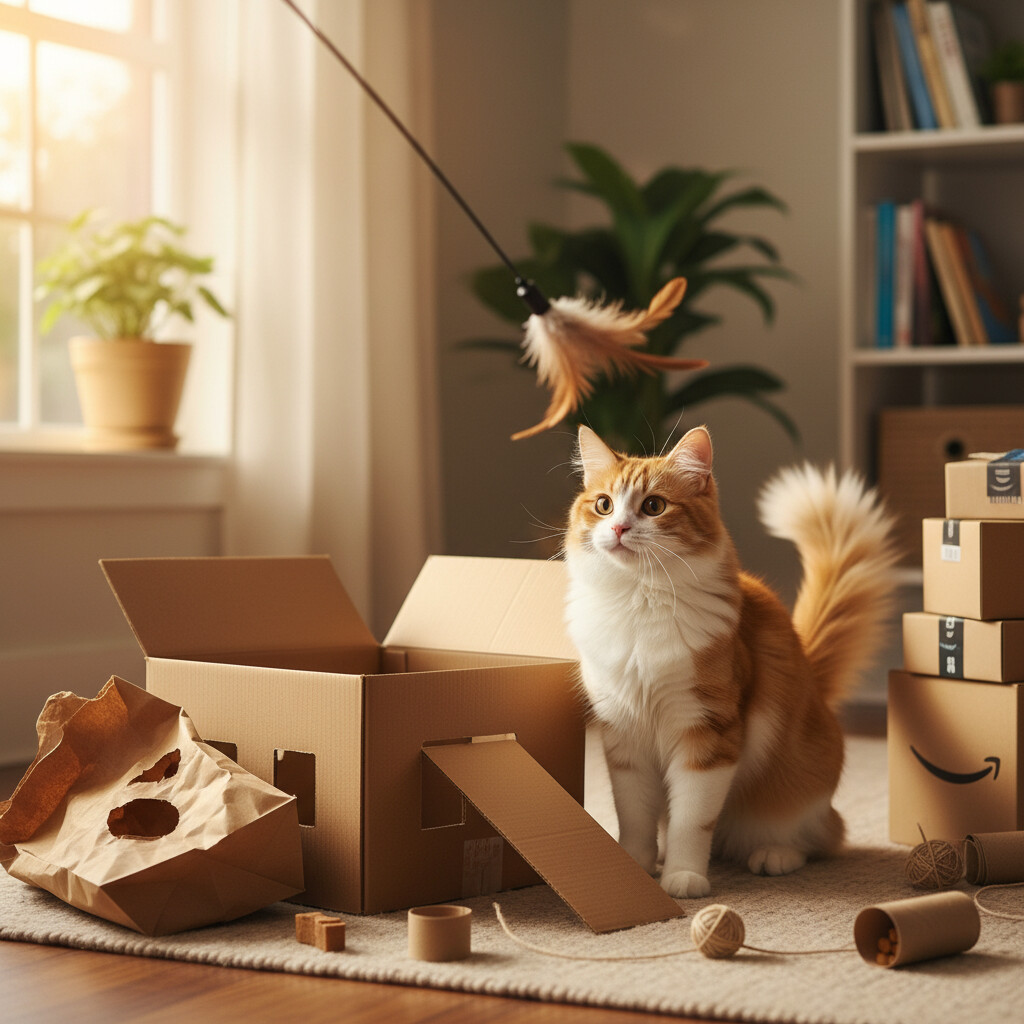
Indoor cats have the same brains, instincts, and hunting drive as their outdoor counterparts. The difference is they have far fewer outlets. These seven enrichment ideas are cheap, genuinely effective, and grounded in what feline behaviour research says actually engages cats — not just what looks good on social media.
Why Enrichment Matters (The Short Answer)
A 2019 review in the Journal of Feline Medicine and Surgery identified environmental enrichment as one of the most important factors in feline welfare, ranking alongside nutrition and social interaction. Cats deprived of adequate mental and physical stimulation develop stress behaviours: over-grooming, redirected aggression, litter box problems, and destructive scratching. If you’re already noticing some of those signs, the 10 Signs Your Cat Is Stressed article covers the full picture — but the fix often starts here.
The good news: cats don’t need expensive gadgets. They need novelty, hunt-simulating activities, and vertical space. Most of that you can provide for free or close to it.
1. Paper Bag Foraging Tunnels (Free)
Leave a paper bag — handles removed, to eliminate a strangulation hazard — open on the floor and toss a few kibble pieces or treats inside. That’s the entire setup. Cats respond to the rustling sound, the enclosed space, and the foraging element. Rotate bags every couple of days so the novelty stays. Variation: loosely crinkle newspaper balls and stuff them inside with treats buried at different layers.
2. The Cardboard Box Tower (Free)
Stack two or three boxes of different sizes and cut connecting holes between them large enough for your cat to pass through (roughly six inches square for most cats). You’ve built a multi-level structure that costs nothing. Add a worn t-shirt inside one of the compartments — your scent is genuinely calming for most cats, consistent with research on social bonding in domestic cats that suggests familiar scents reduce cortisol responses.
3. DIY Puzzle Feeders From Things You Already Have
The simplest puzzle feeder: an empty egg carton with kibble in the compartments, closed so the cat has to open each one. More advanced: cut small holes in a plastic water bottle (slightly larger than a kibble piece), fill it with dry food, and let the cat roll it around to earn pieces.
Research from UC Davis on contrafreeloading behaviour found that many cats actively prefer to work for food when given the option — they’ll choose the puzzle over a free bowl. If your cat has never encountered a puzzle feeder, start with very low difficulty and increase gradually. Cats that find them frustrating immediately tend to disengage rather than problem-solve.
4. A Window Perch With Live Entertainment Below
Cats are visual hunters. A secure window perch — you can build one from a shelf bracket, a flat board, and a yoga mat for traction (under $10 at a hardware store) — gives your cat a dedicated observation post. Place a bird feeder or birdbath directly below that window and you’ve created a live nature channel they’ll watch for hours.
The AAFP (American Association of Feline Practitioners) guidelines on indoor cat welfare specifically list visual access to the outdoors as an environmental enrichment resource. This is the low-budget version that works.
5. Scent Enrichment (Most People Skip This Entirely)
Cats experience their environment largely through smell. Scent enrichment is cheap and almost universally overlooked:
- Catnip or valerian root rubbed onto a sock or piece of fabric — roughly 50–65% of cats respond to catnip, and for those that do, it produces a genuine and harmless arousal-then-relaxation cycle
- Silver vine (Actinidia polygama) — a 2017 study in BMC Veterinary Research found that more cats respond to silver vine than to catnip, including many cats that don’t react to catnip at all; worth trying if your cat is in the non-responding majority
- Novel scent objects: a feather, a small amount of prey-scented material from a pet store, herbs like valerian or dried catnip in a fabric sachet — all trigger investigatory behaviour even in cats with low toy drive
Rotate scent items every few days. Habituation happens fast.
6. The 15-Minute Wand Toy Session
Not expensive, but worth naming specifically because it’s chronically underused. Fifteen minutes of interactive wand toy play — where you actively simulate prey movement — is one of the highest-engagement activities possible for most cats.
The key is simulating actual prey: erratic, stop-start, hiding under a blanket edge, freezing then bolting. A 2019 study from Nottingham Trent University found structured interactive play sessions significantly reduced frustration-related behaviours in indoor cats, including aggression and excessive vocalisation. Dragging a toy in a straight line at a consistent speed doesn’t do the same thing — prey doesn’t move like that.
One wand toy, used correctly, beats three automated gadgets.
7. Safe Outdoor Access (Do It Right or Not at All)
If your indoor cat stares obsessively out windows, chatters at birds constantly, or shows ongoing frustration behaviours despite indoor enrichment, they may be telling you they want real outside time. That’s worth taking seriously.
Options range from a leash-and-harness setup — time-intensive to train but many cats adapt well — to a purpose-built catio, to a fence-mounted containment system that makes your existing yard cat-safe without restricting the space. For anyone researching that last option, oscillotamerica.com has detailed information on how fence-top containment works and which fence types are compatible.
Whether indoor or outdoor, the Indoor vs. Outdoor Cats: What the Research Actually Says article is the most evidence-based starting point for thinking through the tradeoffs.
The One Rule That Makes All of This Work
Rotate everything. Cats habituate quickly. A box that was fascinating Monday is furniture by Thursday. Keep a rotation of four or five enrichment options and cycle them, presenting one or two at a time. What you’re simulating is the unpredictability of a real environment — and unpredictability is the whole point.