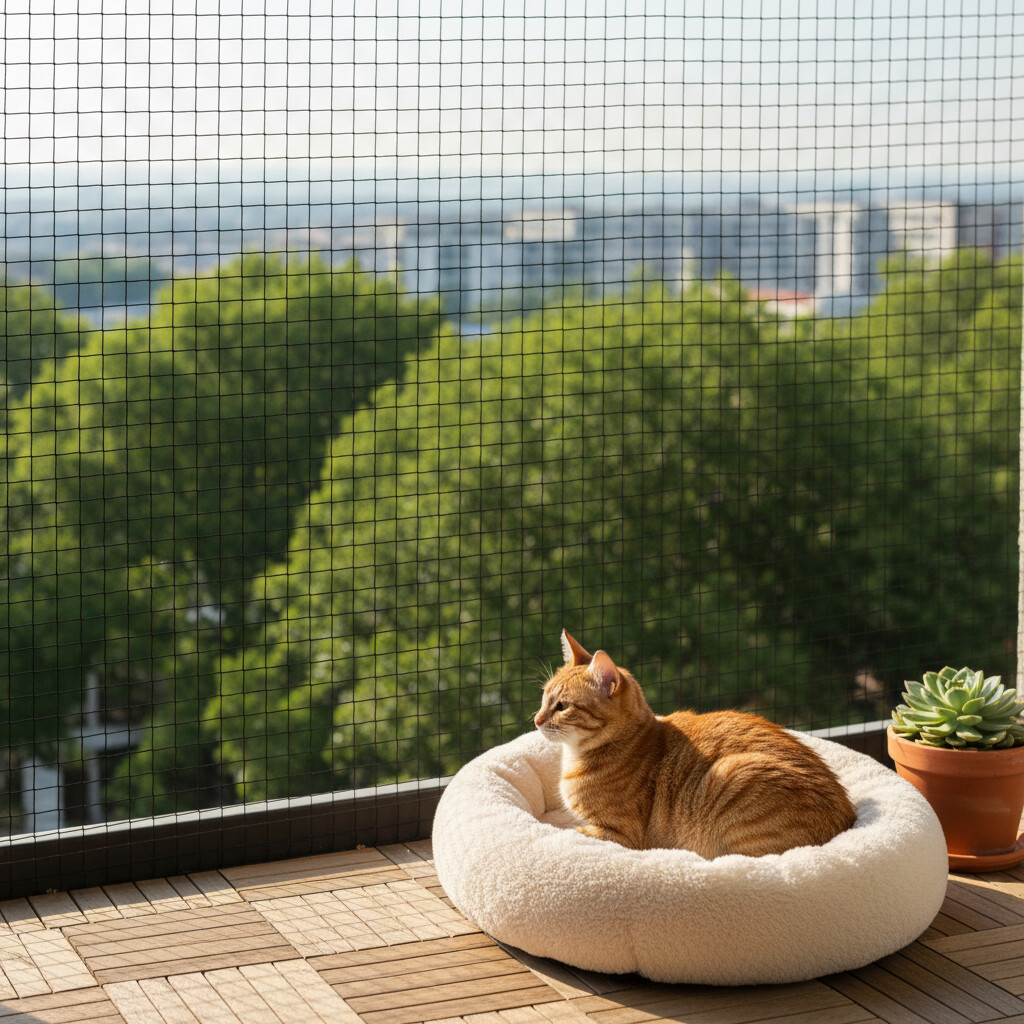
Most indoor cats never get outdoor access. A balcony changes that — but only if you’ve actually made it secure first.
Cats are excellent climbers and creative when it comes to escape routes. A gap you think is too small, a ledge you think is too high — cats have a way of proving both assumptions wrong. Here’s what actually works to make a balcony safe, without spending a fortune or ruining the space.
Assess the Risk Before Buying Anything
Walk your balcony from a cat’s perspective:
- Check every gap. Any opening wider than 10cm (4 inches) is a potential exit route. For kittens, go smaller — 5cm.
- Test every rail and screen. Push and pull. Loose railings won’t survive a determined cat repeatedly pressing against them.
- Look for launch pads. Any furniture, plant pot, or box near the railing is a climbing platform. Cats can clear a standard railing from a standing jump if they have a surface to push off from.
- Scan for toxins on the floor. Balcony cleaning products, pesticide-treated soil, fertilised plants — these are hazards before you even think about fall risk.
The goal isn’t to make the balcony impenetrable to a determined cat with infinite time. The goal is to make it safe for supervised access with occasional unsupervised time once trust is established.
Option 1: Cat Netting (The Most Effective DIY Approach)
UV-stabilised polyethylene netting is the practical gold standard for most setups. It’s available from specialist pet-safety suppliers in mesh sizes from 25mm up, attaches to existing railings, and is largely invisible from inside. The installation is a weekend job.
What to buy:
- Mesh size: 45–50mm for adult cats; 25mm for kittens or particularly small breeds
- Weight: minimum 100g/m² for durability (heavier if you have a large or athletic cat)
- Fixings: stainless steel hooks hold up better than plastic in direct sun over time
Basic installation:
- Run a horizontal cable or cord along the top of the railing — this gives you a fixing point without drilling if you’re renting.
- Attach the netting to the cable at the top and to the bottom rail at the base.
- Keep slight tension in the netting. Slack netting creates a hammock effect that’s fine to rest in but puts pressure on fixings that eventually fails.
If your balcony has a ceiling (the floor of the unit above), you only need to net the vertical sides. Open-top balconies on any floor above the first require ceiling netting too — cats will attempt to climb the netting to the top.
Budget: $30–70 for a typical apartment balcony using DIY mesh.
Option 2: Modular Cat Enclosure Kits ($150–$400)
Several companies sell bolt-together frames with mesh panels that create a full enclosure. These suit renters who can’t drill or anyone who wants the whole system removable. The tradeoff is cost and less flexibility in unusual spaces.
Look for kits specifically designed for catio use — the structural principles are the same. The complete guide to building a catio covers the framing and sizing principles that apply equally to a balcony setup, and it’s worth reading before you buy any kit.
What to Put on the Safe Balcony
Once the structure is secure, the balcony becomes real enrichment:
An elevated resting spot — a folded fleece on a stable surface, a dedicated cat perch, or even a repurposed wooden crate works. Cats want height and a sense of ownership over outdoor space.
Cat-safe plants — catnip, cat grass, rosemary, and valerian are all safe and most cats enjoy interacting with them. Before adding any plant, check the list of common toxic houseplants — lilies, pothos, and peace lily all turn up in balcony gardens and are genuinely dangerous to cats.
Something to watch — a bee-friendly flowering plant near the netting, a small bird feeder on an adjacent wall, or even just positioning the perch to face an active street gives cats the sensory stimulation they’d get from outdoor access. The sounds and smells alone matter.
Water. Balconies heat up fast. A water bowl out there during warmer months is non-negotiable.
Mistakes That Get Cats Hurt
Relying on temporary fixings. Netting clipped with binder clips or zip-tied to a single anchor point will fail. Repeated play-pressure pops fixings over time even without a deliberate escape attempt. Anchor every edge properly.
Assuming height is the deterrent. It isn’t. The ASPCA notes that “high-rise syndrome” — injuries from falls at significant height — is a real and documented phenomenon in cats. Cats do not become more cautious at greater heights; some research suggests the opposite. The netting is the safety, not the altitude.
Forgetting about rope and cord hazards. String lights, blind cords, and plant hangers can form loops at cat height. Strangulation risks on a balcony are the same as indoors — route cords away from where cats can get tangled.
Not supervising early access. Even a well-netted balcony benefits from supervised trial visits at first. Watch where your specific cat tests the boundaries — they’ll often find the one gap you missed.
The Practical Takeaway
A secured balcony meaningfully improves an indoor cat’s quality of life. It provides the sensory richness of the outdoors — wind, smells, sounds, temperature variation, things to watch — without the traffic, predator, and disease risks of free-roaming. The investment is a weekend of setup work and $30–70 for most spaces.
For more indoor enrichment ideas that complement a safe balcony setup, the 7 cheap DIY enrichment ideas covers what works well alongside outdoor access.