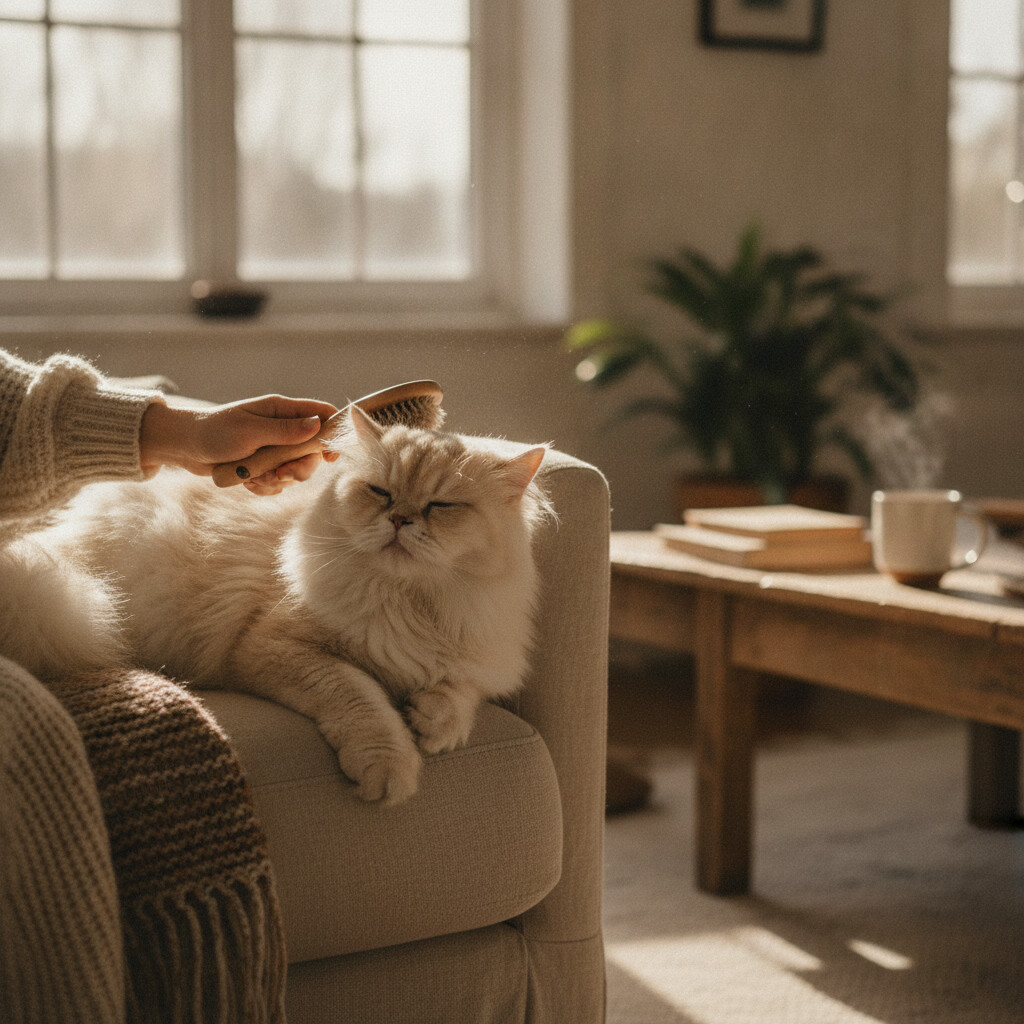
Most cats don’t need baths. But all cats need some level of grooming help — especially longhaired breeds, seniors who can’t reach certain spots, and cats prone to mats. The problem is that some cats actively fight it. Here’s how to actually get the job done without turning every session into a battle.
Why Some Cats Resist Grooming
Cats that hate grooming didn’t start out hating it. Resistance is almost always learned — from sessions that moved too fast, from tools that pulled or hurt, or from being restrained in a way that felt threatening. Understanding this matters for fixing it. If your cat was traumatised by a groomer or a difficult mat removal, you’re doing desensitisation work before you even pick up a comb.
Short-haired cats who’ve rarely been touched have lower tolerance precisely because they haven’t built a positive history with it. The approach for both is the same: go slower than you think you need to.
Build the Association First (Before You Groom)
Skip grooming entirely for the first week if you’re working with a resistant cat. Instead, just touch them in ways they tolerate: slow strokes along the back, brief contact with their neck, gentle handling of their paws while they’re relaxed.
Pair every touch with something good — a small treat, a favourite toy, verbal praise they respond to. You’re teaching their nervous system that human hands are safe.
Only once the cat is relaxed during touch sessions do you introduce a grooming tool — and even then, start by just letting the cat sniff it. Put the comb near them at mealtime. Let them investigate it. A cat who isn’t afraid of the comb has already done half the work.
Start With the Right Tool
The wrong brush can turn a neutral cat into a grooming-hater fast:
- Rubber grooming gloves are the lowest-threat starting point for most cats — they feel like petting, remove loose fur, and don’t catch on tangles
- A wide-tooth comb is better than a bristle brush for longhaired cats prone to mats — it parts the hair without dragging
- A slicker brush (fine wire bristles) removes dead undercoat effectively but requires a gentle touch to avoid scratching the skin
- Deshedding tools (Furminator-style) are effective but should be used sparingly — once a week at most, and not on cats with thin or damaged coats
For the first few sessions with a resistant cat: rubber gloves. You can graduate to a comb once the cat has a few positive sessions under their belt.
The “Less Than They Can Tolerate” Rule
This is the key principle most people violate: always stop before your cat wants you to stop.
If your cat can handle two minutes of brushing before they start twitching their tail, stop at ninety seconds. End the session on a calm note, give a treat, walk away. Tomorrow you do two minutes. The day after, maybe two and a half.
Pushing past tolerance destroys trust fast. A cat who was a “two-minute cat” forced into a five-minute session will remember. Next time they’ll be a thirty-second cat, and you’ve gone backward.
Watch for pre-bite signals: tail lashing, skin rippling along the back, ears rotating backward, low vocalisation, or sudden stillness followed by turning to look at your hand. These all mean stop immediately. Our cat body language guide goes deeper on reading these cues before they escalate.
Dealing With Mats
Matted fur is painful and needs to come out — but how you approach it matters.
Never pull a mat out. Mats are tangled close to the skin, and pulling causes pain and skin damage. Your cat will associate grooming with pain from that point on.
Instead:
- Apply a small amount of cornstarch or talcum powder to the mat and work it in gently — this helps loosen the fibres
- Use the tip of a wide-tooth comb to work from the outside edges inward, loosening small sections at a time
- If a mat is tight against the skin, use blunt-nosed scissors and slide them along the skin — parallel, not toward the skin — to cut the mat lengthwise before working it out
- For severe matting, go to a groomer or vet. Sedated grooming is a real and legitimate option for cats who cannot tolerate it otherwise — it’s not a failure, it’s just cat reality
If your cat’s coat is matting consistently, check with your vet. Sudden increased matting in an older cat often means they’ve stopped self-grooming — which can signal pain or reduced mobility rather than laziness. See our article on signs of pain in older cats if you’re concerned.
What About Baths?
Most cats never need a bath. The exceptions:
- Longhaired cats who’ve gotten into something oily or toxic
- Cats with certain skin conditions where bathing is part of treatment
- Cats with sudden unexplained hair loss where a vet has recommended medicated shampoo
If you do need to bathe a cat:
- Use lukewarm water and shampoo specifically formulated for cats (human shampoo strips their skin’s natural oils)
- Keep the process short — five minutes or less from wet to towelled
- Never direct water onto the face — wipe it with a damp cloth
- Have everything ready before the cat goes in the water. Scrambling mid-bath is when cats panic
Dry shampoo or grooming foam tolerates better than water for many cats — worth trying first.
What to Look for in a Professional Groomer
If your cat is beyond what you can manage at home, a professional groomer is the right call. What to look for:
- Cats-only or low-stress certified — groomers handling only cats (no dogs in the same space, no nearby barking) are significantly calmer environments for anxious cats
- No cage dryers — forced-air dryers in enclosed cages can cause overheating; look for hand dryers or towel-dry protocols
- Experience with resistant cats — ask directly, and describe your cat’s specific challenges
A note on sedation: veterinary grooming under sedation is appropriate for some cats. If your cat is genuinely panicking at the groomer, this is safer than forcing them through a traumatic session twice a year. Ask your vet.
When to See a Vet
Book a vet appointment if:
- Your cat has stopped self-grooming (patchy or matted coat, greasy or unkempt fur that appeared suddenly) — this is a health signal, not a personality issue
- Mats are forming rapidly despite regular brushing
- You notice skin lesions, redness, or lumps under the coat
- Your cat reacts with extreme pain or aggression to being touched in a specific area — they may have an injury or skin condition you haven’t spotted
Regular grooming sessions are also a health check. A few minutes of hands-on contact is often how owners first notice weight changes, lumps, or skin abnormalities that a cat would otherwise hide.