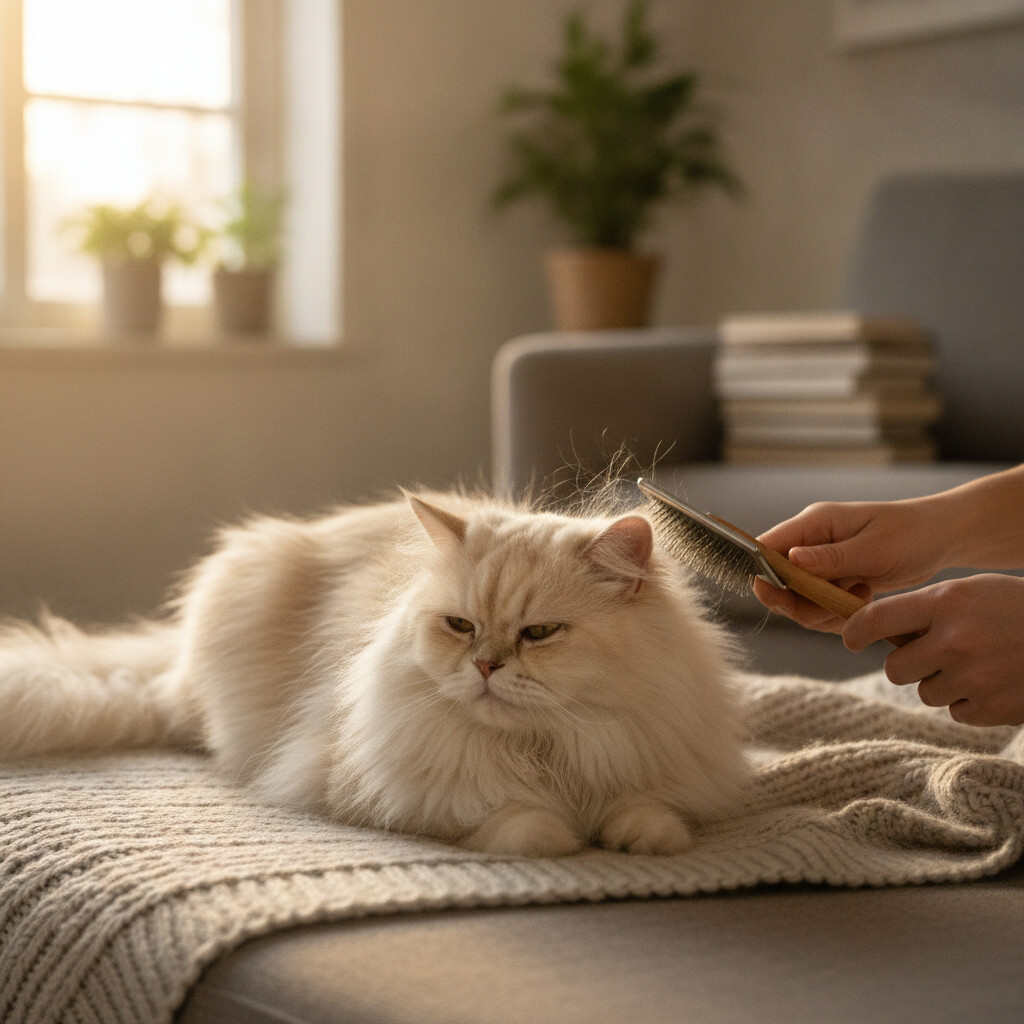
Most indoor cats need a full brushing session once or twice a week, nail trims every 2-3 weeks, and a look-over of their ears and teeth once a month. Long-haired breeds need more — often a quick brush every other day to stay ahead of tangles. There’s no single right schedule, because it depends on coat length, age, and how much your cat grooms themselves, but that’s the baseline most vets and groomers work from.
Here’s how to figure out what your specific cat actually needs, and how to make the process less of a wrestling match.
Why grooming frequency depends on coat type first
Cats groom themselves constantly — a healthy adult cat spends something like 30-50% of their waking hours doing it. That’s why short-haired cats often look fine with minimal help from you: their coat is short enough that self-grooming keeps loose hair and tangles from becoming a problem.
Long-haired breeds (Persians, Maine Coons, Ragdolls) don’t have that luxury. Their coats mat easily, especially behind the ears, under the front legs (the “armpit”), and around the belly and hind legs — spots the cat’s own tongue can’t fully reach or where friction from movement tangles the fur faster than they can manage it.
Rough frequency guide by coat type:
- Short-haired cats: Brush once a week, more during spring and fall shedding seasons.
- Medium-haired cats: Brush 2-3 times a week.
- Long-haired cats: Brush every 1-2 days. Skipping more than a few days lets mats start, and once a mat forms close to the skin, it usually has to be cut out rather than brushed out.
- Hairless breeds (Sphynx): Not a brushing situation — these cats need weekly bathing instead, because without fur to absorb it, the natural body oil builds up on the skin.
Age changes this too. Kittens groom themselves reasonably well once they’re a few months old, but very young kittens and senior cats often need more help — kittens because they’re still learning, seniors because arthritis and reduced flexibility make it physically harder for them to reach their whole body. If you’ve got an older cat, the senior cat wellness guide has more on what changes as cats age.
Nails, ears, and teeth aren’t optional extras
Brushing gets the attention, but the rest of a grooming routine matters just as much.
Nail trims: Most indoor cats need their nails trimmed every 2-3 weeks. Outdoor or highly active cats that scratch on rough surfaces regularly may wear their nails down naturally and need trims less often. Overgrown nails can curl and grow into the paw pad, which is painful and can get infected — so this isn’t purely cosmetic.
Ears: A quick weekly glance is enough for most cats — you’re looking for excess wax, redness, odor, or head-shaking, which can signal ear mites or an infection. Healthy cat ears are largely self-cleaning; you generally don’t need to clean inside the ear canal unless a vet tells you to.
Teeth: This is the one most owners skip, and it’s arguably the most important. The American Veterinary Medical Association notes that dental disease affects the majority of cats by age three. Daily brushing is ideal but rarely realistic — even 2-3 times a week with a cat-safe enzymatic toothpaste meaningfully cuts plaque buildup.
Eyes: Some breeds (Persians, other flat-faced cats especially) get more tear staining and need the corners of their eyes wiped with a damp cloth every few days.
How to keep your cat calm during grooming
The biggest reason grooming routines fall apart isn’t laziness — it’s that the cat hates it, and nobody wants a fight three times a week.
A few things that consistently help:
- Short sessions, often, beats long sessions, rarely. Five minutes of brushing every other day is easier on both of you than a 30-minute battle once a month.
- Pick a calm moment. After a meal or during a normal nap-adjacent lull works better than right after play, when a cat is still keyed up.
- Start with areas your cat already likes being touched — usually the back and shoulders — before moving to more sensitive spots like the belly, tail base, or paws.
- Stop before your cat gets tense, not after. Ending on a good note, even if the session was short, builds a better association than pushing until they’ve had enough.
- Use the right tool for the coat. A slicker brush works well for most coats; a metal comb is better for finding mats close to the skin. A rubber grooming mitt is often the easiest entry point for cats who are outright brush-averse, since it feels more like petting.
If your cat is genuinely difficult about the whole process, our guide to grooming a cat that hates being groomed goes deeper on desensitization techniques. And if you’d rather compare actual brushes and combs before buying anything, our roundup of grooming tools breaks down what’s actually worth it.
Professional grooming: how often, and who actually needs it
Not every cat needs a professional groomer, but some genuinely do — mainly long-haired cats prone to matting, senior cats who can no longer groom themselves well, and overweight cats who physically can’t reach certain areas of their own body.
For cats who need it, every 6-8 weeks for a full groom (bath, brush-out, nail trim, sanitary trim) is a common interval among professional groomers, though a lot depends on how well the at-home routine is keeping up between visits. If mats are already established when you get to the groomer, they may need to be shaved out rather than brushed out — which is safer for the cat’s skin than trying to cut mats out with scissors at home.
When to see a vet
Grooming struggles are sometimes a sign of something more than a stubborn cat. Talk to your vet if you notice:
- Mats that keep reforming in the same spot despite regular brushing — this can sometimes point to a skin issue underneath
- Bald patches, especially if the cat seems to be over-grooming (licking one area raw) or under-grooming (stopping self-care almost entirely)
- Redness, scabs, or a strong odor from the skin or ears
- A sudden drop-off in self-grooming, particularly in an older cat — it’s one of the more reliable early signs of arthritis pain or general illness, since a cat that hurts often stops bothering
- Nails that seem to be growing unusually fast or curling despite regular trims
A vet can rule out or address underlying causes — allergies, parasites, dental pain that’s making the cat reluctant to groom near the face, or joint pain — that no amount of brushing will fix on its own.
The bottom line
Match the routine to the coat: short-haired cats need light weekly maintenance, long-haired cats need brushing every day or two, and everyone benefits from nail trims every few weeks and a bit of dental care in between. Keep sessions short and end them before your cat’s patience runs out, and you’ll have a cat that tolerates — sometimes even enjoys — being groomed, instead of one that bolts at the sight of a brush.