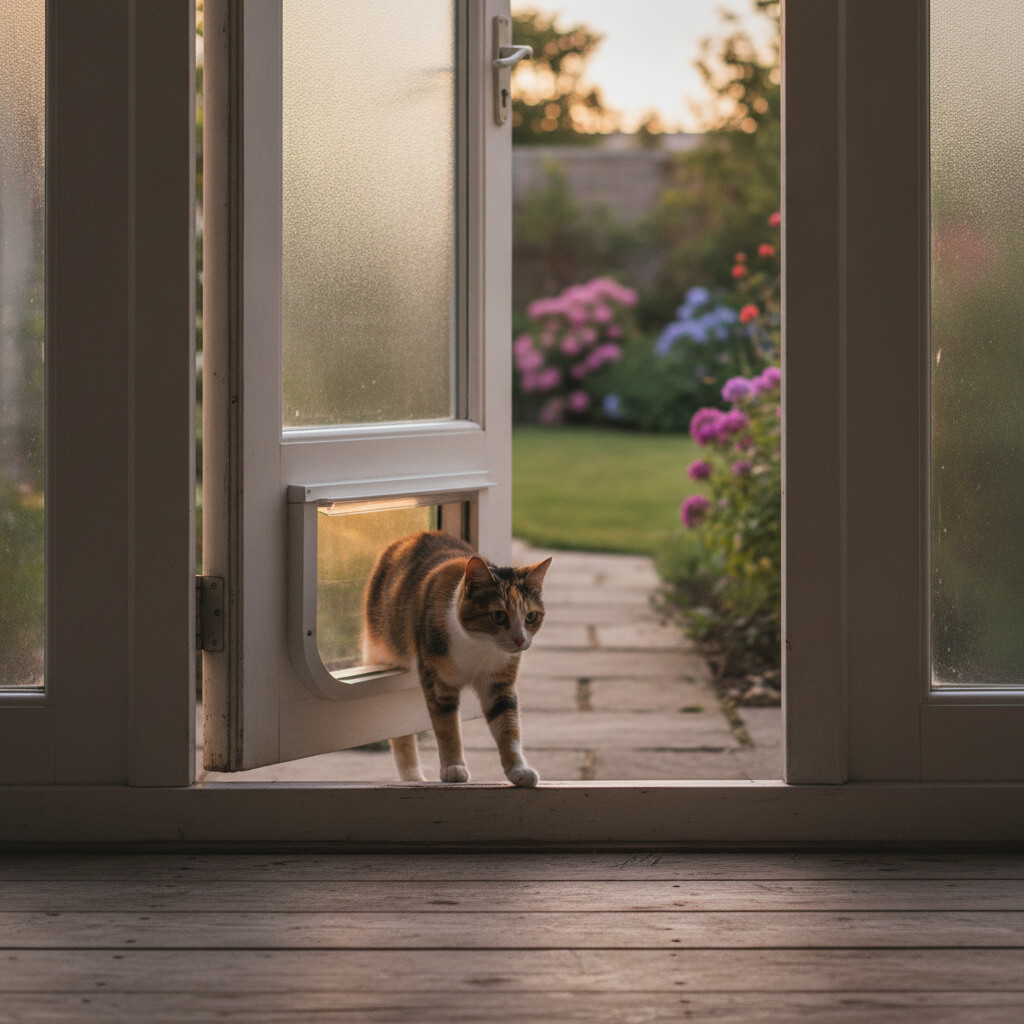
Most cats figure out a cat door in under two weeks if you train the transition instead of just installing the flap and hoping. The short version: prop the flap open first, lure with food and play across the threshold, then lower resistance gradually — never force a cat through a swinging door before they trust it won’t trap or startle them.
Cat doors solve a real problem: you want your cat to come and go without you playing full-time doorman, but a badly introduced one just becomes a piece of plastic your cat refuses to touch for the next three years. Cats are neophobic about anything that moves unpredictably near their face, and a stiff, unfamiliar flap qualifies. The good news is the training itself isn’t complicated — it just has to happen in the right order.
Why Cats Refuse Cat Doors (And It’s Rarely Stubbornness)
When a cat balks at a cat door, it’s almost never defiance — it’s a rational response to an object that looks like it might hit them. The flap moves on its own, it can stick, and pushing through it means briefly losing sight of what’s on the other side. For a species that survives by controlling its environment and avoiding ambush, that’s a legitimate design flaw from the cat’s point of view.
Age matters too. Kittens and younger adult cats typically pick up cat-door use faster than cats over seven or eight, who’ve had years to build a stable sense of “how doors work” that doesn’t include one that swings back and smacks them. That’s not a reason to skip training with an older cat — it just means budget more sessions and lower your expectations for week one.
The Step-by-Step Training Process
Step 1: Prop it open (days 1–3). Tape or wedge the flap fully open so your cat can walk through the frame without touching plastic at all. Let them use it like a hole in the wall for a few days. This step alone solves most of the anxiety — the cat learns the location is safe before the mechanism is introduced.
Step 2: Introduce resistance gradually (days 4–7). Lower the flap so it’s only propped partway — enough that the cat has to nudge it, but it doesn’t swing freely yet. Use wet food or a favorite treat placed just on the other side, and let your cat push through to get it. Repeat several short sessions a day rather than one long one; cats learn better from many brief, low-stress reps.
Step 3: Let it swing (days 8–12). Remove the prop entirely. Some cats sail through at this stage with no issue. Others freeze at the fully mobile flap — if that happens, go back to Step 2 for a few more days rather than pushing forward. Never physically push a cat through a swinging door; it teaches them the door is something that happens to them, which sets training back further than starting from scratch.
Step 4: Build two-way confidence (days 10 onward). Cats often master going one direction (usually the direction toward food or a person) before the other. Practice both ways deliberately — call your cat back through from outside with a treat, so exiting and entering both feel equally safe.
Total training time is typically one to three weeks with consistent short sessions. If your cat still won’t approach the door after three weeks of proper step-by-step exposure, the issue may be less about the door and more about what’s on the other side — see the next section.
What Actually Slows Training Down
A few common mistakes turn a two-week process into a two-month standoff:
- Skipping the propped-open phase. This is the single biggest reason cat-door training fails. Owners install the flap, expect the cat to “just figure it out,” and the cat never builds trust in the space before meeting the mechanism.
- Training when the cat is stressed about something else. A new cat door introduced during a household move, a new pet, or construction noise outside will get blamed for unrelated anxiety. Wait for a calm week if you can.
- Choosing a door that’s too stiff. Magnetic or heavy weatherproof flaps are harder for small or older cats to push through. A lighter flap, at least during training, makes the physical task easier while confidence builds.
- Placing the door somewhere the cat doesn’t want to be anyway. If the door exits onto a loud street, a dog’s territory, or direct sun that overheats the space, the cat’s reluctance may be about the destination, not the door.
Microchip and Selective-Entry Doors: Worth the Extra Cost?
Basic flap doors let anything through — your cat, the neighbor’s cat, and occasionally a raccoon. Microchip-activated and RFID-collar doors solve this by only unlocking for registered pets, and they’re worth the higher price if you live somewhere with a lot of outdoor cat traffic or wildlife pushing into garages and mudrooms. The training process is identical; the door just stays locked until your cat’s chip or tag is read, so budget a couple of extra days for your cat to learn there’s now a brief pause before the flap gives.
Where the Cat Door Leads Matters as Much as the Door Itself
A cat door is only as good as what’s on the other side of it. If it opens into a fully open yard, you’re solving the access problem but re-opening every risk that comes with unsupervised outdoor time — traffic, predators, disputes with other cats, and the simple fact that a cat who comes and goes at will eventually wanders further than planned. Our guide on indoor vs. outdoor cats and what the research actually says covers that trade-off in detail if you’re still deciding.
Many owners land on a middle ground: a cat door that opens into a fully enclosed catio or a yard with a containment system, rather than an unrestricted street-facing yard. If you’re building your own enclosed space, our beginner’s guide to building a catio walks through the basics. For cat owners who want the whole yard rather than a single enclosed structure, fence-mounted containment systems — like Oscillot — are another option worth knowing about; they work by making the top of an existing fence impassable rather than confining the cat to one small area. You can read more about how that approach works at oscillotamerica.com.
If full outdoor access isn’t right for your situation, leash walking is a genuinely good middle step — see our guide on leash training your cat for safe outdoor walks.
The Practical Takeaway
Don’t install a cat door and expect instinct to take over — prop it open first, add resistance in small stages over one to three weeks, and never force a cat through a swinging flap. Where the door leads matters just as much as the training: think through what “safe outdoor access” actually looks like for your cat before you cut the hole in the wall.