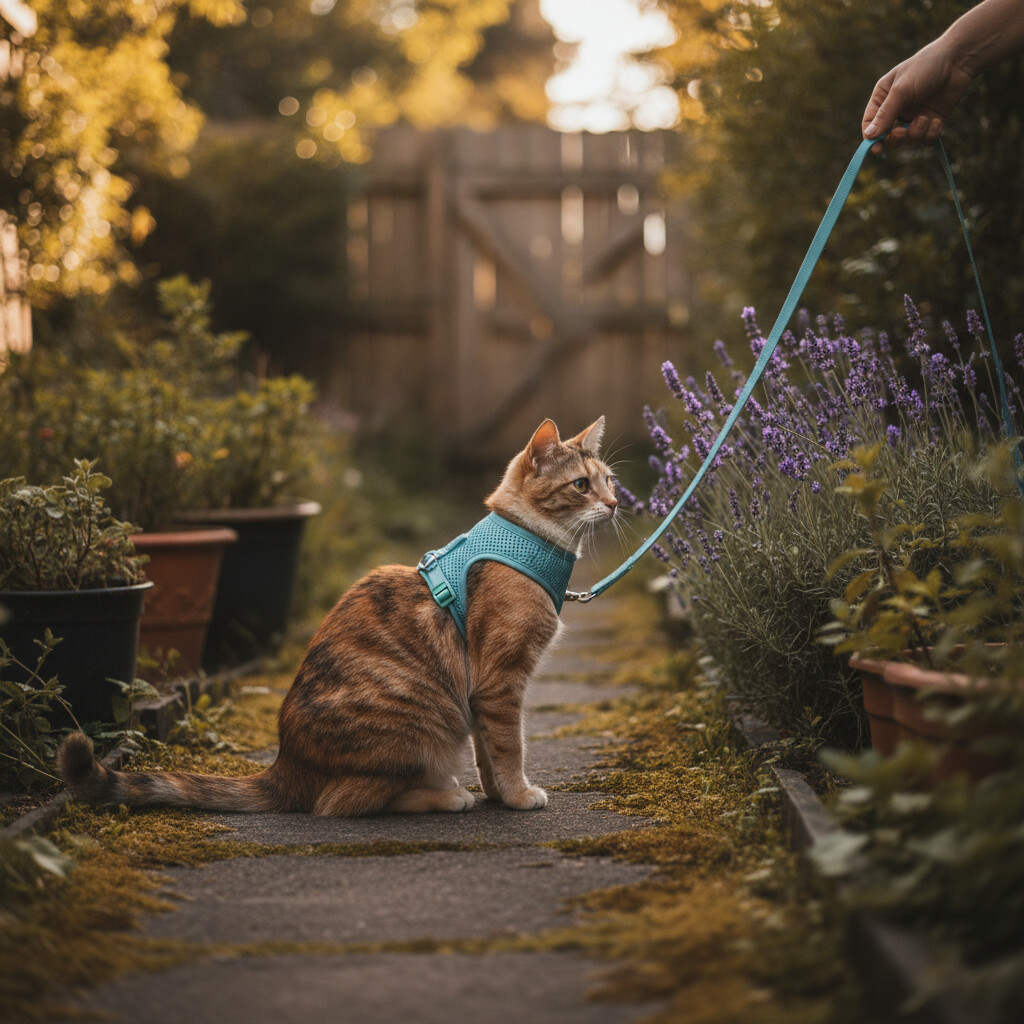
Yes, cats can be leash trained — but it takes longer than most people expect, and the harness matters more than the leash. The short version: start indoors with the harness alone, build up in short sessions over one to three weeks before ever heading outside, and pick a well-fitted H-style or vest harness over a collar, which cats can back out of in seconds. Here’s how to actually do it without the process turning into a wrestling match.
Why Bother Leash Training a Cat
For indoor cats, a well-run leash walk is one of the only ways to give them real outdoor sensory input — grass, air, sounds, movement — under full control. It’s not a replacement for a safe, permanent outdoor setup, but it’s a genuinely useful supplement, especially for cats showing signs of under-stimulation or window-frustration. It’s also worth being honest about the limits: some cats never enjoy it, and forcing a cat who’s clearly stressed by the harness or the outside world isn’t worth the fight. This is optional enrichment, not a requirement of good cat ownership.
Choosing the Right Harness
Skip the collar entirely — a startled cat can slip a collar or, worse, injure their neck pulling against it. What you want is a harness that distributes pressure across the chest and shoulders and that your cat physically cannot back out of.
- H-style harnesses have two straps that form an H across the back and chest, adjustable at multiple points. Good for cats who tolerate a snugger fit.
- Vest-style (wrap-around) harnesses cover more surface area and tend to feel more secure to nervous cats, since there’s less exposed strap to wriggle against.
- Fit test: you should be able to fit two fingers snugly between the harness and your cat’s body — tight enough that they can’t back out, loose enough that it’s not restrictive.
Avoid figure-8 harnesses and anything that only clips around the neck like a collar. If in doubt, a slightly oversized vest harness is safer than an undersized H-style one.
The Indoor Training Phase (Don’t Skip This)
This is the step people rush, and it’s the reason so many leash-training attempts fail in the first five minutes outside.
Days 1–3: Leave the harness sitting near your cat’s food bowl or favorite napping spot so it stops being a novel, scary object. Let them sniff it. Don’t put it on yet.
Days 3–5: Put the harness on for 30 seconds to a minute at a time, paired immediately with a high-value treat or a meal. Take it off before your cat starts trying to remove it themselves — you want the association to stay positive. Most cats will freeze, flop over, or walk stiffly the first several times. That’s normal; it’s not distress unless it’s paired with hiding, hissing, or panicked struggling.
Days 5–10: Extend the time the harness stays on gradually, letting your cat walk around the house in it during normal activity — mealtime, play, lounging. Attach the leash but let it drag loosely; don’t pick it up yet.
Days 10–14 (or longer): Start holding the leash indoors, following your cat’s lead rather than steering. The goal at this stage is just “leash exists and nothing bad happens,” not directional walking.
Some cats move through this in a week. Others need a month. Cat temperament varies enormously here — there’s no reliable shortcut, and pushing the timeline usually backfires into a cat who now avoids the harness altogether.
Taking It Outside
Once your cat is calm and moving normally on the leash indoors, choose a quiet outdoor spot for the first outing — not a busy sidewalk, not a location with unfamiliar dogs nearby. A backyard, porch, or quiet corner works best. Let your cat set the pace entirely; the first few outdoor sessions are about acclimating to open space, not covering distance. Watch for flattened ears, a low crouch, dilated pupils, or attempts to bolt — any of these mean it’s time to go back inside, not push through.
Keep early sessions to five or ten minutes. Cats tire of new stimulation faster than dogs do, and a short positive session beats a long one that ends in stress.
What Leash Walking Can’t Replace
It’s worth being clear-eyed about this: leash walks are supervised, time-limited, and require your full attention for the duration. They’re not a substitute for a cat’s daily need for autonomous outdoor access or exercise, and they don’t scale — you can’t leash-walk a cat for six hours while you’re at work. For owners wanting to give their cat more independent outdoor time without the risks of free-roaming, options like a secure catio (see our beginner’s guide to building one) or a fence-top containment system such as Oscillot are worth looking into as a complement to, not a replacement for, leash walks. Vertical space indoors matters here too — a leash-trained cat still needs places to climb and perch on the days you don’t get outside together.
Troubleshooting Common Problems
Cat goes limp and refuses to move. This is extremely common and not a sign of trauma — it’s often just uncertainty. Sit down at their level, let them adjust, and try short forward motion with a treat as a lure rather than pulling the leash.
Cat tries to climb out of the harness. Usually a fit problem, not a training problem. Recheck sizing — a harness that’s even slightly loose gives a determined cat room to wriggle free.
Cat seems fine indoors but panics outside. Go back a step. Spend more sessions on the porch or in a fully enclosed yard before attempting anywhere with traffic, dogs, or strangers nearby.
The Bottom Line
Leash training a cat is entirely possible for most cats, but it’s a slow-build project measured in weeks, not an afternoon activity. The harness fit and the unhurried indoor phase are what separate a cat who eventually enjoys supervised outdoor time from one who now hides at the sight of the harness. If your cat clearly isn’t warming to it after a genuine, patient attempt, that’s a legitimate outcome too — plenty of cats get their enrichment needs met entirely indoors, and that’s fine.