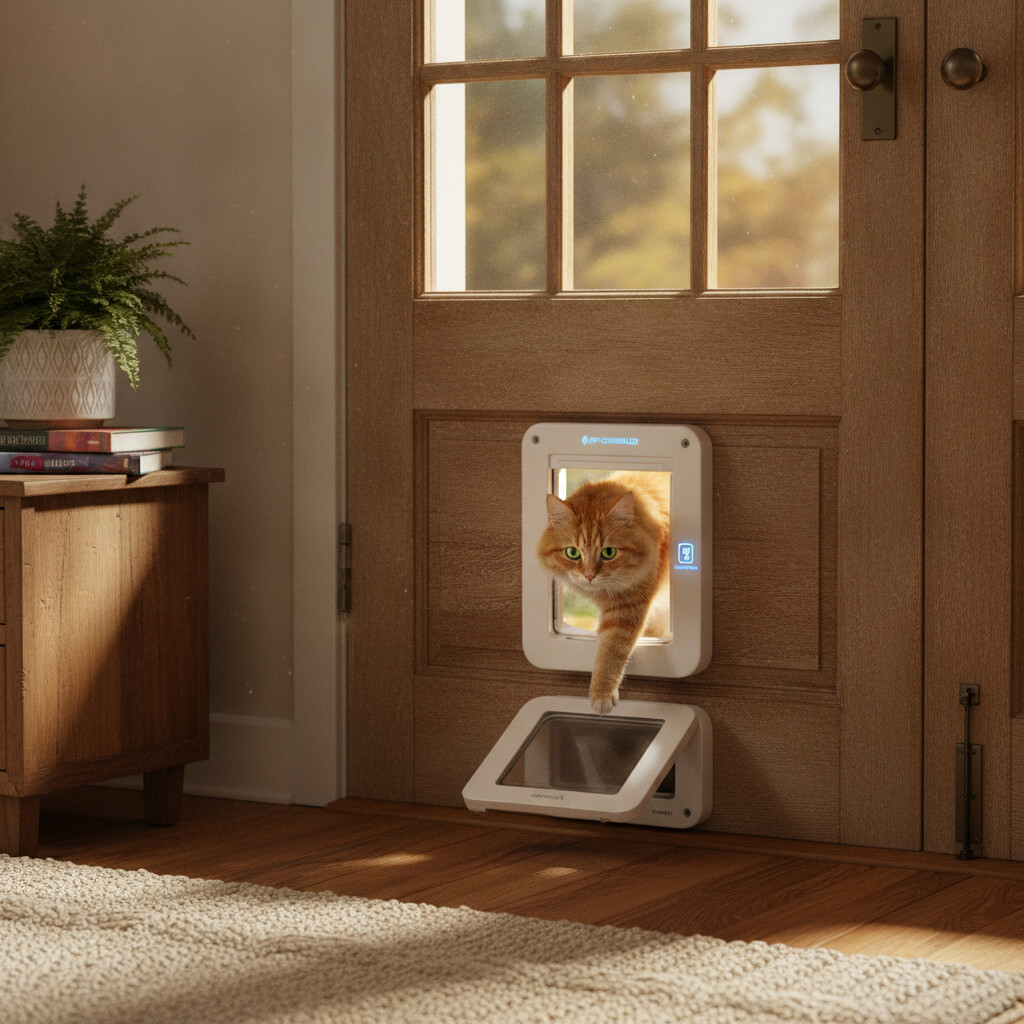
A manual flap door costs $20 and works with any cat who’ll walk through it. A microchip-reading door costs ten times that and solves a specific problem: keeping other animals out. Which one you need depends entirely on what you’re actually trying to control — your own cat’s access, or everyone else’s.
The Three Real Categories
Cat doors break down into three tiers, and the jump between them is about selectivity, not just price.
Manual flap doors are a hinged flap set into an actual door, wall, or window that any animal (or determined raccoon) can push through. They’re cheap, simple, and have almost nothing to break. The tradeoff is that they don’t discriminate — your cat, the neighbor’s cat, and local wildlife can all use them equally.
Magnetic-collar doors unlock only when a cat wearing a paired magnetic key (usually on the collar) approaches. They’re a step up in selectivity and cost less than microchip models, but they depend on the cat reliably wearing a collar — which not every cat tolerates, and collars can fall off or get left behind.
Microchip and RFID doors read your cat’s existing ID microchip (or a separate RFID tag) and only unlock for registered chips. No collar needed. This is the category to consider if the real problem is other animals getting in — a neighborhood cat helping themselves to your cat’s food, or wildlife wandering into the house.
There’s also a fourth, more recent category: app-controlled doors with a camera and a phone app, which layer scheduling, activity logs, and remote lock/unlock on top of microchip recognition. These cost the most and are the most failure-prone (Wi-Fi drops, batteries die, apps update badly) but they’re the only option that lets you keep a cat in or out on a schedule without being home.
What Actually Matters When Choosing
What problem are you solving? If your cat already only goes where you want and the door is just a convenience, a manual flap is genuinely fine — there’s no reason to pay for selectivity you don’t need. If unwanted animals are the issue, skip straight to microchip. If you want to control the schedule (keep your cat in overnight, say), you need app control.
Installation surface. Manual and magnetic doors install easily into a hollow door or thin wall. Microchip and app-controlled doors are heavier and often need a solid mounting surface — glass installations usually require a professional cut, and exterior walls need weatherproofing that a DIY install can get wrong.
Battery life and failure mode. Every electronic door runs on batteries (usually 4x AA, sometimes rechargeable). Check what happens when they die — the better designs default to “locked” so nothing unwanted gets in, but a few default to “unlocked,” which defeats the purpose. This is worth confirming before buying, not after.
Weather sealing. For exterior installs, look for a door with a proper brush or magnetic seal around the flap. A poorly sealed door in a Midwest winter will cost you more in heating than the door itself.
Multi-cat households. Microchip doors can usually be programmed to recognize multiple chips, but check the stated limit — some budget models cap out lower than expected, which matters if you have four or five cats.
Training Your Cat to Use One
Even the best door is useless if your cat won’t go through it. A few things make the transition faster:
- Prop the flap open for the first few days so your cat can walk through without pushing anything
- Use treats or a favorite toy on the other side to build a positive association
- Lower the resistance/stiffness setting if the door has one — a flap that requires real force to push open will spook a hesitant cat
- Never force a cat through — let them investigate and approach it on their own timeline
Most cats take one to two weeks to use a new door confidently. If yours is still refusing after that, the resistance is usually too high, or the door is placed somewhere the cat associates with a startling noise or draft. For more on the training side specifically, our guide to safely training a cat to use a cat door walks through the process step by step.
A Note on Outdoor Access
A cat door — of any kind — controls entry, not what your cat encounters once they’re outside. It doesn’t stop road traffic, other animals, or your cat wandering further than you’d like. If the actual goal is safe, contained outdoor access rather than just a convenient way in and out, that’s a separate problem with a separate set of solutions — worth researching on its own before you assume a door alone solves it. It’s also worth reading what the research actually says about indoor vs. outdoor cats before deciding a door is the right move at all, and having a plan ready in case a cat door leads to a cat getting further than expected.
The Bottom Line
Start with the problem, not the product. If it’s just convenience for a cat who already stays where you want, a $20–40 manual flap does the job with the least to go wrong. If other animals are getting in, a microchip door earns its higher price. App-controlled doors are worth it only if you genuinely need scheduling or remote control — otherwise you’re paying extra for a feature you won’t use, and adding a battery and Wi-Fi dependency you didn’t need. Match the door to the actual problem, and skip the tier above it.