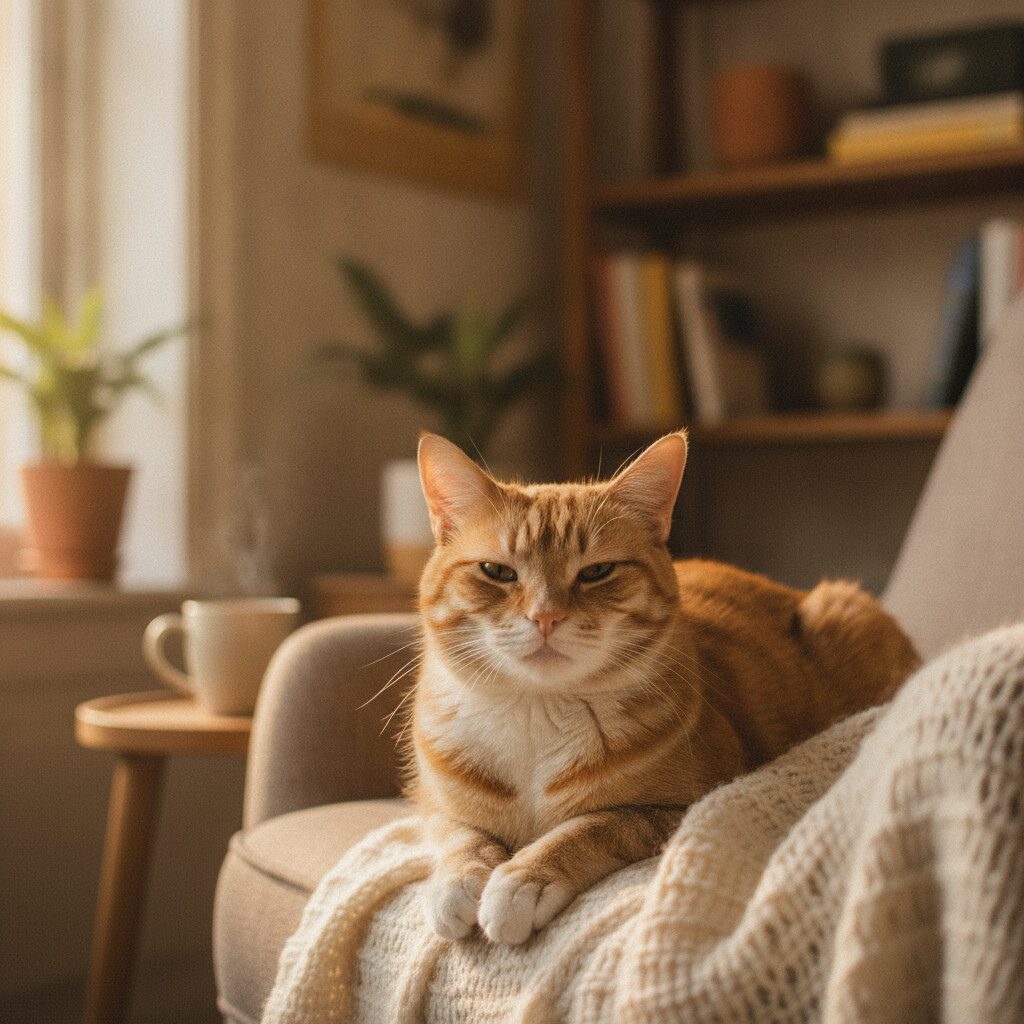
You’ve probably heard that if you slow blink at your cat and they blink back, it means they trust you. Cat content creators have made this into one of the defining behaviours of the “speaking cat” genre. But what does the research actually say — and does the technique work if you initiate it?
The honest answer: there’s real science behind it, with a few important caveats.
What a Slow Blink Actually Signals
In cat communication, sustained direct eye contact signals threat or challenge. Wild cats and domestic cats both use hard staring as a dominance or threat signal. A slow, deliberate blink from a cat has the opposite effect — it’s a signal that means “I’m relaxed around you, and I’m choosing not to look threatening right now.”
Think of it as a cat’s version of standing down. A cat that slow blinks in your presence is demonstrating that they don’t perceive you as a threat and are comfortable enough to momentarily break eye contact and close their eyes — a vulnerable thing to do for a predator.
This is well documented in the veterinary behaviour literature. It’s not a sign of love in the human sense, but it is a genuine communication of ease and trust.
What the Research Says
A 2020 study published in Scientific Reports by researchers at the University of Sussex (conducted by Dr. Karen McComb and Dr. Tasmin Humphrey) is the most cited piece of direct research on this. They ran two experiments:
Experiment 1: Owners slow blinked at their cats in their home environments. Cats responded with significantly more slow blinks and half-blinks compared to when owners maintained a neutral expression (no deliberate blinking). This showed cats respond to the signal.
Experiment 2: A stranger — not the cat’s owner — approached a cat and either slow blinked first or used a neutral expression. Cats approached the strangers who slow blinked significantly more often than those with neutral expressions.
The study concluded that the slow blink sequence is a genuine positive emotional signal that cats produce and respond to, and that humans can initiate it successfully even with unfamiliar cats.
This is genuinely unusual in animal cognition research — most human-animal communication studies show that signals go in one direction or are lost in translation. Here, a human-initiated cat signal produced a measurable response.
Does It Actually Work? Practical Guidance
The research says yes — but with conditions:
What increases success:
- Relax your expression before you start. Tension around your eyes or forehead undercuts the signal.
- Slow down. A slow blink takes about 2–3 seconds — eyes closing slowly and opening slowly. Not a blink, not a long stare with a wink.
- Don’t stare intensely before starting. A brief soft look, then close slowly.
- Half-blinks count. Cats don’t always return a full slow blink — a half-blink, or a brief eye closure, is a response.
What doesn’t work:
- Forcing it on a stressed or highly aroused cat. If a cat’s tail is puffed, ears are flat, or they’re actively hiding, the slow blink doesn’t apply. A cat needs to be at baseline calm for the signal to land.
- Doing it from across the room at a cat you’ve never interacted with. The Sussex study showed it works with strangers, but context matters — a cat already wary of you needs more groundwork first.
- Treating it as a one-way trick. The slow blink is communication, not a hack. A cat that consistently does NOT respond to slow blinks is telling you something about their comfort level with you.
When Cats Initiate the Slow Blink
The most reliable version of this signal is when a cat does it unprompted. If your cat is sitting across the room, watching you do something, and they do a long slow blink in your direction — that’s a cat saying “I see you, and I’m completely fine with you being here.” It’s an affiliation signal that domestic cats have developed specifically for humans, which is significant: most cat social signals evolved for cat-to-cat communication, not cross-species use.
For context on the full range of cat body communication — including tail postures, ear positions, and vocalisation — see the Cat Body Language Guide on the forum.
The Bigger Picture: What This Tells Us About Cats
The slow blink research is notable for a reason beyond the behaviour itself. For a long time, domestic cats were considered less socially complex than dogs — less attuned to human signals, less interested in communication. The Sussex study is part of a growing body of evidence that cats are more socially responsive to human cues than previously thought, and that their communication is simply more subtle and less obvious than dogs’.
Cats show affiliation differently: through proximity, shared space, scent exchange (the headbutt, or “bunting”), and quiet signals like the slow blink. If you’ve been interpreting your cat’s blank stare as indifference, check whether it’s interspersed with slow blinks — you may have been missing the “I’m fine with you” messages entirely.
If your cat’s body language generally suggests stress rather than ease — and you’re not sure where the tension is coming from — the 10 Signs Your Cat Is Stressed article covers what to look for and what to do about it.
The Short Version
Yes, slow blinking works. It’s grounded in real behavioural research, not internet mythology. Your cat produces this signal naturally, and they respond when you do it too — even if you’re a stranger to them. The catch is that it only works when the cat is already calm, and it requires you to do it properly: slow, deliberate, relaxed. When in doubt, return a slow blink when your cat gives you one first. That’s always the right move.