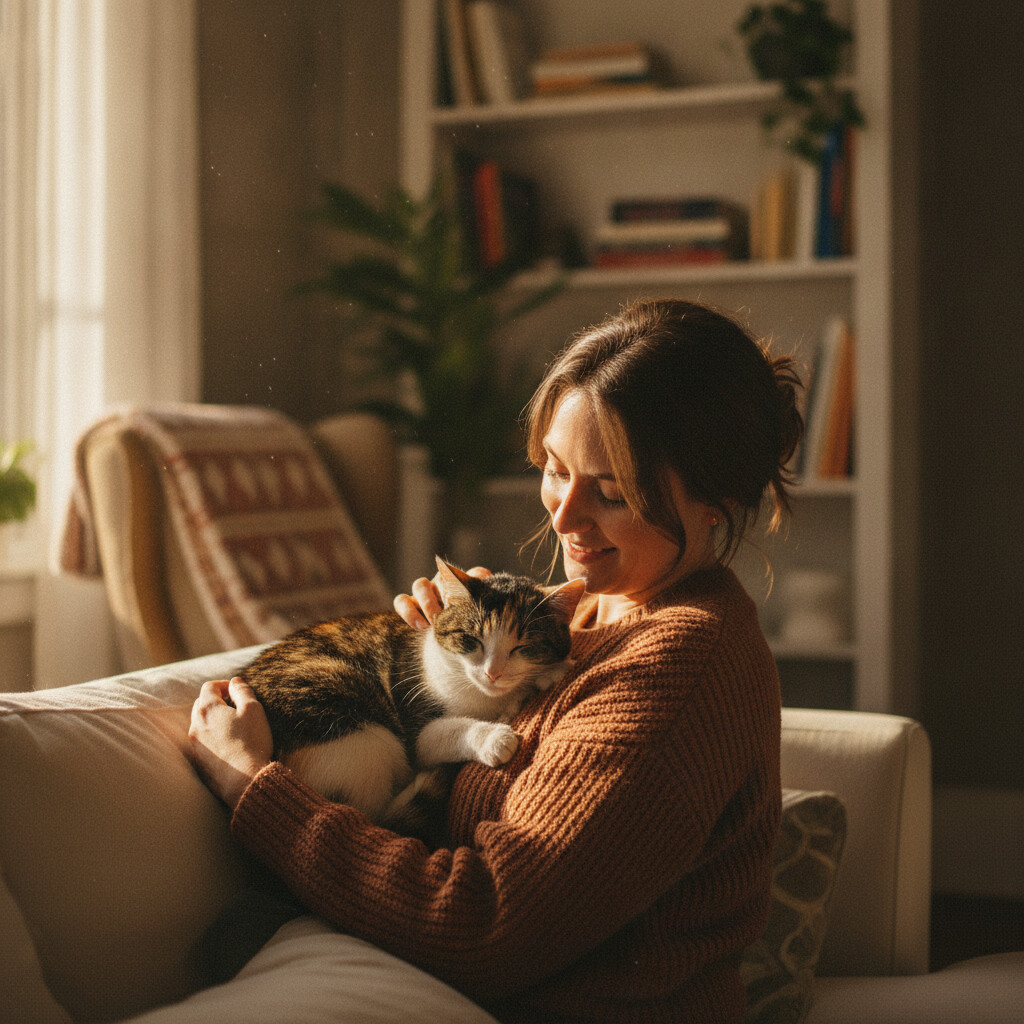
If your cat has one person they follow around, sleep next to, and tolerate in ways they won’t tolerate from anyone else, you’re not imagining it. Cats really do form stronger attachments to specific people, and researchers have a decent idea of why: it usually comes down to who reads their signals correctly and who doesn’t force interaction on them.
Cats Form Real Attachment Bonds — Not Just Feeding Association
For a long time, the going assumption was that cats bond with whoever feeds them, full stop. Research has complicated that picture. A study published in Current Biology (2019) tested cats using an adapted version of the “strange situation” protocol originally designed to study infant-caregiver attachment in humans, and found that the majority of cats displayed secure attachment behaviors toward their owner — seeking proximity when stressed, using the person as a “secure base” to explore from. This is the same attachment framework used to study dogs and human infants, and cats showed comparable attachment styles, not the purely transactional relationship they’re often assumed to have.
Feeding matters, but it’s not the whole story. Cats in multi-person households often gravitate toward someone who doesn’t feed them at all, which is the strongest evidence that something else is driving the preference.
What Actually Predicts a Cat’s Favorite Person
Who lets the cat initiate contact. This is probably the single biggest factor. Cats are far more likely to bond with people who wait for them to approach, rather than people who pick them up, chase them for pets, or loom over them. Feline behaviorists consistently point to this as the difference between “the person my cat avoids” and “the person my cat sits on.” If you’ve ever noticed your cat gravitating toward the one guest in the room who’s ignoring them, that’s exactly this dynamic — indifference reads as safety.
Who respects the cat’s body language. Cats communicate reluctance clearly — a flick of the tail, ears rotating back, a stiffening body — and people who back off when they see those signals get trusted more over time than people who push through them. This is consistent with what’s known about feline stress responses generally: cats build associations quickly with people (and situations) that reliably predict discomfort versus ones that don’t.
Consistency and predictability. Cats are creatures of routine, and people who interact with them in predictable ways (same tone of voice, same rough timing, same type of attention) tend to become the “safe” choice. Erratic attention — enthusiastic petting one day, ignored the next — doesn’t build the same trust.
Low-pressure proximity. Sitting quietly nearby, working at a desk, reading — these give a cat the option to approach without demanding anything from them. Cats often choose to bond with the person in the house who is simply around the most in an unpressured way, not necessarily the person actively trying hardest to win them over.
Scent and voice familiarity, especially from early life. Kittens exposed positively to a particular person’s voice and scent during the socialization window (roughly 2–7 weeks) can carry a bias toward that kind of person into adulthood, though this is a much smaller factor for adult cats forming new bonds.
Why “Trying Harder” Often Backfires
If you’re the person your cat avoids, the instinct is usually to try harder — more attention, more treats, more physical affection. This usually makes things worse, not better. Cats read persistent pursuit as pressure, and pressure is the opposite of what builds trust. The more effective approach, according to behaviorists who study human-cat interaction, is closer to the opposite: sit near the cat without looking directly at them (direct eye contact can read as a threat display to a nervous cat), let them approach, and reward proximity with calm, low-key attention rather than an enthusiastic response that might spook them.
A slow blink — a relaxed, half-closed-eye look held for a second or two — is one of the more reliable non-threatening signals you can send. Cats who receive slow blinks from a person are measurably more likely to slow-blink back and approach, according to research on feline-human communication.
Does It Mean the Cat Loves That Person More?
Not necessarily — it usually means that person is easier to be around. A cat’s favorite person is often simply the one who creates the least social friction: predictable, unpressured, responsive to the cat’s own signals. That’s not a lesser form of affection; for a species that evolved as a solitary hunter without much need for complex social bonding, it may be the clearest form cat affection takes.
It’s also worth noting that “favorite person” status isn’t fixed. Cats can and do shift preferences over time, particularly after a change in household routine, a move, or simply as the relationship with a person evolves. If you’re consistently the one doing feeding, litter maintenance, and vet visits but your cat still prefers someone else, that’s not a verdict on the relationship — it just means the other person has, probably without trying, hit the right combination of low-pressure and predictable.
How to Become the Preferred Person (If You Want To Be)
- Let the cat approach first, every time you can manage it
- Avoid picking the cat up unless they’re already seeking that contact
- Use slow blinks instead of prolonged eye contact
- Keep your voice and movements calm and predictable around them
- Spend unstructured time in the same room without demanding interaction
- Offer a hand at cat-nose-height and let them choose whether to sniff and lean in
None of this works overnight. Cats build trust incrementally, and a cat who’s had a few bad experiences with over-eager handling may take weeks of consistent, low-pressure exposure before they start choosing to approach on their own.
The Bottom Line
A cat’s favorite person usually isn’t the one who tries hardest — it’s the one who reads the room best. If you want to understand more of what your cat’s body is telling you day to day, our Cat Body Language Guide breaks down tail, ear, and posture signals in detail, and our piece on The Slow Blink goes deeper into one of the simplest tools you have for building trust with a wary cat.