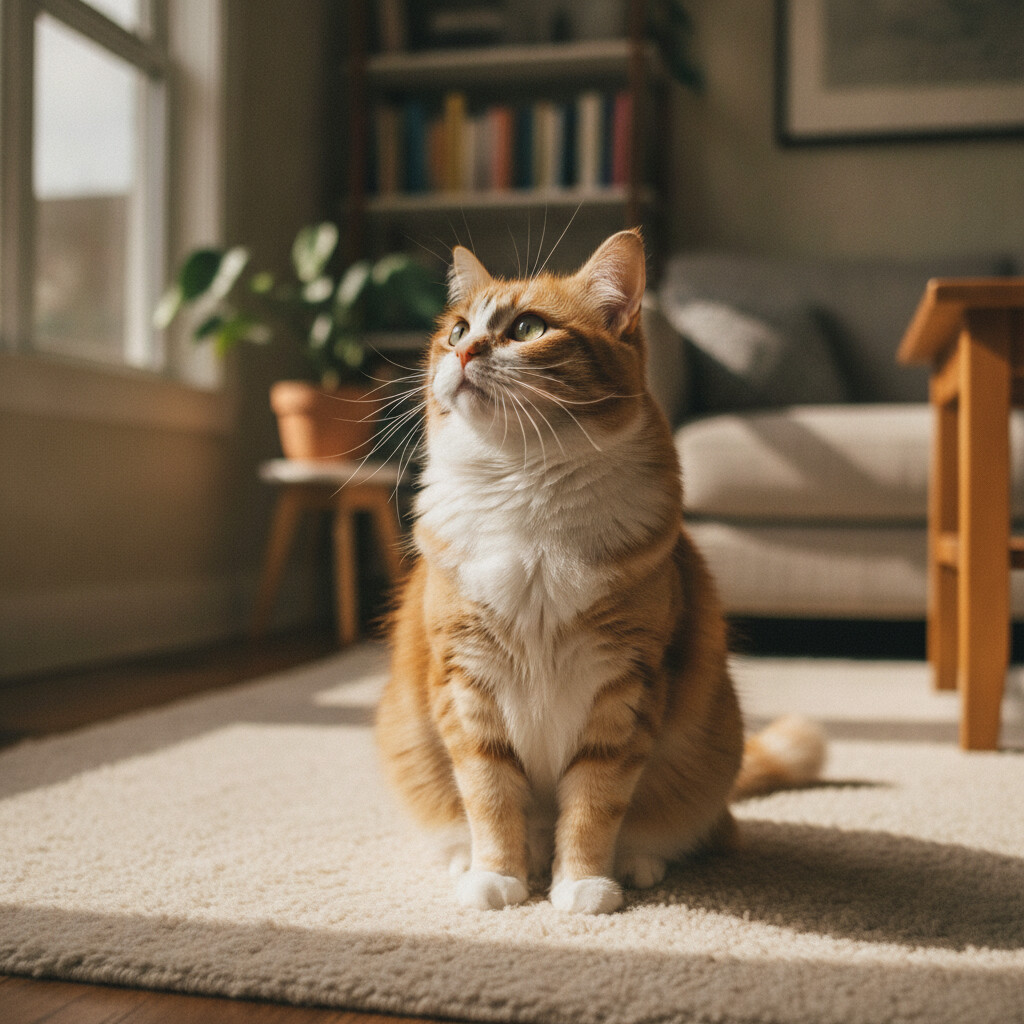
Your cat tilts their head because they’re actively trying to locate and interpret a sound — usually your voice — and it’s most often a sign of engagement, not confusion. It’s one of the more charming feline behaviors precisely because it looks like understanding, and in a real sense, it kind of is.
The Leading Theory: Better Sound Localization
Cats have exceptional hearing — a range up to roughly 64 kHz, well beyond human hearing and even beyond most dogs’ range, which helps them detect the ultrasonic calls of small rodents. But that same sensitivity comes with a tradeoff: a cat’s outer ear shape and the position of their ears on their head can make it harder to pinpoint exactly where a sound is coming from when it’s directly in front of them, especially unfamiliar or complex sounds like human speech.
Tilting the head shifts the angle at which sound reaches each ear canal, which helps the brain triangulate the sound’s source and better distinguish its component frequencies — the same reason owls and dogs do a version of this too. When you talk to your cat in that slightly higher-pitched, sing-song way most people unconsciously use, you’re producing a more complex, variable sound than a flat statement — and complex, novel sounds are exactly what triggers the head tilt. It’s a listening posture, not a “does not compute” moment.
It’s Also a Bonding and Attention Signal
The sound-localization theory explains the mechanism, but it doesn’t fully explain why some cats do it constantly with their favorite person and rarely with strangers. Cats are highly attuned to human vocal tone, and there’s growing interest among feline behaviorists in how cats use physical responses like head tilts, slow blinks, and ear position as social feedback during interaction — signals that say “I’m paying attention to you specifically.”
A cat who tilts their head when you speak directly to them, especially while making eye contact, is engaging with you the way they might orient toward another cat’s chirp or a bird outside the window: with focused interest. It tends to show up most with cats who already have a strong bond with their owner, which is part of why it reads as endearing — it usually is a form of attention.
If you’re curious about other subtle communication signals cats use with people they trust, The Slow Blink: What It Means and Whether It Actually Works and Why Does My Cat Stare at Me Without Blinking? cover two of the more researched examples.
Not Every Head Tilt Is the Same
Context matters. A brief, alert head tilt in response to your voice, a squeaky toy, or an unfamiliar noise — followed by the cat returning to a normal head position — is the engaged, curious version. So is a tilt paired with forward-facing ears and slow blinking, which usually signals comfort and interest rather than alarm.
Compare that to a head tilt that’s constant, one-sided, or held for an extended period without an obvious trigger. That’s a different phenomenon entirely, and it’s worth taking seriously.
When Head-Tilting Isn’t Cute — Vestibular Disease and Ear Problems
A persistent or constant head tilt — where the cat’s head stays tipped to one side even when nothing is happening around them — is a recognized clinical sign, not a personality quirk. The most common causes are:
- Ear infections or inflammation (otitis externa or media), often from mites, bacteria, or yeast, which affect balance-related structures in the middle and inner ear
- Idiopathic vestibular disease, which can appear suddenly, especially in older cats, and often comes with disorientation, circling, or abnormal rapid eye movements (nystagmus)
- Less commonly, polyps, tumors, or neurological issues affecting the vestibular system
According to veterinary consensus on feline vestibular disorders, a true vestibular head tilt is typically accompanied by other signs: loss of balance, falling or leaning to one side, circling, or eyes that flick back and forth involuntarily. A cat engaging playfully with your voice, by contrast, tilts briefly, looks otherwise normal, and isn’t struggling to stay upright.
When to See a Vet
Contact your vet if you notice any of the following, rather than assuming it’s the cute, conversational version:
- The head tilt is constant or doesn’t resolve after the sound or interaction ends
- Your cat seems off-balance, is stumbling, or is leaning or falling to one side
- You notice rapid, jerky eye movements
- There’s visible discharge, odor, redness, or swelling in or around the ear
- The tilt appeared suddenly, especially in a senior cat
- Your cat seems disoriented, is vomiting, or is reluctant to move normally
Ear infections and vestibular disease are both very treatable when caught early, but they don’t resolve on their own, and untreated ear infections in particular can worsen quickly. A same-week vet visit rather than a wait-and-see approach is the right call here.
The Takeaway
A quick, situational head tilt in response to your voice is your cat actively listening and engaging — enjoy it, it’s one of the more genuine signs of a bonded, attentive cat. A tilt that’s constant, one-sided without an obvious trigger, or paired with balance problems is a different story and belongs in front of a vet, not written off as personality. The distinction is really about duration and company: brief and situational is normal; persistent and isolated is a symptom.