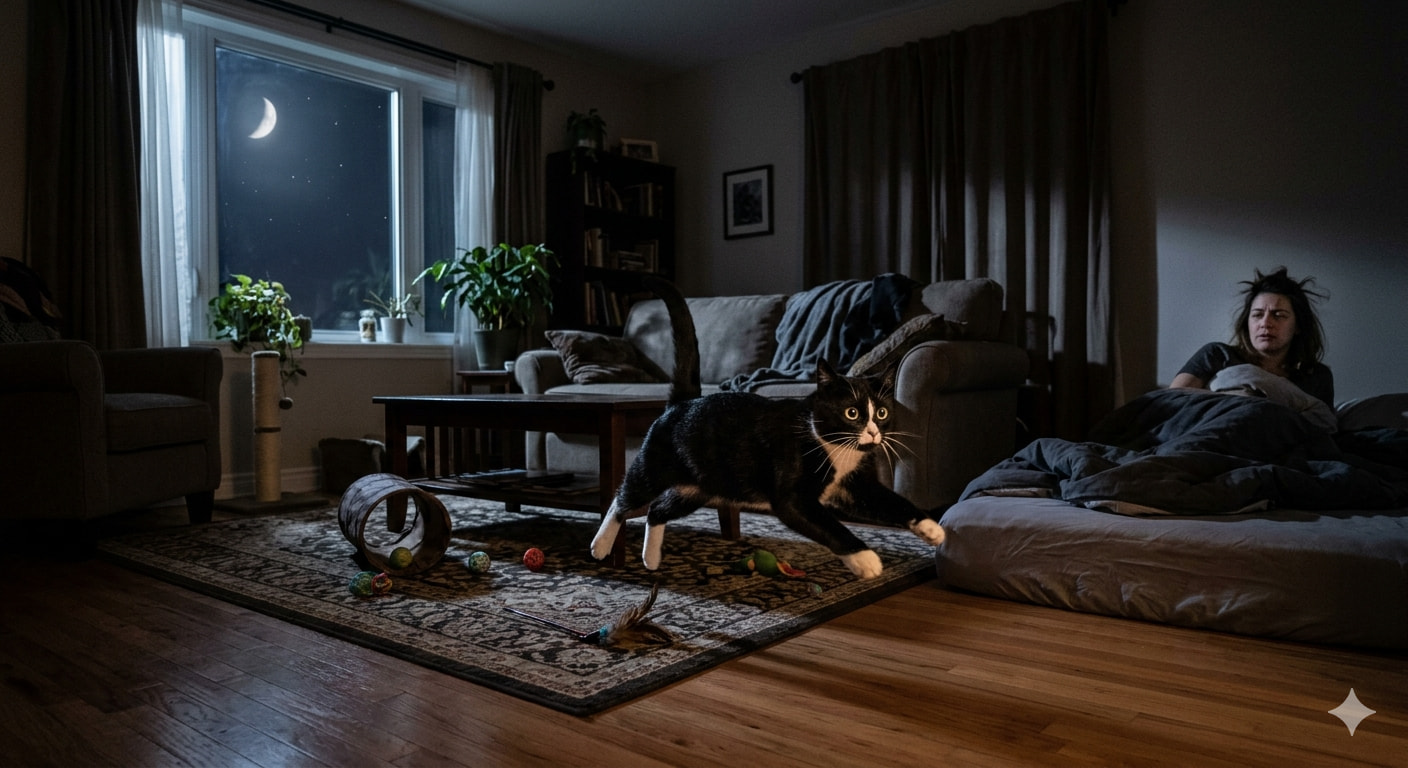
Your cat has been perfectly calm all evening. Then, somewhere around 2–4am, the thundering starts. Laps around the apartment. Furniture parkour. A brief, inexplicable sprint across your face. Then stillness.
This is the night zoomies — and it’s not random, not a glitch, and not your cat’s attempt to destroy you. It makes complete biological sense once you understand how cats are actually wired.
Cats Are Not Nocturnal — They’re Crepuscular
The common assumption is that cats are nocturnal. They’re not. Cats are crepuscular, meaning their peak activity naturally falls at dawn and dusk — the same windows when their primary prey (small rodents and birds) are most active.
In the wild, a cat would spend those twilight hours hunting. At 3am in your apartment, with no prey available and a full food bowl, that predatory energy has nowhere to go. So it gets expressed as a sprint around the living room.
Research on felid activity patterns confirms this: domestic cats retain the same crepuscular rhythm as their wild relatives, modified somewhat by the household schedule. A cat who has adapted to a human household will often shift their activity windows to overlap more with when their humans are awake — but the underlying drive to be active at dawn/dusk doesn’t disappear. It just waits.
Why Some Nights Are Worse Than Others
If zoomies were purely about crepuscular timing, they’d be predictable. Often they are — but several factors amplify them:
Under-stimulation during the day. A bored cat accumulates energy. An indoor cat who has spent 14 hours doing nothing much has a lot more drive to burn when the biological clock says “hunt.” Active play sessions in the evening blunt this significantly.
Age. Kittens and young adult cats (under 3 years) have considerably more raw energy than older cats. If you’ve recently acquired a kitten, the zoomie frequency is working as designed. It does calm down.
Diet timing. Cats in the wild eat immediately after a successful hunt. A meal before bed can sometimes signal to the brain that the “hunt” is complete, reducing the drive to stay active. Some owners find a small wet food meal right before their own bedtime shifts the cat’s wind-down timing closer to theirs.
Temperature. Warmer rooms can increase activity; cats run hotter than humans and may be responding to environmental cues as well as internal ones.
Medical factors. Less commonly, sudden or new night activity can indicate a medical issue — hyperthyroidism in middle-aged and older cats is a known cause of increased restlessness and vocalisation at night. If zoomies appear suddenly in a cat over 7 who was previously settled overnight, it’s worth a vet check.
How to Actually Reduce Nighttime Zoomies
The most reliable approach is structured play before bed, not punishment or restriction.
The pre-bed hunt sequence:
- Use a wand toy (feather, rod, or fishing-line type) for 10–15 minutes of active play in the evening — not afternoon, specifically before you go to sleep
- End the play session by letting the cat “catch” the toy and giving a small meal (wet food works best for the satisfaction signal)
- Wind down your own activity; cats often mirror household energy
This mirrors the natural hunt-catch-eat-groom-sleep cycle. Most cats who go through this sequence are significantly more likely to settle for the night.
If you’re looking for toys that work for this kind of structured play, our guide to interactive cat toys for indoor cats covers what actually engages cats versus what looks interesting but gets ignored after a day.
Other practical adjustments:
- Don’t engage with night zoomies. Getting up, talking to the cat, or reacting in any way is rewarding. The cat isn’t acting up to get attention — but attention during zoomies teaches that zoomies generate interaction.
- Scheduled playtime, not just ad hoc. Cats adapt to routines faster than most owners expect. A consistent evening play session at the same time each day tends to become anticipated and relied upon — the cat starts coming to you for play, which is both more satisfying and easier to channel.
- More vertical space and enrichment during the day. A cat with more to interact with during daylight hours burns more energy before the evening peak arrives. Cat trees, window perches with an interesting view, and puzzle feeders all help reduce the surplus energy available at 3am.
If you have a kitten: the honest answer is that this mostly just takes time. Kittens are designed to be highly active. Structured play helps, but kittens under 6 months have energy levels that no amount of strategy will fully contain. A second kitten as a play partner is one legitimate solution if you’re open to it — they’ll wear each other out instead of wearing you out.
When to Actually Worry
Night zoomies in young, healthy cats are normal behaviour. But a few patterns are worth a vet conversation:
- Sudden onset in a previously settled adult cat (especially over 7 years old) — consider hyperthyroidism, hypertension, or pain
- Vocalisation accompanying the zoomies — cats don’t typically vocalise during normal play. Crying or yowling at night can indicate cognitive dysfunction (common in senior cats), pain, or anxiety
- Accompanying changes in appetite, weight, or litter box habits — any cluster of new symptoms gets a vet check
For signs that your cat’s nighttime restlessness might be stress-related rather than energy-related, our article on 10 signs your cat is stressed covers what to look for and how to distinguish stress from normal cat behaviours.
The Short Answer
3am zoomies exist because your cat is a predator with a built-in crepuscular clock and too little hunting to do. The fix is structured evening play ending with a meal — giving the hunt-eat-sleep cycle something real to complete. Do that consistently and most cats settle into a schedule that doesn’t involve running over your head.
It doesn’t disappear entirely, especially in younger cats. But “occasionally spirited at odd hours” is a long way from “reliably preventing sleep.” The right play routine gets you most of the way there.