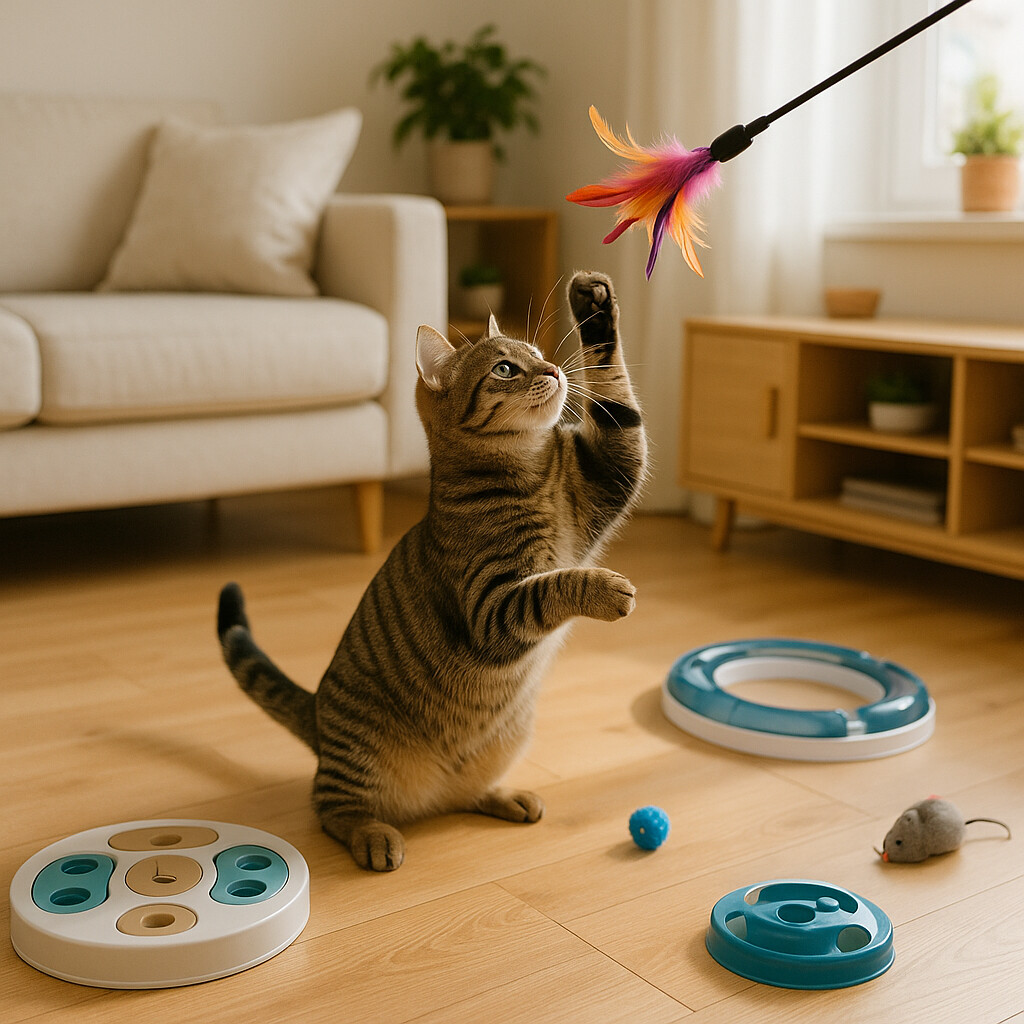
Here’s a truth most cat product roundups won’t tell you: at least half the interactive cat toys on the market end up ignored within a week. Your cat bats at it once, decides it’s beneath them, and goes back to attacking your shoelace.
I’ve spent way too much time researching what actually keeps indoor cats engaged — not just for 5 minutes, but consistently. This isn’t a sponsored list. It’s what the behavioral science says works, filtered through real owner experiences.
Why Indoor Cats Need Stimulation (The Numbers)
Indoor cats live longer — 12-18 years vs 2-5 years for outdoor cats, according to the ASPCA. But longer life doesn’t mean better life if they’re bored out of their minds.
The stats on under-stimulated indoor cats are sobering:
- Over 50% of US cats are overweight or obese (Association for Pet Obesity Prevention, 2024)
- Bored cats develop behavioral issues at 3x the rate of enriched cats
- Stress-related conditions (over-grooming, urinary issues, aggression) are overwhelmingly linked to environmental boredom
The right toys aren’t luxury — they’re preventative healthcare. A $25 puzzle feeder now can save you a $400 vet visit for stress-related cystitis later.
Category 1: Puzzle Feeders — The Single Best Investment
If you buy ONE thing from this list, make it a puzzle feeder. Multiple studies from veterinary behaviorists show that cats who work for their food show:
- Lower stress hormones
- Healthier weight
- Fewer behavioral problems
- More confidence
Top picks and why:
Doc & Phoebe’s Indoor Hunting Feeder ($20-25) — Three mouse-shaped feeders you hide around the house. Your cat “hunts” for meals. This one is backed by actual veterinary research and mimics natural feeding behavior better than any product I’ve found. Start with easy hiding spots and increase difficulty.
LickiMat Casper ($8-12) — Spread wet food or plain yogurt on the textured surface. Cats spend 10-15 minutes licking instead of inhaling their food in 30 seconds. Bonus: the licking action releases calming endorphins. Freeze it for an even longer challenge.
Trixie Activity Fun Board ($15-20) — Five different puzzle modules on one board. Great for figuring out what type of puzzle your specific cat prefers. Some cats are “diggers,” some are “sliders,” some are “lifters” — this board tests all of them.
Budget option: Muffin tin + tennis balls. Put treats in a muffin tin, cover holes with tennis balls. Free if you already have these items, and surprisingly effective.
Category 2: Motion Toys — Mimicking Prey
Cats are ambush predators. Their play drive is triggered by erratic, unpredictable movement — not steady, mechanical motion. That’s why so many electronic toys fail. They move too predictably and cats figure them out fast.
What works:
PetDroid Boltz Robotic Cat Toy ($16-20) — Random movement pattern that changes direction when it hits objects. The irregularity is key. Battery lasts about 3 weeks of daily 15-minute sessions. Not all cats love it, but the ones that do go absolutely feral.
SmartyKat Hot Pursuit ($15-18) — Concealed wand spins under a fabric cover. Cats can see movement but can’t predict where the “prey” will emerge. The hidden element triggers hunting instincts much more effectively than exposed moving targets.
Da Bird Feather Wand ($8-12) — Nothing electronic, just feathers on a string that spin and flutter when you wave the wand. Sounds boring. It’s not. The feather rotation mimics actual bird flight so accurately that most cats can’t resist it. You do need to be the operator — this is interactive play, not self-play.
Key insight: Rotate motion toys. Leave one out for 3-4 days, then swap it for a different one. Novelty drives engagement far more than quality.
Category 3: Vertical Space — The Overlooked “Toy”
This isn’t technically a toy, but it’s more impactful than any toy you’ll buy. Vertical space — cat trees, wall shelves, window perches — transforms your cat’s experience of their environment.
A 1,000 sq ft apartment feels like 500 sq ft to a cat if they can only use the floor. Add vertical surfaces and that same apartment becomes a jungle.
Best value cat trees:
- Go Pet Club 72" ($65-80): Ugly? Kind of. Functional? Extremely. Multiple platforms, sisal posts, condos. It’s a bestseller for a reason.
- On2Pets Large Cat Condo ($90-110): If aesthetics matter. Real wood shelves, modern design, wall-mountable.
DIY window perch: A $15 suction cup window shelf gives your cat “Cat TV” — birds, squirrels, weather changes. If you want to take this to the next level, put a bird feeder outside that window. Hours of entertainment, zero electricity required.
For cats that do get some outdoor time, safe yard access with a proper containment system can provide even richer stimulation than any indoor setup.
Category 4: Self-Play Toys for When You’re at Work
The reality: most cat owners work 8+ hours. You need toys that work without you.
Catnip kicker toys ($5-10) — Long, body-sized toys filled with catnip that cats can bunny-kick. The kicking action satisfies predatory wrestling instincts. Look for ones with a mix of catnip and silvervine — about 30% of cats don’t respond to catnip, but almost all respond to silvervine.
Crinkle balls ($3 for a 12-pack) — The crinkle sound triggers prey-hunting instincts. Lightweight enough for cats to bat and chase solo. Cheap enough that losing 6 under the couch isn’t devastating.
Cat tunnel ($12-20) — Collapsible tunnels mimic the “den and ambush” environment cats crave. Put a crinkle ball inside. You now have a 20-minute self-play setup.
The Play Schedule That Actually Works
Buying toys isn’t enough. When and how you use them matters:
- Two 15-minute interactive play sessions per day (morning + before dinner). This matches the natural dawn/dusk hunting pattern
- End each session with a treat or small meal — this completes the hunt-catch-eat cycle and prevents frustration
- Rotate toys weekly — put half away, bring back forgotten ones. “New” toy excitement without spending money
- Never use hands or feet as toys — this trains biting behavior that’s cute in kittens and painful in adults
If your cat seems totally uninterested in play, check with your vet. Sudden play disinterest in a normally active cat can signal pain or illness — it’s one of the early signs your cat is stressed.
What NOT to Buy
Save your money on:
- Laser pointers as a primary toy — They create frustration because the cat never “catches” anything. OK occasionally if you end sessions by landing the dot on a physical treat or toy they can grab.
- App-controlled toys you’ll never open the app for — Be honest with yourself.
- Expensive electronic toys with predictable patterns — Cats decode them in hours.
- Any toy marketed as “indestructible” — That’s not a feature. If a cat can’t “kill” it, they lose interest.
My Final Recommendation
If you’re starting from zero, here’s the best $50 you can spend:
- Doc & Phoebe’s hunting feeder ($22)
- Da Bird wand ($10)
- Crinkle balls 12-pack ($4)
- A suction cup window perch ($14)
Total: ~$50. That covers puzzle feeding, interactive play, self-play, and environmental enrichment. Your cat’s behavior will change within a week.
— CatLady6 