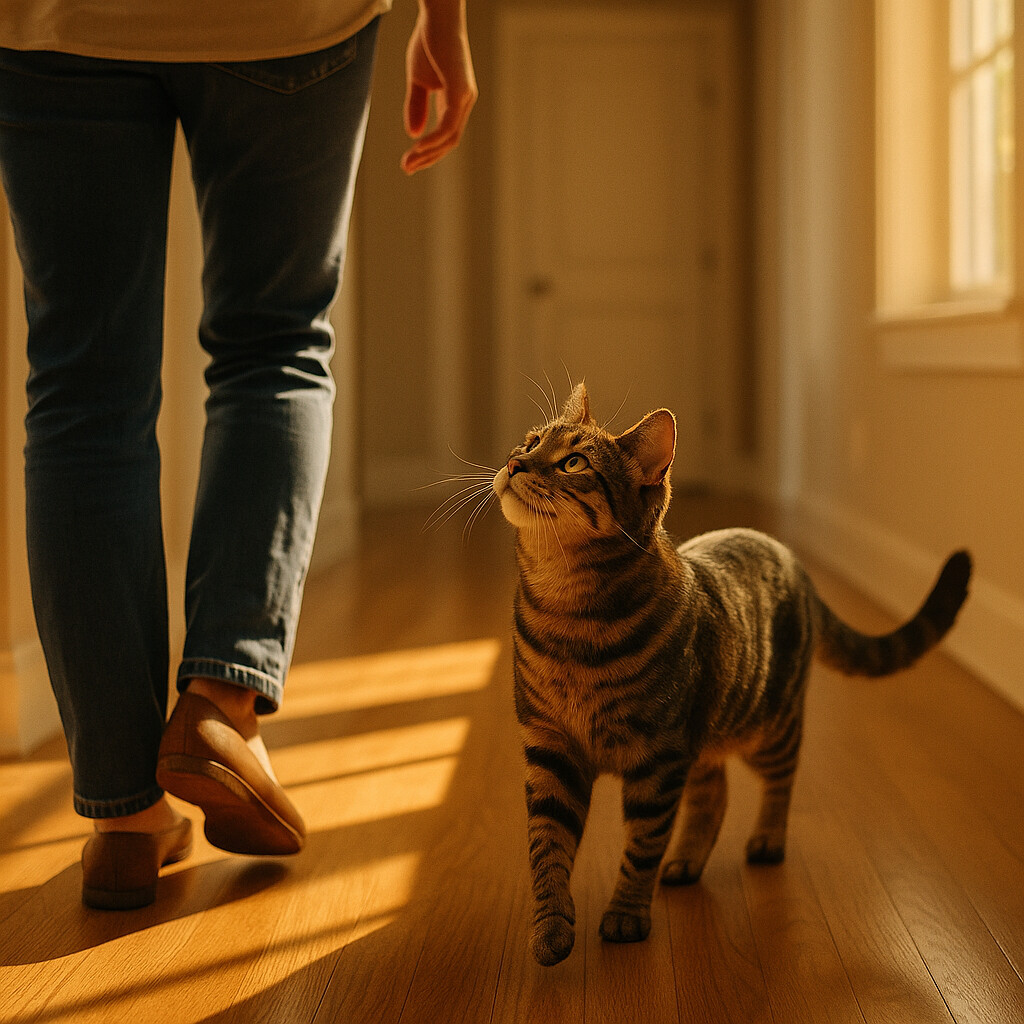
If your cat follows you from room to room — into the bathroom, the kitchen, even hovering outside a closed door — you’re not imagining it. And no, your cat isn’t broken. This is one of the most common behaviors cat owners notice, and it usually means something specific about your cat’s emotional state, health, or environment.
I’ve lived with cats who follow me like GPS-enabled roommates, and I’ve spent way too much time researching why. Here’s what the science actually says, and when you should pay attention.
It’s Not Just “Love” — It’s More Specific Than That
The easy answer is “your cat loves you.” That’s not wrong, but it’s incomplete. Cats aren’t pack animals like dogs. They don’t follow you out of social obligation. When a cat chooses to shadow you, it’s making a deliberate decision based on one (or more) of these actual motivations:
Secure attachment. A 2019 study published in Current Biology tested cats using a “secure base test” — the same method used to study attachment in human infants and dogs. The result? About 65% of cats showed secure attachment to their owners. These cats used their person as a safe home base: they explored when the owner was present and became visibly stressed when left alone. Following you room-to-room is a textbook sign of secure attachment. Your cat feels safer when you’re nearby.
Routine prediction. Cats are meticulous observers of patterns. If you always feed them after you go to the kitchen, or play with them after sitting on the couch, they’re not following you — they’re following the sequence. Indoor cats especially build their entire day around your predictable movements.
Territory patrol partner. Your home is your cat’s territory. When you move through it, your cat may follow as a co-patrol partner — checking that everything is in order. This is especially noticeable after you’ve been gone for a few hours. Your cat isn’t greeting you. It’s auditing the premises with you.
The Hunger Factor (Be Honest With Yourself)
Before you assume it’s deep emotional bonding, ask: does the following intensify around mealtimes?
A 2020 survey by the Association for Pet Obesity Prevention found that 61% of cats in the US are overweight or obese. Many of those cats have learned that following their person leads to treats, extra meals, or table scraps. If your cat follows you primarily to the kitchen, meows persistently while doing it, and loses interest once fed — the motivation is food, not feelings.
This isn’t a judgment. It’s just worth being honest about so you can manage portion control. The ASPCA recommends most adult indoor cats eat between 200–300 calories per day depending on weight, but your vet can give you an exact target based on your cat’s body condition score.
When Following Becomes Clingy: Separation Anxiety in Cats
Here’s where it gets important. There’s a meaningful difference between a cat who casually follows you around and a cat who:
- Becomes destructive or eliminates outside the litter box when you leave
- Vocalizes excessively (meowing, yowling) when you’re out of sight
- Follows you with dilated pupils, a tucked body, or rapid breathing
- Refuses to eat unless you’re in the room
- Over-grooms to the point of bald spots
These are signs of feline separation anxiety, which veterinary behaviorists now recognize as a legitimate condition. A 2020 study in PLOS ONE surveyed over 200 cats during COVID lockdowns and found that cats whose owners suddenly went back to work showed significant increases in destructive behavior and vocalization.
If you’re seeing these signs, it’s worth a vet visit. Treatment usually involves environmental enrichment (more interactive toys, vertical space, puzzle feeders), gradual alone-time training, and in severe cases, anti-anxiety medication.
Breed Matters More Than You’d Think
Some breeds are genuinely wired to follow their people. If you have a Siamese, Burmese, Ragdoll, Maine Coon, or Sphynx, the shadowing behavior is practically breed standard. Siamese cats in particular were developed for human companionship and can become extremely vocal and clingy if under-stimulated.
If you’re choosing a new cat breed for your home, factor in how much companionship that breed typically demands. A Ragdoll will follow you into the shower. A British Shorthair probably won’t.
The Age and Health Check
Sudden following behavior in a cat that was previously independent is a red flag worth investigating:
- Senior cats (11+ years) may follow you because their vision or hearing is declining. You become their navigation aid.
- Hyperthyroidism — extremely common in cats over 10 — causes restlessness, increased appetite, and “needy” behavior. If your older cat is suddenly your shadow AND losing weight despite eating more, get bloodwork done.
- Pain or illness. Cats in pain sometimes seek proximity to their person. If the following is accompanied by hiding, decreased appetite, or changes in gait, a vet visit is non-negotiable.
- Cognitive decline in senior cats (feline cognitive dysfunction) can cause aimless wandering and disorientation that looks like following.
What You Can Actually Do About It
If the following is healthy and you just want to manage it:
Give them their own “job.” Puzzle feeders, window perches with bird views, and rotating toys give your cat something to focus on besides you. A bored indoor cat will default to following the most interesting thing in the house — and that’s you.
Create safe outdoor access. If possible, giving your cat supervised or contained outdoor time dramatically reduces velcro-cat behavior. The mental stimulation of fresh air, sounds, and smells is irreplaceable. Even a safe outdoor enrichment setup can transform an anxious follower into a confident explorer.
Don’t punish it. Pushing your cat away or shutting doors aggressively will increase anxiety, not reduce it. Instead, reward independent behavior — toss a treat to their bed when they settle down on their own.
Scheduled play sessions. Two 15-minute play sessions per day (wand toys work best) drain energy and satisfy the hunting instinct that drives a lot of restless following.
The Bottom Line
Most cats who follow you everywhere are simply well-bonded, food-motivated, or slightly bored. That’s normal and healthy. But if the behavior is new, intense, or accompanied by other changes, it’s your cat telling you something — and it’s worth listening.
Has your cat always been your shadow, or did it start suddenly? I’d love to hear your stories below.
— CatLady6 