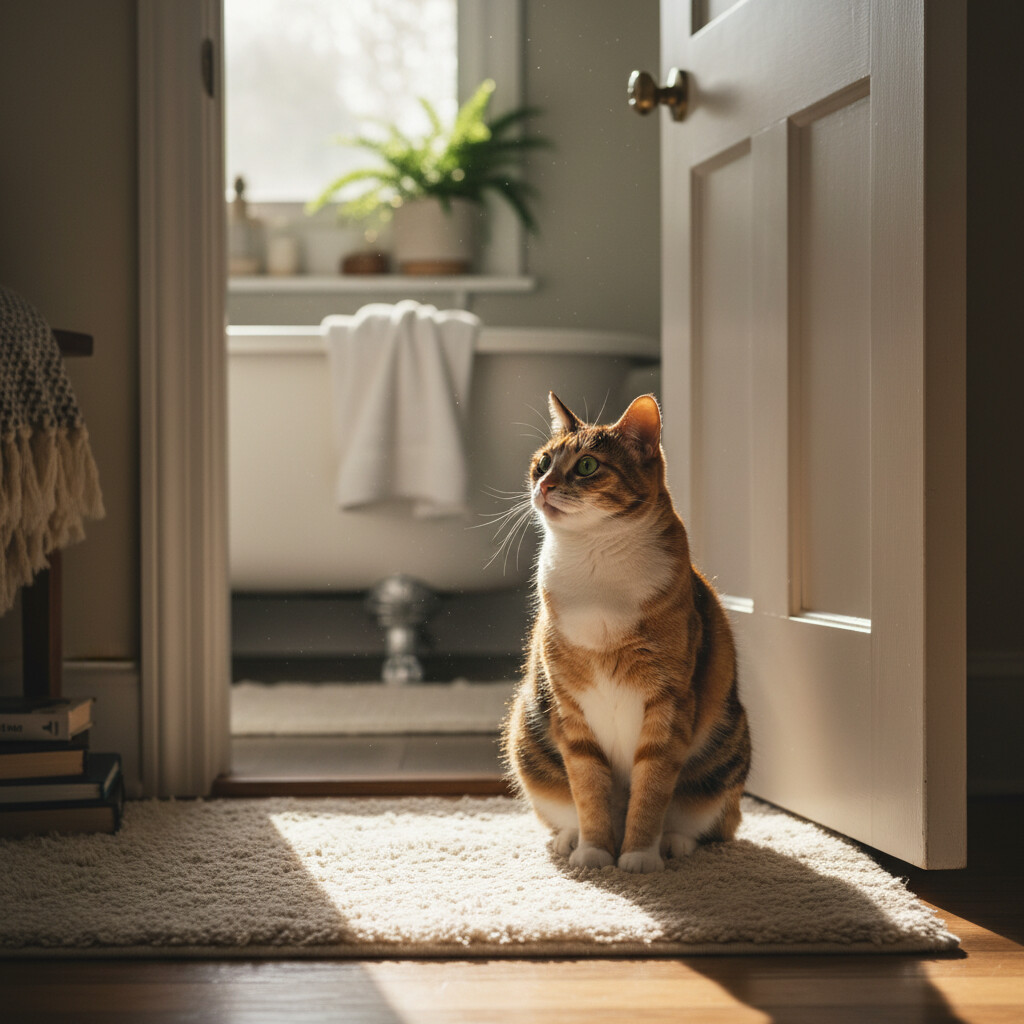
Your cat follows you to the bathroom because you’re their chosen social companion — and a closed door between you is something cats find genuinely strange. It’s not quirky or random. It’s rooted in how cats form attachments and how they understand territory.
Most cats who follow their owners throughout the house will eventually show up outside the bathroom door. Here’s what’s actually happening.
Cats Hate Closed Doors — And It’s Not About Control
Cats are territorial animals. In your cat’s mind, every room in your home is their territory that you both share. A closed door doesn’t just separate you from them — it cuts off access to a space they consider part of their domain.
Research published in Applied Animal Behaviour Science shows that many cats form secure attachment bonds with their owners that mirror the attachment patterns seen in young children and caregivers. When a securely attached cat loses sight of their person behind a closed door, they investigate — not out of demanding behaviour, but out of genuine social interest.
The bathroom is particularly compelling for several reasons:
- Novel smells. Soaps, shampoos, and your concentrated personal scent make the bathroom chemically interesting.
- Running water. Many cats are instinctively drawn to moving water — it signals freshness in the wild, which is why cats often prefer drinking from taps.
- Your undivided attention. You’re sitting still, not looking at a screen, not walking from room to room. From your cat’s perspective, this is premium interaction time.
The Attachment Science Behind the Behaviour
A 2019 study from Oregon State University found that 64% of cats showed secure attachment to their owners — similar to rates found in dogs and human infants. Securely attached cats use their owner as a “secure base,” checking in regularly and following them through transitions.
Following you to the bathroom is part of this pattern. Your cat is maintaining proximity to their secure base. This is especially pronounced in single-cat households, where you’re your cat’s entire social world.
For cats with a broader tendency to follow you from room to room, the bathroom behaviour is just an extension of that pattern — not a separate quirk.
Is This Separation Anxiety or Normal Social Behaviour?
Most bathroom-following is completely normal. But there’s a spectrum, and on the far end sits genuine separation anxiety.
Normal following looks like:
- Sitting patiently outside the door, or slipping in when it’s open
- A brief meow or two, then settling
- Investigating briefly and then moving on
- A relaxed, unhurried pace when they trail behind you
Anxiety may be a factor if:
- Your cat vocalises persistently and distressingly at the door
- They pace, scratch the door, or appear panicked
- The behaviour is part of a broader pattern — not eating while you’re out, destructive behaviour when alone, or excessive grooming
- It’s escalating rather than being a stable, long-standing habit
If you’re seeing the anxiety signs, it helps to pay close attention to your cat’s body language cues — catching stress signals early makes them easier to address.
For most cats, though, bathroom attendance is simply your cat being social. The bathroom is just where you happen to be.
Why Some Cats Are More Persistent Than Others
A few factors amplify the behaviour:
Single-cat households. With no feline companion, you’re the primary social outlet. Any separation gets more attention.
Breed tendencies. Ragdolls, Siamese, Burmese, and Maine Coons are bred for high human-contact behaviour. These cats follow because social proximity with people is deeply wired into their personality.
Learned behaviour. If opening the bathroom door reliably results in attention, play, or food, your cat has learned that waiting outside is a useful strategy. They’re not manipulating you — they’ve simply done the maths. Intermittent reward is actually more reinforcing than consistent reward, which is why this behaviour can become very persistent once it starts.
Age. Kittens and young cats follow more actively while socially developing. Senior cats often follow more closely because they become more reliant on routine and familiar company as they age.
How to Handle It (If You Want To)
This is a personal call. If you find it charming and your cat isn’t distressed when the door is closed, there’s genuinely nothing to fix.
If you’d prefer privacy, consistency is key: close the door every time, don’t open it in response to vocalisation, and make sure your cat has something engaging available — a puzzle feeder, a window perch, or a brief play session before you disappear. Cats adapt well when alternatives are provided.
What doesn’t work is inconsistency. Opening the door sometimes and not others creates an intermittent reinforcement schedule — and that’s the most powerful way to cement a behaviour permanently.
When to See a Vet
If bathroom-following is accompanied by sudden behavioural changes — especially if a cat who previously had no interest in following you is now doing so urgently — a vet visit is worth it. Sudden clinginess can signal pain, cognitive dysfunction in older cats, or illness. Cats mask discomfort well, and increased proximity-seeking is sometimes one of the first observable signs that something is off.
The same applies if your cat shows distress at the door rather than patient waiting: persistent yowling, frantic scratching, or visible panic. A vet or certified feline behaviourist can assess whether there’s an anxiety component that needs professional attention.
Most of the time, a cat outside your bathroom door is just a cat who likes you. That’s a good thing.