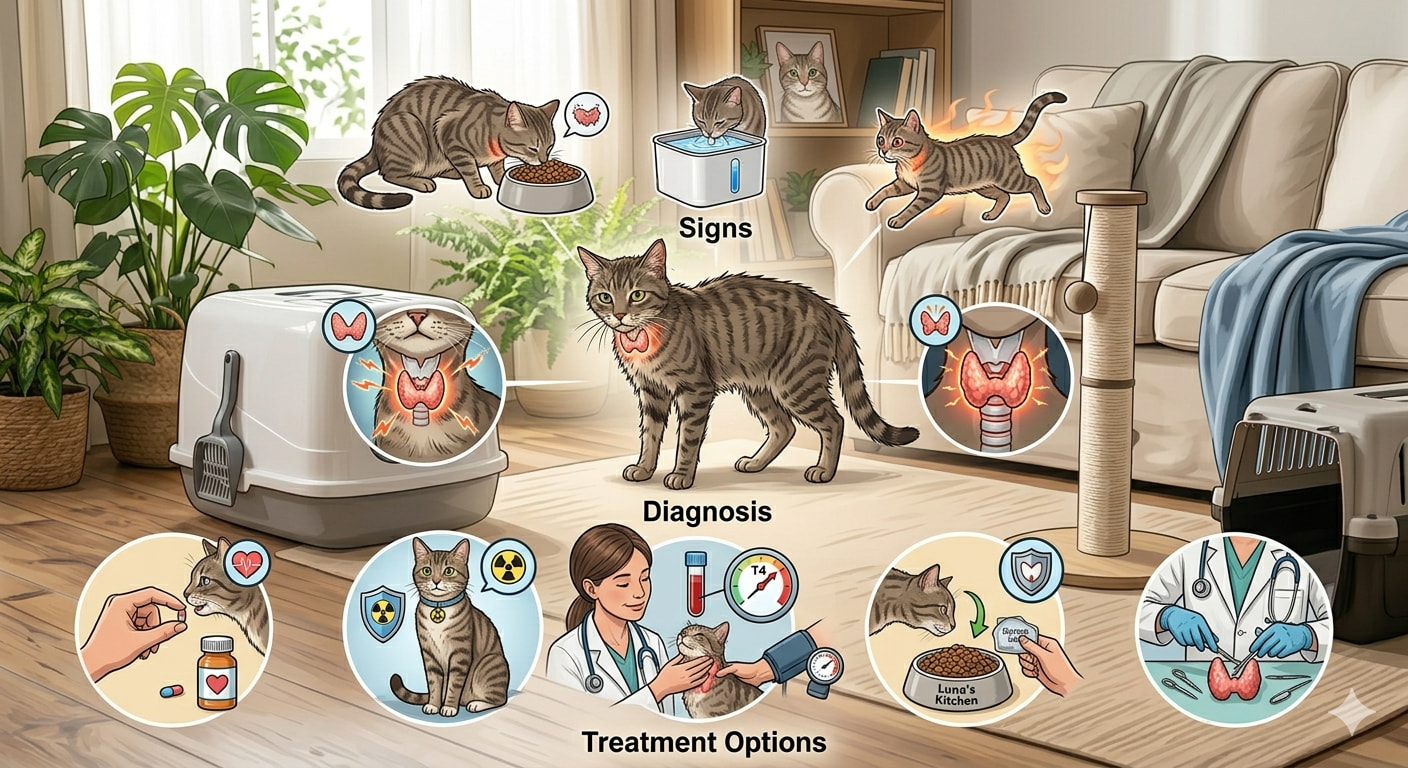
Hyperthyroidism is the most common hormonal disorder in cats, and it’s almost always treatable. If your middle-aged or older cat is eating constantly but still losing weight, acting unusually wired, or vomiting more than usual, hyperthyroidism belongs at the top of your vet’s checklist.
Here’s what it is, how it’s diagnosed, and what treatment actually looks like.
What Is Hyperthyroidism?
The thyroid gland sits on either side of the trachea in your cat’s neck. When it starts overproducing thyroid hormones — specifically T3 and T4 — it throws nearly every system in the body into overdrive. Heart rate climbs. Metabolism accelerates. The cat burns through calories faster than it can eat.
The underlying cause in roughly 97–98% of cases is a benign tumor called an adenoma — not cancer, but an overactive cluster of thyroid cells that won’t stop producing hormones. In fewer than 3% of cases, the cause is malignant (thyroid adenocarcinoma), which requires more aggressive management.
Hyperthyroidism almost exclusively affects middle-aged to older cats. The average age at diagnosis is around 13, and it’s rare before age 8. Research published in the Journal of Feline Medicine and Surgery (Peterson, 2012) estimates it affects approximately 10% of cats over age 10 in the United States — making it one of the most common conditions your senior cat might face.
The Classic Signs
The hallmark is the counterintuitive combination of increased appetite with weight loss. The body is burning through fuel faster than the cat can replace it, and muscle wasting often follows.
Other common signs:
- Increased thirst and urination — hormone overproduction disrupts fluid balance and affects kidney filtration
- Hyperactivity or restlessness — older cats acting “kittenish” again, or pacing, vocalising at night, seeming unable to settle
- Vomiting — typically intermittent, often shortly after eating
- Poor coat quality — matted, greasy, or unkempt fur; some cats develop patchy hair loss as the condition progresses
- Rapid or irregular heartbeat — hyperthyroid cats frequently develop hypertrophic cardiomyopathy; your vet may detect a heart murmur or arrhythmia during examination
- Diarrhea or increased stool volume — gut motility speeds up along with everything else
- Hypertension — high blood pressure is a frequent complication and, if untreated, can cause sudden retinal detachment and blindness
Less commonly, a subset of cats presents with the reverse picture: lethargy, loss of appetite, and weakness rather than hyperactivity. This is called apathetic hyperthyroidism, and it’s sometimes misdiagnosed as other conditions before thyroid levels are tested.
How It’s Diagnosed
Diagnosis is usually straightforward: a blood test measuring total thyroxine (T4). An elevated T4 in a cat with matching clinical signs is diagnostic.
Occasionally, a cat has classic symptoms but a T4 that falls in the high-normal range. In borderline cases, vets may use a free T4 test (more sensitive), a T3 suppression test, or simply retest in a few weeks — thyroid levels fluctuate, and what’s borderline one week may be clearly elevated the next.
One important complicating factor: hyperthyroidism can mask underlying chronic kidney disease. Elevated thyroid hormones increase blood flow to the kidneys, which can make renal function appear normal on bloodwork when it isn’t. When hyperthyroidism is treated and blood flow normalises, pre-existing kidney disease may become apparent. This isn’t a reason to delay treatment — it’s a reason to monitor kidney values carefully once therapy starts.
Treatment Options
There are four main options. Which is right for your cat depends on their overall health, your circumstances, and what’s available where you live.
Daily Medication (Methimazole)
Methimazole (sold as Tapazole or Felimazole) is the most common first-line treatment in the US. It works by blocking thyroid hormone synthesis — not by curing the underlying tumor. That means it must be given daily for life, typically twice a day.
It comes as an oral tablet, a compounded liquid, or a transdermal gel applied to the inner ear flap (the gel is more convenient for difficult cats but somewhat less effective). Side effects occur in roughly 15–20% of cats and include facial scratching (an itch response), vomiting, lethargy, or — more seriously — low white blood cell count or liver toxicity. Bloodwork monitoring every 3–6 months is standard once stable.
Methimazole is not a cure, but it is reversible — useful if you want to stabilise thyroid levels before pursuing a definitive option, or if your cat can’t tolerate surgery or radiation.
Radioactive Iodine (I-131)
For most otherwise healthy hyperthyroid cats, radioactive iodine is considered the treatment of choice by the American Association of Feline Practitioners (AAFP). A single injection of radioactive iodine concentrates in overactive thyroid tissue and destroys it, while largely sparing normal tissue. Around 95% of cats are cured with one treatment.
The catch: the cat must be hospitalised in a licensed radiation facility for typically 3–5 days until radiation levels drop to safe limits. Owners can’t visit during this period. Cost in the US ranges roughly from $1,000–$2,500 depending on facility and region.
For cats who qualify, I-131 is often the most cost-effective choice over a lifetime compared to years of daily medication and quarterly bloodwork.
Thyroid Surgery (Thyroidectomy)
Surgical removal of the affected thyroid lobe is another curative option, with success rates comparable to I-131. It requires general anaesthesia and an experienced surgeon. The main risk is inadvertent damage to the parathyroid glands, which sit adjacent to the thyroid and regulate calcium. Post-surgical hypocalcaemia can be life-threatening but is manageable when caught early and monitored correctly.
Surgery is typically considered when I-131 isn’t accessible or when the cat needs rapid stabilisation.
Iodine-Restricted Diet (Hill’s y/d)
Hill’s Prescription Diet y/d is formulated with extremely low iodine — the mineral the thyroid needs to produce hormones. Studies show it can normalise T4 levels in around 75% of cats fed on it exclusively.
The limitation is absolute: the cat must eat nothing else. No treats, no other food, no access to other pets’ bowls. Even small amounts of regular food will undermine results. It’s a viable option for cats who can’t tolerate medication or anaesthesia, but it demands strict household management.
When to See a Vet
Book an appointment — soon, not urgently — if your cat shows:
- Unexplained weight loss despite normal or increased appetite
- Noticeably increased thirst or litter box use
- A pounding or racing heartbeat when you hold them
- New or worsening vomiting (more than once or twice a week)
- A notable shift in energy or behaviour, either direction
Go immediately if your cat collapses, has difficulty breathing, or loses vision suddenly. These point to cardiac or hypertensive crisis, both of which are emergencies.
Hyperthyroidism is one of those conditions where early diagnosis genuinely changes outcomes. Cats caught before significant cardiac involvement tends to respond more cleanly to treatment and live longer post-diagnosis.
What to Expect After Treatment
With treatment, most cats do well. Studies show median survival after radioactive iodine treatment typically exceeds two years, and many cats gain several comfortable years of life.
The complicating factor remains kidney function. As discussed above, treating hyperthyroidism can reveal pre-existing kidney disease that was masked by elevated blood flow. This doesn’t mean treatment was a mistake — it means ongoing monitoring matters. Your vet will likely run bloodwork 2–4 weeks after starting treatment and periodically thereafter.
The bottom line: if your older cat is eating everything in sight but still losing weight, don’t wait. Hyperthyroidism is one of the most treatable serious conditions in geriatric cats, and the sooner it’s caught, the better the outcome.