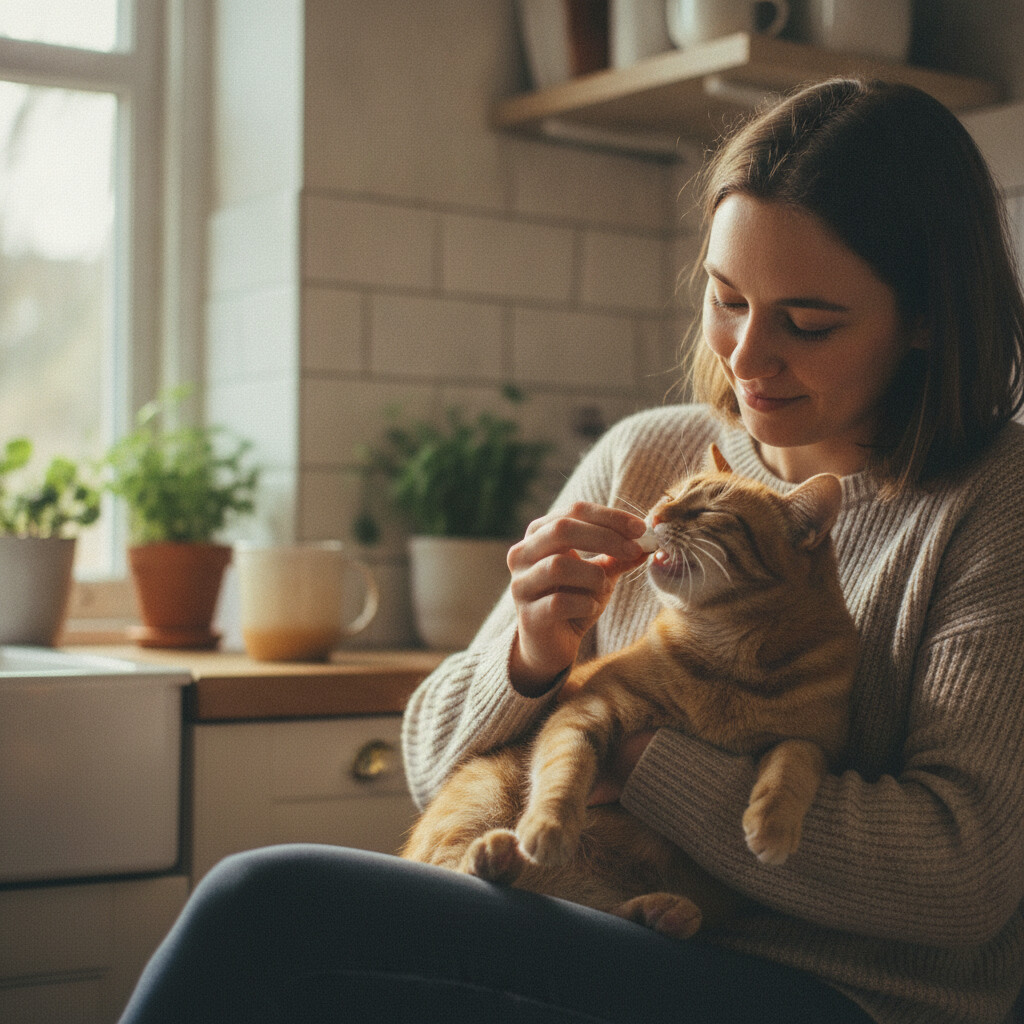
Giving a cat a pill is one of those skills nobody teaches you until you desperately need it. The short version: the fastest, least stressful method is usually hiding it in food, not prying open their jaw. Here’s what actually works, in order of what to try first.
Try Food First, Always
Before you attempt any hands-on method, try disguising the pill. Most cats will eat a pill wrapped in something strong-smelling and soft enough to fully encase it — a small ball of wet food, a pill pocket treat, a bit of tuna, or a dab of cream cheese. The key is making sure the pill is completely covered; cats are excellent at finding and spitting out anything that pokes through.
A trick vets often recommend: give three or four “practice” treats with nothing in them first, then the one with the pill, then one or two more empty ones afterward. This stops your cat from associating the treat routine with medicine and getting suspicious of the next round.
What doesn’t work as well as people think: crushing pills into a full meal. Cats have around 470 taste receptor genes related to smell and are quick to detect and avoid an altered flavor across an entire bowl, which means they may just stop eating that meal rather than eat around the pill. Small, concentrated treats work better than diluting the pill through a large amount of food. Also check with your vet or pharmacist before crushing anything — some medications (extended-release formulas especially) lose their effectiveness or become dangerous if crushed.
If Food Doesn’t Work: The Direct Method
Some cats are too smart or too food-motivated-in-reverse for hiding to work. If you need to pill directly:
- Get the cat calm first. Wrap them in a towel like a burrito with only the head exposed if they’re wriggly — this isn’t cruel, it’s the same principle as swaddling, and it prevents scratches for both of you.
- Tilt the head back gently, cupping over the top of the skull with one hand so the chin points toward the ceiling. This naturally causes most cats’ jaws to relax slightly.
- Use your other hand to open the lower jaw by applying gentle pressure at the sides of the mouth, and drop the pill as far back on the tongue as you comfortably can — the farther back, the less likely they are to spit it out.
- Close the mouth and stroke the throat gently, or blow lightly on the nose, both of which typically trigger a swallow reflex.
- Follow immediately with a small amount of water or wet food — this helps the pill go all the way down rather than getting stuck partway, which can irritate the esophagus.
A pilling device (a small plastic syringe-like tool designed to place the pill at the back of the tongue without your fingers anywhere near the teeth) is worth the few dollars it costs if you’ll be doing this regularly. Most pet pharmacies and vet clinics carry them.
Two Cats, Divide and Conquer
If you have a helper, one person can hold and stabilize the cat while the other handles the pill — this is significantly easier than doing both jobs alone, especially with a larger or more resistant cat. If you’re on your own, sitting on the floor with the cat between your knees, facing away from you, gives you more control than trying to do it standing up.
Liquid Medications and Compounding
If your cat consistently fights pilling, ask your vet whether the medication is available as a liquid or as a flavored compounded formulation (fish, chicken, and beef flavors are common at compounding pharmacies). This isn’t possible for every drug, but for cats on long-term medication — thyroid medication for hyperthyroidism, for example — it can turn a twice-daily wrestling match into a five-second routine.
What to Avoid
- Don’t pill from directly above the cat’s head — it triggers a defensive response in most cats. Approach from the front or slightly to the side instead.
- Don’t skip the water/food chaser. Pills that lodge in the esophagus without enough liquid can cause ulceration, which is a real risk with some medications (doxycycline is a known culprit).
- Don’t give up after one failed attempt and hide the pill in the food bowl anyway, hoping they’ll eat around it — most won’t, and now they’re suspicious of that bowl too.
- Don’t try to medicate a cat who is actively hissing or in fight mode. Give them 10 minutes to calm down first. Forcing it in that state increases the odds of a bite or scratch and makes the next dose harder.
When to Call Your Vet Instead of Fighting It
If a cat consistently refuses a needed medication despite trying the above, call your vet rather than skipping doses or giving up. Missed doses of things like thyroid medication or antibiotics can make the underlying problem worse or lead to resistance. Your vet can usually offer an alternative: a different formulation, a longer-acting version given less often, or in some cases a technician visit to demonstrate technique in person. If your cat becomes aggressive or you’re getting bitten or scratched trying to medicate them, that’s also worth mentioning — a vet can show you handling techniques suited to your specific cat, and for cats that are especially difficult to grab, checking with your vet about how to tell if pain is part of the resistance is worth doing, since a cat in pain will fight handling much harder than a healthy one.
The Takeaway
Start with a well-hidden treat, use the practice-treat trick to keep it from becoming predictable, and reserve the direct method for when hiding genuinely isn’t working. If you’re consistently struggling, don’t just push through it twice a day for weeks — a two-minute conversation with your vet about liquid or compounded alternatives can save both you and your cat a lot of stress.