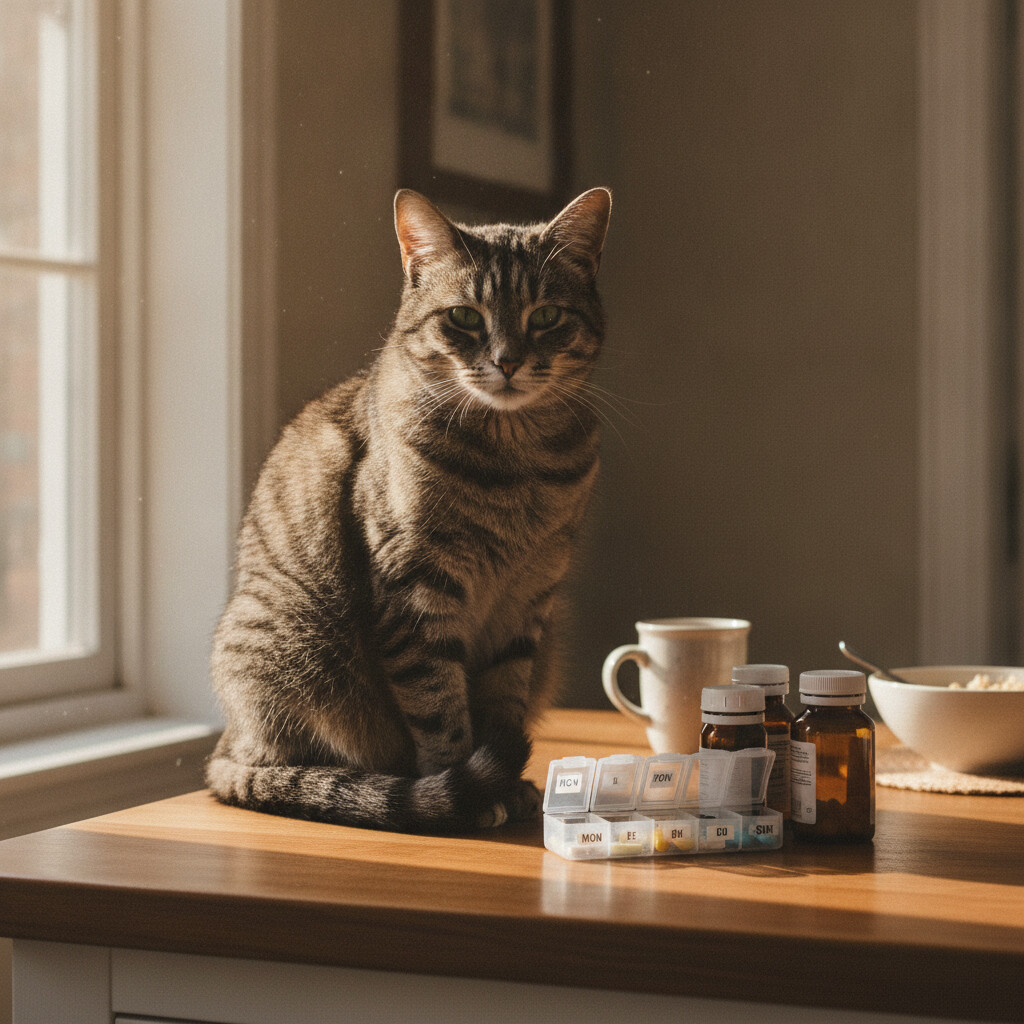
Once a senior cat is managing two or three conditions at once — think kidney disease plus hyperthyroidism, or arthritis plus high blood pressure — it’s common to end up with four or five different medications, each with its own timing, food requirement, and quirks. The fix isn’t a better memory. It’s a system: a written schedule, a fixed routine, and a plan for what to do when a dose gets missed.
Here’s how to build one that actually holds up on a busy Tuesday morning.
Start With a Written Medication Map, Not a Mental One
Once a cat is on more than two medications, relying on memory is where things start slipping — a missed dose here, a doubled-up dose there. Veterinary literature calls this “polypharmacy,” and it’s increasingly common in cats over 10 as multiple age-related conditions overlap and each one picks up its own prescription.
Write down, for every medication:
- Name and dose (in the actual unit on the label — mg, mL, or number of tablets)
- Time(s) of day
- With food or without — this matters more than owners expect. Some thyroid medications need to be given consistently either with or without food because absorption changes either way; some kidney-support phosphate binders only work if they’re mixed into a meal.
- What it’s treating — so if a new vet or a pet sitter is looking at the list cold, they understand why the cat is on it.
Keep this list somewhere physical — on the fridge, in a note pinned by the food bowls — not just in your head or buried in a phone app you won’t open at 6 a.m. If your cat sees more than one vet (a primary vet plus a specialist), bring an updated copy to every appointment. Medication lists get out of sync between providers more often than owners realize, and that’s exactly how interactions get missed.
Build a Routine Around Your Cat’s Day, Not the Clock
Rigid “8 a.m. and 8 p.m.” schedules look tidy on paper but fall apart the first time you sleep in or work late. Anchor doses to things that already happen every day instead: the first can of food, the last one before bed, when you get home from work. Consistency in the interval between doses matters far more than hitting an exact clock time for most medications — check with your vet on any drug where that’s not true (some, like certain thyroid medications or insulin, are more time-sensitive).
A few practical habits that make multi-med days easier:
- Use a labeled pill organizer, even for liquids — small labeled syringes or bottles lined up by time of day prevent the “wait, did I already give this one?” moment.
- Give the least pleasant medication first, while your cat is still relaxed and hungry, and save anything easy (a treat-hidden pill, a favorite food mixed with a supplement) for last.
- Log each dose the moment you give it — a checkmark on a printed weekly grid is enough. It removes the guesswork when two people in the household are sharing the job.
If pilling itself is the sticking point rather than the schedule, our guide to giving a cat a pill without losing a finger covers technique — burrito wrap, pill gun, timing around meals — that makes the physical act easier regardless of how many medications are involved.
Know Which Combinations Need Extra Attention
Most medication combinations prescribed by a vet are perfectly safe together — that’s the point of a vet managing the whole picture rather than each condition being treated in isolation. But a few things are worth flagging to your vet or pharmacist proactively, especially if prescriptions come from more than one source:
- NSAIDs and kidney medication — cats with any degree of kidney disease need extra caution with anti-inflammatory pain relief, since both affect kidney blood flow.
- Multiple supplements stacked on top of prescription drugs — well-meaning add-ons (extra joint supplements, appetite stimulants, herbal calming aids) can interact with prescription medications or simply overload a cat that’s already taking a lot. If you’re adding anything beyond what the vet prescribed, mention it at the next visit — our piece on cat supplements: what actually helps (and what doesn’t) is a useful gut-check before adding one more thing to the pile.
- New medications from a specialist — if your cat sees a cardiologist, nephrologist, or oncologist in addition to a primary vet, make sure each provider has the full list. This is the single most common way overlapping prescriptions slip through unnoticed.
When a senior cat is juggling multiple diagnoses to begin with, the medication list tends to grow the same way the diagnosis list does — our guide on when your senior cat has more than one diagnosis goes deeper into managing overlapping conditions as a whole, not just the pills that come with them.
What to Do When You Miss a Dose
It happens, even with a good system. The general rule vets give: if it’s close to when you’d normally give it, go ahead; if it’s almost time for the next dose, skip the missed one rather than doubling up — but this varies by drug, and insulin in particular should never be adjusted without your vet’s specific instructions. Ask your vet in advance what to do for each medication your cat is on, and write the answer directly on your medication map. Having the answer ready before you need it is far less stressful than trying to figure it out at 11 p.m.
When to Call the Vet
Reach out to your vet promptly if you notice any of the following after starting or adjusting a medication:
- Vomiting, diarrhea, or refusal to eat that starts within a day or two of a new prescription or dose change
- Unusual lethargy, wobbliness, or disorientation
- Increased or decreased thirst and urination that’s noticeably different from your cat’s baseline
- Any sign that two medications given together seem to be causing a reaction — swelling, hives, or sudden behavior change
And if keeping track of everything is starting to feel unmanageable, say so at the next appointment. Vets can often simplify a regimen — combining dosing times, switching to a longer-acting formulation, or dropping something that’s no longer pulling its weight — once they know it’s become a burden. A plan a caregiver can’t sustain isn’t actually working, however sound it looks on paper.
The takeaway: write it down, anchor doses to routine rather than the clock, flag anything you’re adding on your own, and know your vet’s answer for a missed dose before you need it. Multiple medications don’t have to mean daily chaos — they just need a system built once and followed, not reinvented every morning.