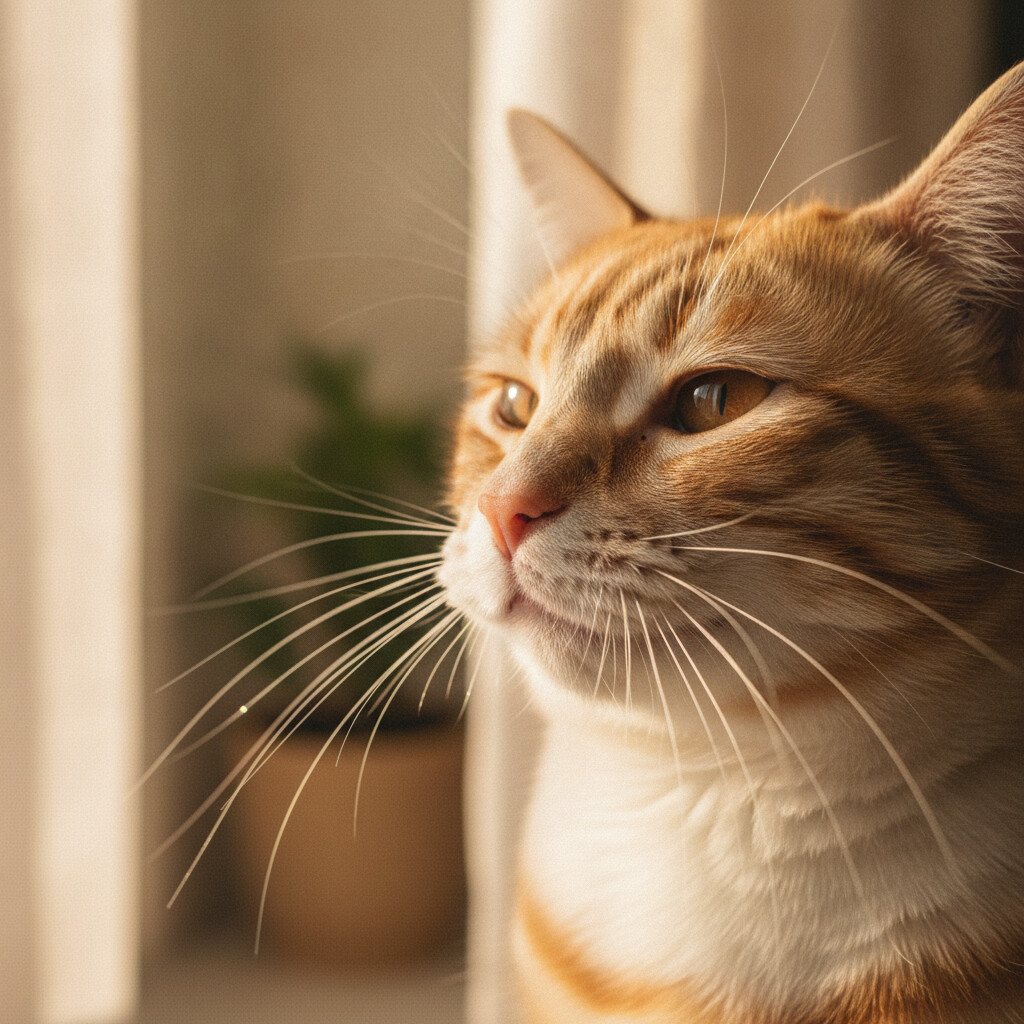
Cat whiskers aren’t fur — they’re a dedicated sensory organ, and trimming, plucking, or dismissing them as decorative can genuinely disorient your cat. Here’s what they actually do, why cats have them in such specific places, and when whisker changes are worth a vet visit rather than a shrug.
What Whiskers Actually Do
Whiskers (vibrissae) are thicker, stiffer hairs rooted three times deeper than regular fur, in follicles packed with blood vessels and nerve endings. Each root is surrounded by a blood-filled capsule that amplifies even the faintest deflection of the hair, then feeds that signal straight to the sensory cortex and trigeminal nerve — the same nerve pathway responsible for facial sensation. Functionally, whiskers work like a hand feeling around a dark room: they detect air currents, surface textures, and the size and location of nearby objects without the cat needing to touch anything directly.
This is why a cat can navigate a cluttered room in near-total darkness, or judge whether a gap is narrow enough to get stuck in before committing to it. Researchers studying feline vibrissae (work published in the Journal of Anatomy and referenced by the Cornell Feline Health Center) describe them as a proprioceptive and tactile system working in tandem — whiskers don’t just sense the environment, they help the cat understand its own body’s position relative to it.
Cats have whiskers in more places than most owners realize: the muzzle (the ones everyone pictures), above the eyes, on the chin, and on the back of the front legs (carpal whiskers). The leg whiskers matter more than people assume — they help a cat gauge prey movement and terrain while climbing or hunting, which is part of why cats seem to “feel” their way down from a jump before fully committing their weight.
Why You Shouldn’t Trim or Pluck Them
Because whiskers are a sensory organ and not a grooming feature, trimming them doesn’t tidy a cat up — it functionally blinds part of their sensory input. Cats whose whiskers have been cut short by well-meaning owners (or occasionally by an overzealous groomer) often become noticeably more hesitant: bumping into furniture, misjudging jumps, or seeming anxious in spaces they normally move through with confidence. The effect is temporary — whiskers regrow over roughly two to three months — but there’s no upside to cutting them in the meantime.
The same goes for plucking a broken or bent whisker “to tidy it up.” Whiskers do occasionally break or bend without pain (they’re structurally similar to fur in that the shaft itself has no nerve endings — the sensitivity is in the follicle), but pulling one out prematurely disrupts the follicle and is unnecessary. If a whisker looks damaged, leave it; it will shed and regrow on its own cycle.
Whisker Fatigue: Real Phenomenon, Overstated Online
“Whisker fatigue” or “whisker stress” gets a lot of attention in cat-product marketing, usually as a pitch for wide, shallow food bowls. The underlying idea has a kernel of truth: repeated whisker contact against the sides of a narrow bowl during eating is a genuine sensory stimulus, and some cats do show food-related behaviors — pawing food out of the bowl, hovering over food without eating, seeming reluctant at the bowl — that improve with a wider, shallower dish.
That said, there’s no peer-reviewed evidence establishing whisker fatigue as a defined clinical condition with consistent diagnostic criteria, and plenty of cats eat from narrow bowls their entire lives with zero issue. If your cat is doing the pull-food-onto-the-floor routine, a flatter bowl is a cheap, low-risk thing to try — but treat it as one plausible fix among several (it can also be a dominance/whisker-unrelated food preference, an ant-avoidance behavior, or simply how that particular cat likes to eat), not a confirmed diagnosis.
What Changes as Cats Age
Like the rest of the coat, whiskers can go gray or white with age even in cats whose fur stays pigmented, and older cats sometimes shed whiskers slightly faster than they regrow them, leading to a visibly sparser whisker set. This is generally cosmetic and not a welfare concern on its own. What is worth tracking in senior cats is whether reduced whisker sensitivity — which isn’t well studied but is plausible given general nerve-conduction changes with age — coincides with new clumsiness, hesitation at heights, or increased startling. Those changes are more often explained by vision loss or arthritis than whiskers specifically, but they’re worth mentioning to your vet together.
When to See a Vet
Whisker changes are rarely an emergency on their own, but a few patterns are worth a vet visit rather than a wait-and-see approach:
- Whisker loss with skin irritation, scabbing, or redness at the follicle — this can indicate a bacterial or fungal skin infection (including ringworm), an allergic reaction, or in rare cases mite infestation, and needs actual treatment.
- Sudden, patchy whisker loss unrelated to normal shedding — especially alongside other coat or skin changes — is worth ruling out as a broader dermatological or endocrine issue rather than assuming it’s cosmetic.
- A cat that seems newly disoriented, is bumping into objects, or hesitates before jumps independent of any whisker trimming — this is more likely a vision or neurological issue than a whisker problem, and vision loss in cats is frequently missed by owners because cats compensate so well. It deserves an exam either way.
The Takeaway
Leave whiskers alone — don’t trim, pluck, or “tidy” them, and don’t worry about occasional broken ones. If your cat seems newly clumsy or hesitant, look first at vision and joint health rather than whiskers; and if you’re troubleshooting a picky eater, a shallow bowl is a reasonable low-cost experiment, just don’t expect it to be a guaranteed fix. For more on reading what your cat’s body is telling you day to day, see our guides on what cat tail positions actually mean and the full cat body language guide — whiskers are one input in a much bigger communication system.