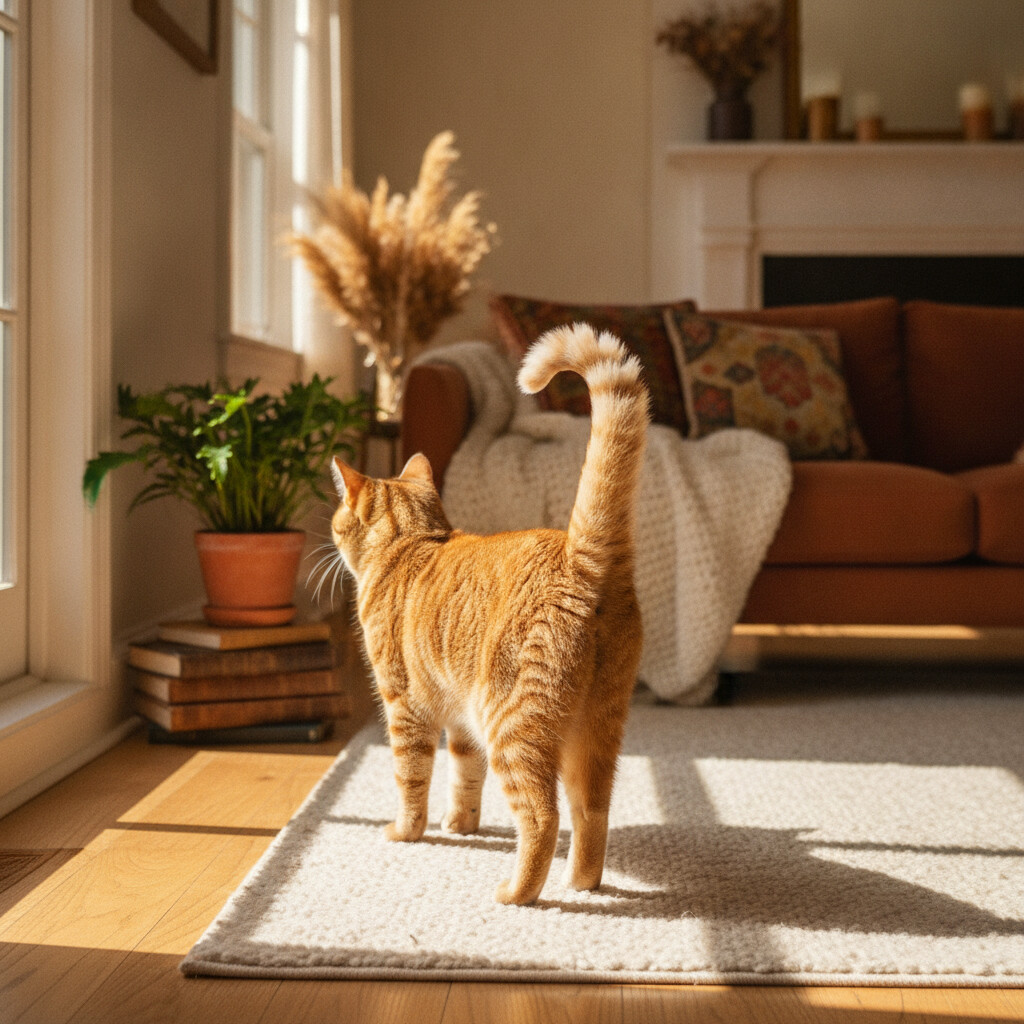
Cats communicate constantly with their tails — direction, height, movement, and fur puffiness all mean something specific. Learning to read these signals is one of the fastest ways to understand what your cat is actually trying to tell you.
The Tail Position Dictionary
Tail straight up, tip slightly curled: Confident, friendly, happy to see you. This is a greeting — when a cat approaches with a vertical tail, they’re feeling secure and social. The slight curl at the tip is often an extra-enthusiastic version of the same signal.
Tail straight up, fully vertical: A confident greeting, common when cats approach food, a familiar person, or a trusted companion. The higher the tail, the better the mood.
Tail horizontal, parallel to the ground: Neutral or exploratory. Your cat is curious, relaxed, taking in the environment. Not particularly emotional either way.
Tail low, tucked between legs: Fear or submission. A tucked tail signals that your cat feels threatened, anxious, or overwhelmed. You’ll often see this combined with flattened ears and a crouched posture — don’t force interaction.
Tail puffed up (bottlebrush tail): The startle response. Hair stands on end through piloerection, making the tail look twice its normal size. Your cat has been frightened or is trying to appear larger as a defensive threat display. Give them space.
Tail slowly swishing back and forth: Concentration or mild irritation. Unlike a dog’s wagging tail, a slowly swishing cat tail signals that something has captured attention — or that patience is running thin. Watch what they’re focused on.
Tail rapidly lashing from side to side: This is the red flag. Fast, hard lashes signal genuine agitation — overstimulation, frustration, or a pre-bite warning. If you’re petting your cat and their tail starts lashing rapidly, stop. They’re done.
Tail wrapped around another cat or person: Affection and social bonding. When a cat wraps their tail around your ankle or around a companion cat, it’s the feline equivalent of a hug. They do this with animals they’re genuinely bonded to.
Tail held vertical with a quiver: In unneutered cats, this signals spray-marking. In neutered cats, a quivering vertical tail (without spraying) is often a high-intensity greeting — common when you return after being away.
Why Cats Use Their Tails This Way
Cats are semi-solitary hunters whose natural social structure differs from pack animals. They don’t rely on constant vocalisation to communicate — but they do share territory and need ways to signal intention without escalating into conflict.
The tail serves as a visible, continuous signal that doesn’t require direct eye contact or vocalisation. It’s readable from a distance and works whether the other party is paying close attention or not.
Research published in Animal Behaviour (2017, Humphrey et al.) found that the vertical tail greeting in domestic cats has been specifically selected for in cats living alongside humans — it’s a carryover from kitten-to-mother communication that adult cats continue using with trusted people. Wild cats show the behaviour far less consistently.
For a complete picture of how cats communicate, the cat body language guide covers ear position, pupil dilation, vocalisation, and body posture alongside tail signals.
Reading the Whole Cat
The tail doesn’t work in isolation. A high tail with dilated pupils and flattened ears tells a very different story than a high tail with relaxed ears and a slow blink.
Some quick combinations:
| Tail | Ears | Body | What It Means |
|---|---|---|---|
| High, vertical | Forward, relaxed | Upright | Confident, happy, approachable |
| Tucked under | Flat against head | Low, crouched | Fearful, wants to be left alone |
| Puffed up | Flat/rotated back | Arched | Alarmed, defensively threatened |
| Slow side swish | Forward | Crouched/alert | Focused, in hunting mode |
| Wrapped around you | Any | Pressed against you | Affectionate, bonded |
Rapid tail lashing during petting is one of the most common causes of cat scratches. It’s also one of the clearest signals cats give — most owners just aren’t watching for it. Once you start noticing it, it becomes very easy to read.
Tailless and Short-Tailed Cats
Manx cats, Japanese Bobtails, and American Bobtails have partial or absent tails, which limits part of their communication range. These cats rely more heavily on ear position, whisker position, vocalisation, and body posture to convey the same information. Research suggests they develop alternative communication strategies naturally, but with these breeds it’s worth paying extra attention to non-tail signals.
What Tail Language Tells You About Stress
A cat who frequently shows a tucked tail, moves through the house with a low-carried tail, or fluffs up easily may be experiencing chronic stress. These signals are worth taking seriously — stress signs in cats covers the full checklist and what commonly drives each one.
The Practical Takeaway
You don’t need to memorise every variation at once. Start with the three most important reads:
- Tail up = happy and confident. Safe to approach.
- Tail lashing fast = overstimulated or frustrated. Back off immediately.
- Tail puffed = frightened. Give space, don’t force interaction.
Once those are automatic, the subtler signals become easier to catch. Your cat is telling you something constantly — the tail is just one of the clearest messages they send.