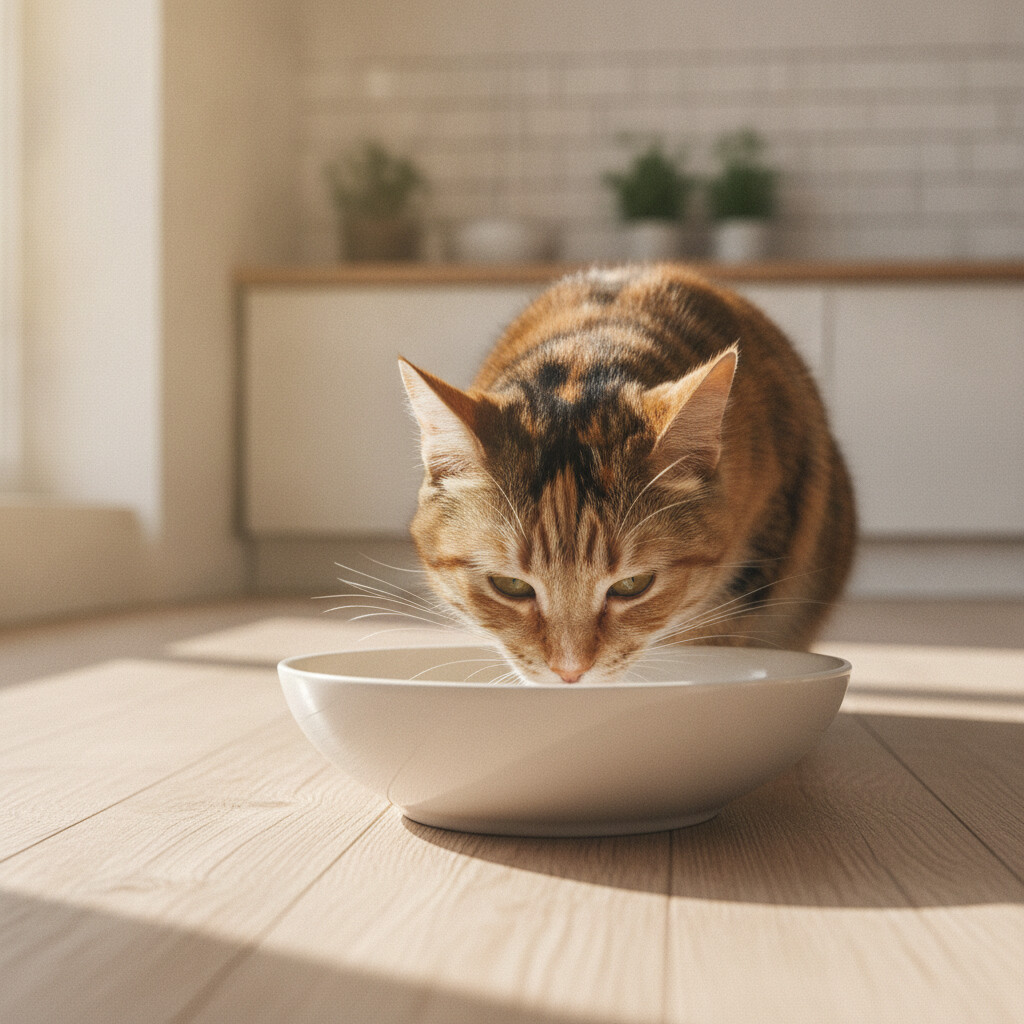
The best cat food bowl for most cats is a wide, shallow dish made of stainless steel or lead-free ceramic, washed daily, and placed away from the litter box and water. Most of the rest of the marketing — “whisker relief,” tilted angles, raised stands — helps some cats and does nothing for others. Here’s what the evidence supports, what’s plausible but unproven, and how to tell whether your cat would actually benefit from a change.
Does Bowl Shape Matter? The Whisker Fatigue Question
“Whisker fatigue” is the idea that a narrow, deep bowl makes a cat’s sensitive whiskers brush the sides with every bite, and that this constant contact is unpleasant enough to put cats off their food. It’s the main selling point behind “whisker-friendly” dishes.
There’s a sound basis for the idea that whiskers are sensitive — each one sits in a follicle packed with nerve endings (more on that in our guide to cat whiskers and why they matter). Whether bowl contact actually stresses cats is a different question, and it’s only been tested in a small way.
The main study, by Slovak and Foster in the Journal of Feline Medicine and Surgery, followed 40 indoor cats as their owners switched them from their usual bowl to a commercially advertised whisker-friendly dish. The researchers found no meaningful difference in how much the cats ate, how long they spent eating, or how much food they dropped. They did report, though, that a majority of cats seemed to prefer the whisker-friendly dish when given the choice.
So the honest summary is: there’s no good evidence that standard bowls cause a defined “whisker fatigue” problem, but many cats appear to like wide, shallow dishes better. Since a shallow dish costs little and carries no downside, it’s a reasonable default.
Signs your cat might prefer a shallower dish:
- Scooping food out of the bowl with a paw and eating it off the floor
- Eating only from the middle and leaving a ring of food around the edges
- Hovering over the bowl, or walking away mid-meal and returning repeatedly
Each of these can have other causes — dental pain, nausea, or just personal preference — so if a bowl swap doesn’t help within a week or two, a vet check is the better next step.
Which Bowl Material Is Best?
Material matters more for hygiene and durability than for anything the cat notices.
Stainless steel is the practical favorite among vets: non-porous, nearly unbreakable, dishwasher-safe, and inexpensive. The main complaints are that lightweight versions slide around and some cats dislike the reflection or the clink of tags against metal.
Ceramic is heavy (so it stays put), easy to clean, and comes in shallow, wide shapes. Choose bowls sold specifically for food use; the US FDA has long warned that some decorative or imported ceramic glazes can leach lead. Replace ceramic bowls once they chip or craze — cracks harbor bacteria.
Glass works similarly to ceramic, with the same chip-and-replace rule.
Plastic is cheap and light, but it scratches easily, and those scratches are hard to clean. Plastic bowls are frequently mentioned as a possible contributor to feline chin acne — the blackheads or crusting some cats get on their chin. The evidence for a direct causal link is limited, and chin acne has several other causes, but many vets suggest switching away from plastic as a first, easy step if your cat has chin breakouts.
Silicone collapsible bowls are handy for travel. For everyday use, they’re harder to keep scrupulously clean than steel or ceramic.
Are Elevated or Tilted Cat Bowls Better?
Raised and tilted bowls are often marketed as better for digestion or posture. There’s no solid research in cats showing that elevated bowls reduce vomiting or improve digestion in healthy cats.
Where they make more sense is for older cats or cats with arthritis, neck pain, or spinal issues. Osteoarthritis is common in senior cats, and lowering the head to floor level can be uncomfortable for a stiff cat. Raising the bowl a few inches is a low-cost comfort adjustment — the same logic behind ramps and other changes in our guide to keeping an aging cat mobile and comfortable.
If your cat regularly vomits right after eating, a raised bowl isn’t the fix to start with. Eating too fast is a far more common cause — see why your cat eats so fast and how to slow them down — and frequent vomiting deserves a vet visit regardless.
Slow Feeders and Puzzle Feeders
These are the bowls with the strongest professional backing, though not for the reasons most product listings give. The 2018 AAFP consensus statement on feline feeding programs encourages feeding approaches that let cats “hunt” for food — puzzle feeders, food-dispensing toys, and multiple small meals — because they align better with cats’ natural pattern of eating many small meals a day and add mental stimulation.
Practical points:
- Start easy. A puzzle that’s too hard frustrates cats into giving up. Begin with the simplest setting.
- Watch intake. Make sure your cat is actually getting their full ration from the feeder for the first week or two.
- You don’t have to buy one. Our guide to DIY puzzle feeders covers homemade options that work just as well.
Separate Water From Food
Many “double bowl” stands put food and water side by side. Plenty of cats drink happily from them, but a common recommendation from feline behavior specialists is to place water a little away from food. The reasoning is that cats seem to prefer water that isn’t near their food, and keeping them apart also stops food bits fouling the water.
If your cat doesn’t drink much, it’s an easy thing to try alongside the other suggestions in why your cat isn’t drinking enough water. Wide water dishes and cat water fountains are both worth testing.
How Often Should You Wash Cat Bowls?
More often than most people do. Wet food dishes should be washed after every meal; dry food and water bowls at least daily. Pet bowls consistently show up as bacterial hotspots in household hygiene research — a 2022 PLOS ONE study on pet bowl hygiene, for example, found most dog owners weren’t following FDA-recommended bowl handling, and that washing practices made a measurable difference to bacterial counts. The same principle applies to cats.
Hot soapy water or a dishwasher is enough. Avoid strongly scented cleaners; residue can put cats off their food.
Where to Put Your Cat’s Bowls
Placement can matter as much as the bowl itself:
- Away from the litter box. Cats generally avoid eating near where they eliminate.
- In a quiet spot. A bowl next to a noisy appliance or in a busy hallway can make a nervous cat eat less.
- Separate stations in multi-cat homes. Shared bowls can lead to subtle food guarding — one cat eats while another waits or gives up. Our article on resource guarding between cats explains what to look for.
The Bottom Line
You don’t need an expensive specialist bowl. For most cats, a wide, shallow stainless steel or ceramic dish, washed daily, in a quiet spot away from water and the litter box, covers everything that the evidence supports. Consider a raised bowl for a stiff or arthritic senior cat, and a puzzle feeder for a fast eater or a bored indoor cat.
If your cat is leaving food, eating less, or dropping weight, don’t assume the bowl is the problem. Appetite changes are one of the earliest signs of dental disease and many other conditions — a bowl swap is fine to try, but a cat who still isn’t eating normally after a day or two should see a vet.