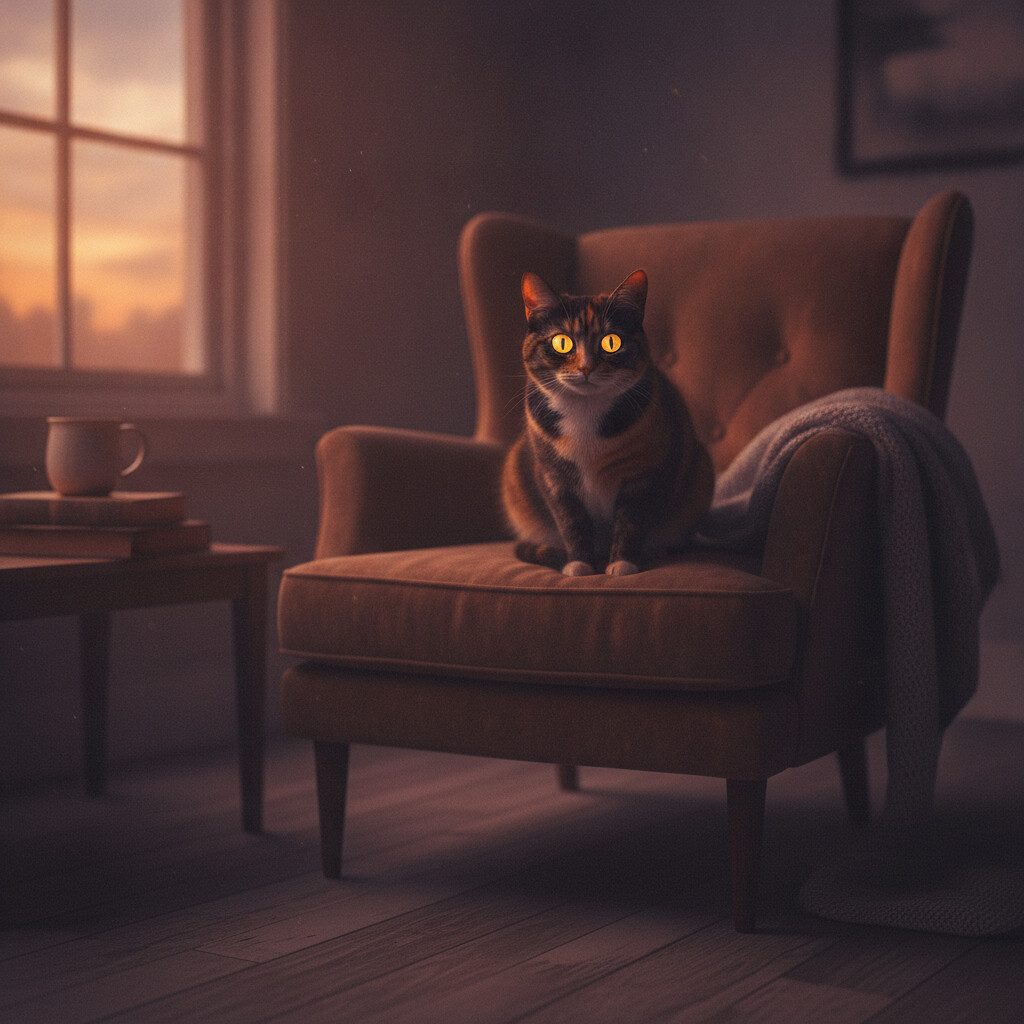
Not quite in pitch-black, but close. Cats need roughly one-sixth as much light as humans to see clearly, which is why they can navigate a dark room that would leave you groping for a wall. It’s not magic — it’s a handful of specific adaptations in their eyes, built for a species that historically hunted at dawn and dusk.
The Eyeshine Is a Real Adaptation, Not a Party Trick
That eerie glow when a cat’s eyes catch a camera flash or a car’s headlights comes from the tapetum lucidum, a mirror-like layer of tissue directly behind the retina. Light that passes through the retina without being absorbed the first time hits this layer and bounces back through the retina a second time, giving the light-sensing cells a second chance to register it.
It’s an efficient trick, and it’s a big part of why cats do so well in low light — but it comes at a small cost. That second bounce of light scatters slightly, which is one reason a cat’s daytime vision is less sharp than a human’s. Good night vision and razor-sharp daytime detail are, to some extent, a trade-off, and cats’ eyes are built to prioritize the former.
More Rod Cells, Fewer Cone Cells
The retina is packed with two types of light-sensing cells: rods, which detect light and motion but not color or fine detail, and cones, which handle color and sharp detail but need more light to work well. Cats have a much higher ratio of rods to cones than humans do — research on feline retinal anatomy puts the ratio at roughly 25 rods for every cone, compared to about 4:1 in humans.
That’s the core trade-off in a cat’s vision: excellent at detecting motion and shapes in dim light, noticeably weaker on fine detail and color range. Cats do see color, contrary to the old myth that they see only in black and white, but their color range is more limited than ours, leaning toward blues and yellows.
Those Vertical Pupils Do a Lot of Work
A cat’s pupils can open far wider, relative to their eye size, than a human’s can — and the vertical slit shape lets them do it efficiently. Vertically elongated pupils can expand to let in dramatically more light in darkness and contract to a thin line in bright sun, giving cats a wider functional range between “too dark to see” and “too bright to look at” than round pupils allow.
Research comparing pupil shapes across species has found that vertical slit pupils are especially common in ambush predators of small or mid-size — animals that need to judge distance precisely while staying low and hidden, which lines up neatly with how cats hunt.
When Vision Genuinely Fails — Whiskers Take Over
Even a cat’s excellent low-light vision has a limit: in true total darkness, with no light source at all, no eye can see anything. That’s where whiskers do a lot of the remaining work. The whiskers around a cat’s face are exquisitely sensitive to air currents and physical contact, letting a cat navigate and judge gaps even when vision alone isn’t enough. We’ve covered how that system works in more depth in our guide to why cat whiskers matter.
Cats Aren’t Actually Nocturnal
It’s a common assumption, but cats aren’t nocturnal — they’re crepuscular, meaning they’re naturally most active at dawn and dusk rather than in the dead of night. That timing lines up with when small rodents and other prey tend to be active, and it’s a big part of why your cat may seem to get a sudden burst of energy right around sunrise or sunset (the so-called “zoomies” hour) rather than at 2 a.m. specifically — though plenty of indoor cats do adjust their activity patterns to match their household’s schedule.
When Vision Changes Are Worth a Vet Visit
A cat’s night vision advantage is a normal, healthy part of how their eyes work — but sudden changes in vision, at any time of day, are not something to wait out. Signs worth a vet visit include: noticeably bumping into furniture or misjudging jumps, pupils that stay very dilated in bright light or don’t react evenly to each other, sudden cloudiness or a change in eye color, or obvious hesitation moving around in dim rooms your cat used to navigate confidently. These can point to anything from high blood pressure to retinal disease, and catching vision loss early matters for treatment options. If you’re caring for a cat who has already lost some or all of their sight, our guide on caring for a blind or deaf cat covers what actually changes day to day.
The Takeaway
Cats aren’t seeing in total darkness — nothing can — but between the tapetum lucidum, a rod-heavy retina, and pupils built to let in maximum light, they’re working with a serious low-light advantage over us. It’s less “magic night vision” and more a finely tuned set of trade-offs, built for a hunter that does its best work in the shadows between day and night.