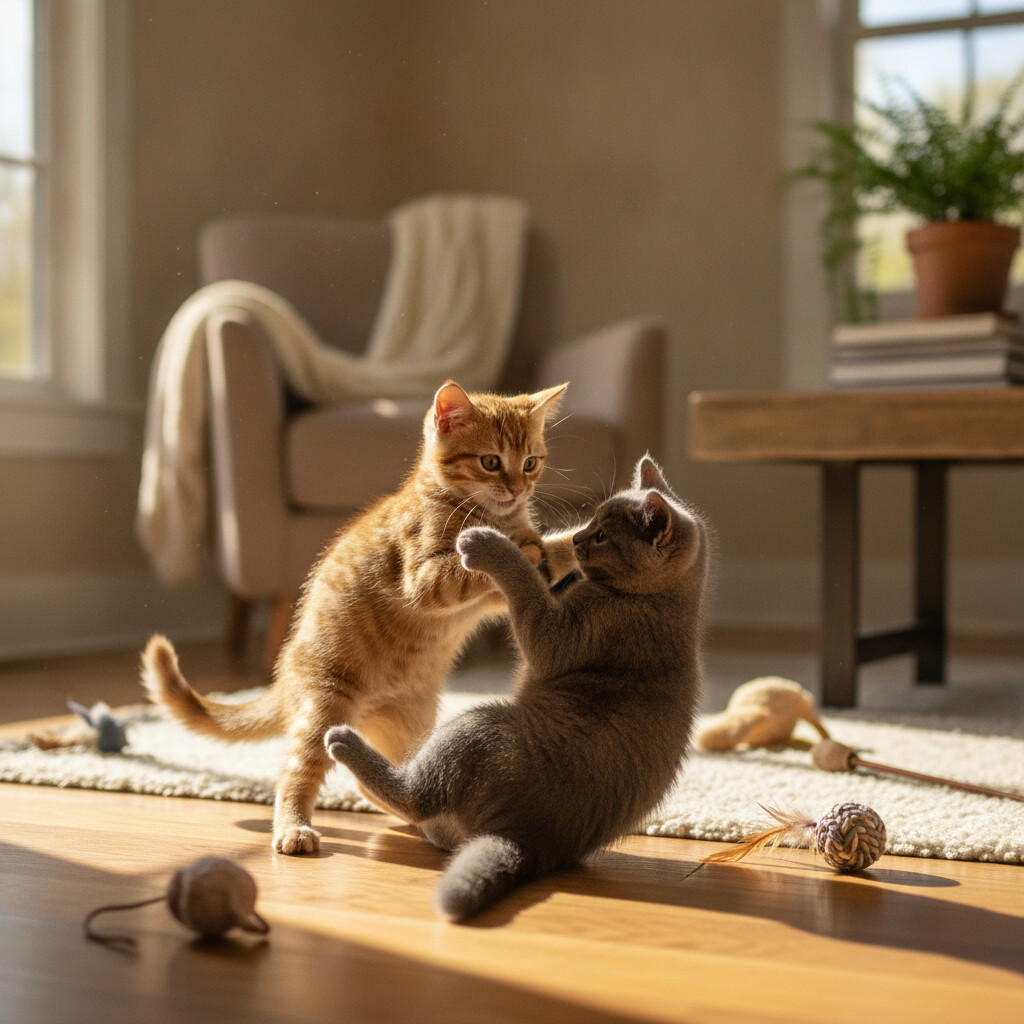
Cats that attack feet, wrestle relentlessly, or draw blood during play aren’t necessarily aggressive — but they might need redirection. Here’s how to tell the difference and what to do about it.
Play is one of the most misunderstood cat behaviours. What looks like aggression to a new owner is often completely normal predatory play. What looks like play can occasionally be early-stage aggression. Knowing which is which matters — both for your cat’s welfare and for your scratched ankles.
Why Cats Play (And Why It Gets Intense)
Cats are solitary hunters. Unlike dogs, who evolved to cooperate in groups, cats hunt alone — stalking, pouncing, catching. Their play is a direct expression of that: they’re practising a kill. This sounds alarming if you’re watching your cat launch itself at your feet, but it’s completely normal behaviour.
Kittens play the most intensely, and for good reason: they’re developing motor skills, practising coordination, and building the reflexes they’d need to hunt. Adult cats who were well-socialised as kittens tend to moderate their intensity naturally. Cats who had limited early socialisation — especially single kittens raised without littermates — sometimes lack the feedback that tells them when play has gone too far.
The American Association of Feline Practitioners (AAFP) recommends regular structured play as a core component of indoor cat welfare — not as optional enrichment, but as a genuine health need.
What Normal Cat Play Looks Like
Normal solo play:
- Stalking, pouncing, and batting at toys
- “Killing” a toy mouse with bunny kicks (hind legs raking while holding the toy)
- Brief intense bursts followed by disengagement
- Chasing a tail or shadow
Normal interactive play (cat + human):
- Chasing and catching a wand toy or feathers
- Pouncing at a moving string or laser
- Dilated pupils and a focused, hunting posture
- Brief biting of the toy — not hard enough to cause injury to a hand
Normal play between cats:
- Wrestling and rolling that both cats willingly engage in
- Both cats periodically pausing to groom or disengage
- Neither cat vocalising (no growling, hissing, or yowling)
- Roughly equal back-and-forth — not one cat consistently fleeing
The key marker of normal play between cats: both look like they’re engaged, even if it looks rough to a human observer. The forum’s cat body language guide covers posture and tail position during these interactions if you want to read the signals more precisely.
What “Too Rough” Looks Like
With humans:
- Bites that break skin without you trying to pull away (reflex biting when you pull free is different)
- Sustained latching rather than quick, released contact
- Stalking and ambushing you with no play cue from you
- Eyes wide and tail lashing aggressively during contact
Between cats:
- One cat consistently fleeing and hiding afterward
- Vocalisation: hissing, growling, yowling
- Raised hackles or a puffed tail
- One cat blocking another’s access to food, litter, or resting spots
The distinction matters because the fix is different. If play has become too intense, structured redirection works. If it’s genuine inter-cat conflict, you’re dealing with a resource or territory problem — which is a different situation. For households where cats are actually fighting, the guide on how to stop cats from fighting in multi-cat households covers that specifically.
Understanding the Hunting Sequence
Cats naturally move through a hunting cycle: stalk → chase → pounce → catch → kill → eat → groom → sleep. In domestic life, they rarely complete the full sequence. Interactive play sessions are most satisfying — and most effective at burning off that energy — when they follow it:
- Start with movement the cat can stalk (a wand toy that “escapes” and hides)
- Let the cat chase
- Allow them to catch and “kill” the toy
- End the session with a small meal or treat
Cats that play without ever getting to catch anything often stay in a frustrated, overstimulated state. This is why laser pointers alone create problems — the dot never lands, so the hunt never resolves. If you use a laser, always end the session with a physical toy they can catch. This connects to the same hunting instinct behind the behaviours explored in why cats bring you dead animals — it’s all the same hardwired drive.
Young cats and kittens need two 15-minute play sessions per day at minimum. Adult indoor cats benefit from at least one dedicated session daily. Think of it the way you’d think of a dog’s daily walk — it’s not optional for mental health.
When Play Becomes a Problem With Humans
If your cat regularly ambushes you, bites without clear provocation, or has drawn blood, the most likely causes are:
Insufficient play. An under-stimulated cat redirects energy at you. Double the dedicated daily play sessions first — this alone fixes the majority of cases within 2–3 weeks.
Rough play reinforced early. If play-wrestling with hands was encouraged as a kitten, the cat learned that hands are toys. Fix it by using only toys going forward, and withdrawing completely the moment contact happens.
Overstimulation. Petting-induced biting looks similar to play aggression but has a different trigger — it’s the cat saying “I’ve had enough” after prolonged petting, not hunting you. Watch for the tail starting to flick and skin rippling along the back as warning signs.
The rule for rough play with humans is consistent: the moment contact is made, freeze (don’t pull away — that triggers the prey reflex), then disengage completely and ignore the cat for two minutes. No yelling, no spray bottles. Just withdrawal of attention. Most cats learn within a few weeks of this being applied consistently.
Never use your hands as toys. Not once, not with a kitten, not “just this time.” The habit forms quickly and is slow to undo.
When to See a Vet
Talk to a vet if:
- Play behaviour changed suddenly without an obvious cause — sudden behaviour changes can signal pain or illness
- Biting is hard enough to break skin repeatedly and hasn’t improved after 4–6 weeks of consistent redirection
- A multi-cat household has escalating conflict that doesn’t respond to environmental adjustments
- You’re seeing anxiety signs alongside the rough play: hiding, over-grooming, appetite changes
A vet can rule out medical causes and refer you to a certified animal behaviourist if the problem persists. Most play aggression responds to environmental changes before it gets to that point — more sessions, better toys, consistent rules. But if it doesn’t, professional input is the right next step.