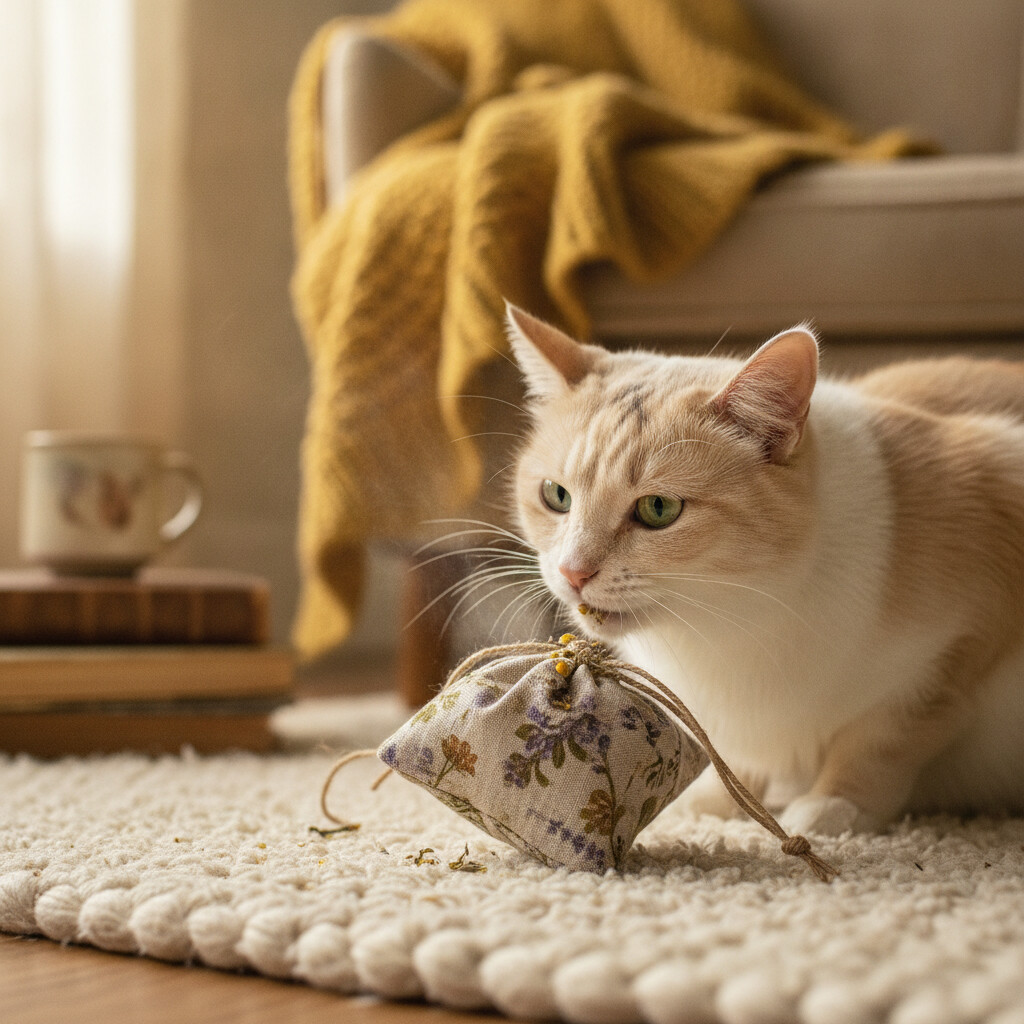
A cat’s world runs on smell before it runs on anything else. If your enrichment routine is all toys and no scent, you’re skipping the sense your cat actually leads with — and scent enrichment is some of the cheapest, lowest-effort environmental enrichment you can add. Here’s what it is and how to do it without buying anything fancy.
Why Scent Matters So Much to Cats
Cats have roughly 45–80 million scent receptors in their nose, compared to a human’s 5 million — estimates vary by study, but the gap is enormous either way. On top of that, cats have a second scent organ humans don’t: the vomeronasal (Jacobson’s) organ, located in the roof of the mouth, which is why you sometimes see a cat freeze with their mouth slightly open after sniffing something interesting — that’s the flehmen response, and it’s them processing scent information through a completely different channel than regular smell.
Behaviorally, scent is also how cats build their sense of territory and safety. Facial rubbing, scratching (which deposits scent from glands in the paws), and even the way a cat re-marks a “safe” piece of furniture are all scent-based communication. An indoor cat with limited scent variety in their day-to-day environment isn’t just missing out on fun — they’re missing a core input their brain is built to process constantly.
Easy Scent Enrichment Ideas You Can Start Today
None of this requires special equipment. The goal is variety and novelty, introduced at a pace your cat is comfortable with.
- Rotate catnip, silvervine, and valerian. Not every cat responds to catnip (it’s genetic — an estimated 50–70% of cats have the sensitivity), but silvervine and valerian trigger a response in many cats that don’t react to catnip at all. Rotating between the three, rather than leaving one out permanently, keeps the response strong instead of letting cats habituate to it. We go deeper on how each one works in our comparison of catnip, silvervine, and valerian.
- Scent trails for hunting-style engagement. Drag a treat or a piece of string lightly scented with something novel (a spice, a dried herb) across the floor before hiding it. This taps into a cat’s natural tracking instinct in a way that a stationary bowl of food doesn’t.
- Introduce novel household scents in a low-stakes way. A worn sock, a paper bag that held groceries, a box that shipped from somewhere new — letting your cat investigate ordinary “new smell” objects on their own terms is enrichment that costs nothing.
- Herb sachets. Small cloth pouches of dried catnip, valerian root, or silvervine powder, left in different spots around the house, spread the novelty out instead of concentrating it on one toy.
- Swap, don’t just add. Enrichment fatigue is real. Rotating scented items in and out of circulation every week or two keeps them interesting longer than leaving everything out permanently.
Using Scent to Reduce Stress, Not Just Boredom
Scent enrichment isn’t only about entertainment — it’s also one of the more evidence-backed tools for reducing feline stress. Synthetic feline facial pheromone products (marketed as Feliway and similar) are designed to mimic the pheromone cats deposit when they cheek-rub something they consider safe, and are commonly recommended by veterinary behaviorists as a supportive tool during stressful transitions — moving house, introducing a new pet, or vet visits — though they work best alongside behavioral management, not as a stand-alone fix.
More simply: if you’re moving, boarding your cat, or introducing them to a new space, bringing an item that already smells like home (an unwashed blanket, a favorite scratcher) gives them an anchor of familiar scent in an unfamiliar place. It’s a small thing that measurably eases the adjustment period for a lot of cats.
If you’re not sure whether your cat’s current behavior reflects stress versus normal orneriness, our guide to the signs your cat is stressed is a good place to check first.
What to Avoid
Scent enrichment done carelessly can backfire, because a cat’s nose is far more sensitive than ours:
- Essential oils are a real hazard, not just a “some cats don’t like it” situation. Oils like tea tree, citrus, pine, and wintergreen can be toxic to cats even in small amounts or through skin absorption — the ASPCA and veterinary toxicology resources flag essential oil diffusers and topical oils as a genuine poisoning risk for cats specifically (their liver metabolizes certain compounds very differently than ours or a dog’s). Skip diffusers and oil-based products entirely.
- Strong synthetic fragrances (heavily scented candles, air fresheners, scented litter) can be overwhelming rather than enriching — cats’ noses are built for subtlety, not intensity.
- Don’t force it. If a cat backs away from a new scent, that’s information, not a failure. Let them approach on their own schedule.
The Takeaway
Scent enrichment is one of the highest-value, lowest-cost things you can add to an indoor cat’s routine — rotate a few safe scent sources, keep novelty coming in small doses, and skip anything with essential oils or heavy synthetic fragrance. It won’t replace physical enrichment or play, but paired with it, it closes a gap that a lot of enrichment routines miss entirely.